
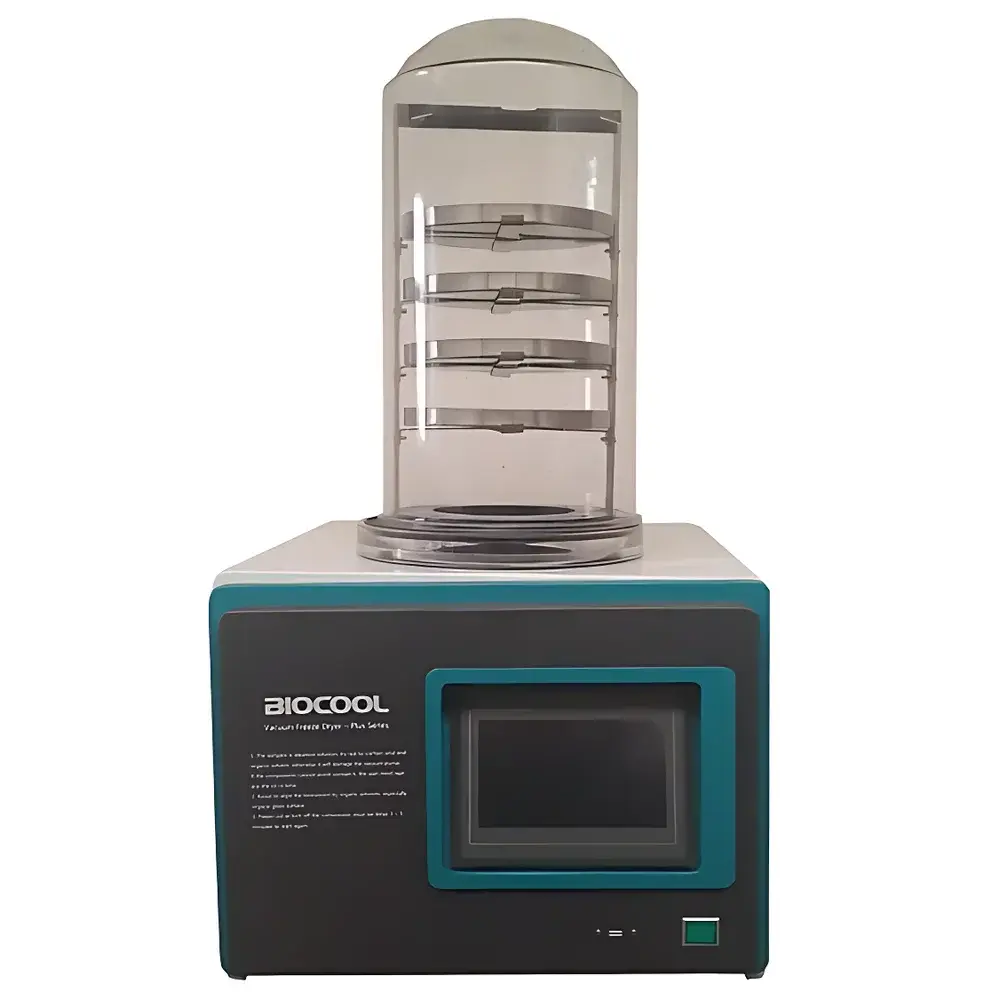
BioCoool FD-1A-80+ Benchtop Freeze Dryer
| Brand | BioCoool |
|---|---|
| Origin | Beijing, China |
| Model | FD-1A-80+ |
| Instrument Type | Standard Shelf-Type Freeze Dryer |
| Application | Laboratory-Scale Lyophilization |
| Lyophilization Area | 0.12 m² |
| Ultimate Vacuum | <9 Pa |
| Condenser Temperature (No-Load) | −85 °C |
| Condensate Capacity (24 h) | 4 L |
| Control System | PLC + Touchscreen Interface |
| Sample Temperature Monitoring | Dual Pt100 Sensors |
| Defrost Method | Hot-Gas Defrost |
| Optional Inert Gas Backfilling | Imported Solenoid Valve for N₂ or Other Inert Gases |
| Compliance | Designed for GLP-compliant workflows |
Overview
The BioCoool FD-1A-80+ is a compact, benchtop shelf-type freeze dryer engineered for reproducible, process-controlled lyophilization of heat-sensitive biologicals, pharmaceuticals, and research samples in academic, QC, and early-stage development laboratories. It operates on the fundamental principles of sublimation under high vacuum: frozen water is removed directly from the solid phase to vapor without passing through the liquid state, preserving structural integrity, bioactivity, and chemical stability. The system integrates a −85 °C deep-cold condenser, robust two-stage refrigeration circuitry using internationally certified compressors, and a sealed一体成型 (monolithic) drying chamber fabricated from high-strength stainless steel—eliminating weld seams and potential leak paths. Its design prioritizes thermal uniformity across the shelf surface, precise vacuum regulation, and real-time thermodynamic monitoring—key prerequisites for developing scalable, transferable lyophilization cycles.
Key Features
- Monolithic stainless-steel drying chamber: Seamless construction ensures vacuum integrity, corrosion resistance, and long-term mechanical stability.
- −85 °C cold trap: Achieves rapid ice capture and maintains stable vacuum performance during extended runs; optimized for high-moisture-load samples such as aqueous suspensions and viscous formulations.
- Dual Pt100 sample temperature probes: Enable real-time, non-invasive monitoring of product temperature at multiple locations—critical for determining primary drying endpoints and avoiding collapse or melt-back.
- PLC-based control with intuitive touchscreen interface: Supports programmable multi-step drying protocols, automatic pressure ramping, and adjustable shelf temperature profiles.
- Hot-gas defrost system: Delivers rapid, uniform, and safe condenser defrosting without requiring manual intervention or system venting.
- Data logging & traceability: Records shelf temperature, condenser temperature, chamber pressure, and time-stamped process events; data exportable via USB drive in CSV format for offline analysis and regulatory documentation.
- Inert gas backfilling capability: Integrated solenoid valve permits controlled nitrogen or argon reintroduction post-drying to protect oxygen-sensitive materials and facilitate sterile handling.
Sample Compatibility & Compliance
The FD-1A-80+ is validated for lyophilizing aqueous solutions, colloidal suspensions, and semi-solid matrices with eutectic temperatures above −20 °C—common among proteins, vaccines, enzymes, probiotics, and botanical extracts. Its 0.12 m² shelf area accommodates standard Ø200 mm trays or stacked glassware configurations. The system meets baseline mechanical and electrical safety standards per IEC 61010-1. While not pre-certified for GMP manufacturing, its architecture supports qualification (IQ/OQ/PQ), data integrity controls (e.g., user access levels, electronic signatures), and integration into 21 CFR Part 11–compliant environments when deployed with validated firmware and documented procedures. It aligns with ISO 22072-1:2019 guidelines for laboratory-scale lyophilizer performance testing.
Software & Data Management
The embedded control system provides native cycle programming, real-time graphing of temperature/pressure trends, and automatic generation of lyophilization curves. All logged parameters—including timestamps, setpoints, deviations, and alarm states—are stored internally and exportable to USB mass storage devices in machine-readable CSV format. For advanced compliance needs, optional PC-based software (sold separately) enables remote monitoring, multi-unit fleet management, electronic batch record (EBR) generation, and audit trail review per ALCOA+ principles. Data encryption, role-based authentication, and configurable retention policies are available in validated configurations.
Applications
- Stabilization of monoclonal antibodies, recombinant proteins, and plasmid DNA for long-term storage and transport.
- Preparation of reference standards and calibration materials in analytical chemistry and clinical diagnostics.
- Routine dehydration of microbial cultures, tissue homogenates, and plant extracts for metabolomic or proteomic profiling.
- Process development support: Cycle scouting, critical quality attribute (CQA) mapping, and shelf-life prediction studies.
- Education and training: Hands-on instruction in freeze-drying thermodynamics, mass transfer limitations, and formulation science.
FAQ
What types of samples are compatible with the FD-1A-80+?
Aqueous solutions, suspensions, emulsions, and gels with eutectic points above −20 °C—such as biologics, vaccines, enzymes, and natural product extracts.
Does the system support automated cycle development?
It provides full manual and semi-automated protocol programming; advanced model-based cycle optimization requires external software tools or custom scripting.
Is the vacuum pump included?
A domestic 2 L/s rotary vane pump is supplied standard; optional upgrades include oil-free scroll pumps and high-vacuum turbo-molecular systems.
Can the unit be qualified for GxP use?
Yes—the hardware platform supports IQ/OQ/PQ execution; validation documentation packages and vendor-supported qualification services are available upon request.
What maintenance is required for long-term reliability?
Routine tasks include vacuum pump oil changes every 3–6 months, condenser cleaning after high-load runs, and annual calibration of temperature and pressure sensors by an accredited service provider.



