
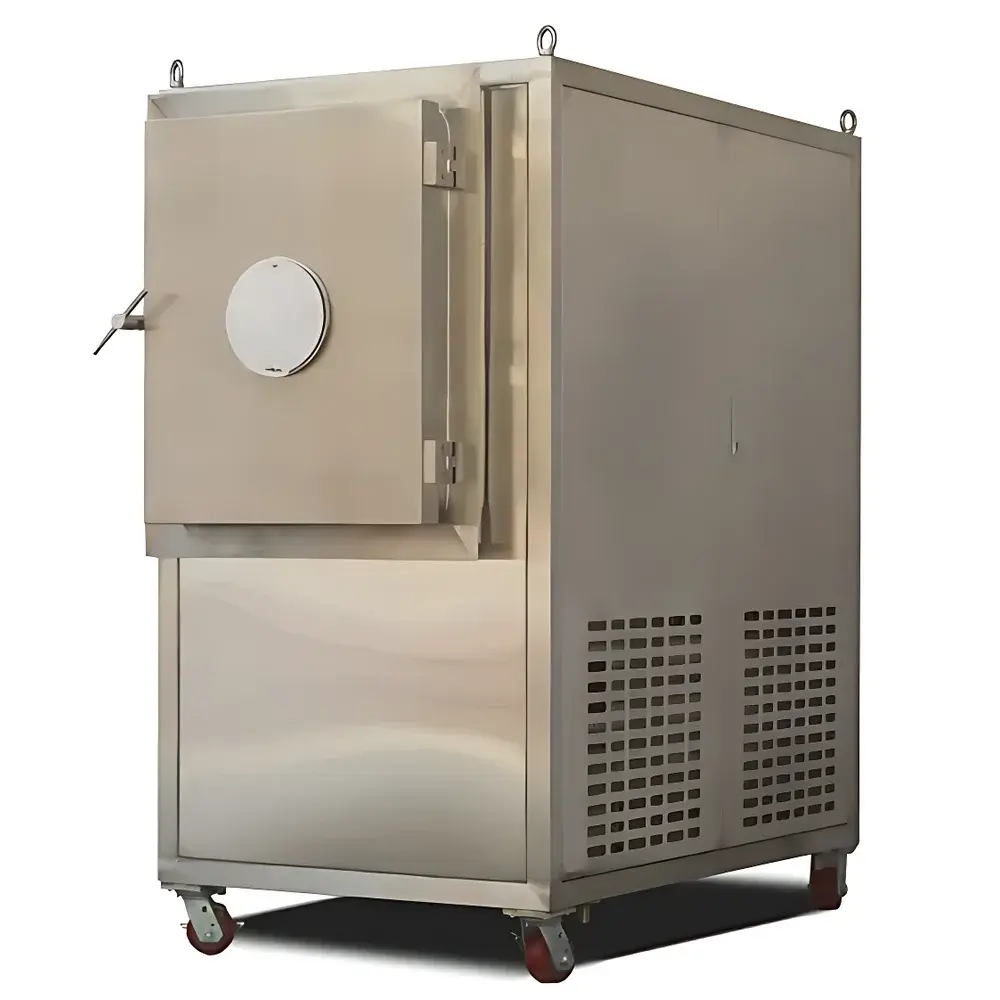
BioCoool Pilot3-6 Pro Laboratory-Scale Freeze Dryer
| Brand | BioCoool |
|---|---|
| Origin | Beijing, China |
| Model | Pilot3-6 Pro |
| Instrument Type | Standard Shelf-Type Freeze Dryer |
| Application Scope | Pilot-Scale Processing |
| Lyophilization Area | 0.42 m² |
| Ultimate Vacuum | <1 Pa |
| Condensate Capacity (24 h) | 6 L |
| Cold Trap Temperature | −85 °C |
| Dual Refrigeration System | Yes |
| Dual Vacuum System | Yes |
| Built-in Eutectic Point Tester | Yes |
| Hydraulic Stoppering System | Imported |
| Oil Mist Filter | Standard |
| Nitrogen/Inert Gas Backfilling | Supported |
Overview
The BioCoool Pilot3-6 Pro is a GMP-aligned, pilot-scale freeze dryer engineered for reproducible lyophilization of pharmaceuticals, biologics, diagnostics, and research-grade formulations under controlled, scalable conditions. It operates on the fundamental principle of sublimation—removing water from frozen samples under deep vacuum while maintaining product integrity through precise thermal management. With a lyophilization area of 0.42 m² and a cold trap capable of reaching −85 °C, the system supports batch processing of up to 900 vials (20 mL) or 1700 vials (5 mL), making it suitable for process development, formulation optimization, and small-batch cGMP manufacturing. Its dual refrigeration and dual vacuum architectures ensure operational continuity and regulatory compliance during extended runs—critical for validation protocols in QC/QA environments.
Key Features
- GMP-compliant chamber constructed from SUS304 stainless steel with opaque, non-reflective black interior coating to eliminate stray radiation and suppress internal light-induced degradation.
- Corrosion-resistant internal surfaces and sealing materials compatible with acidic, alkaline, and volatile organic solvents—enabling safe drying of diverse formulations including buffer-based biologics and organic-solvent suspensions.
- Dual independent refrigeration circuits and vacuum systems: automatic failover ensures uninterrupted operation and meets ICH Q5C stability testing requirements for equipment redundancy.
- Integrated eutectic point tester for empirical determination of collapse temperature—essential for rational cycle design per USP & Ph. Eur. monographs.
- Shelf pre-freezing capability eliminates reliance on external ultra-low freezers, reducing contamination risk and enabling full-cycle control within a single platform.
- Hydraulic stoppering system (imported components) delivers uniform, programmable pressure profiles—critical for vial integrity and residual moisture consistency across batches.
- Oil mist filtration standard; nitrogen/inert gas backfilling supported with pulse-controlled repressurization (slow/medium/fast modes) to prevent particle dispersion in fragile lyophiles.
- Non-electric cold trap defrosting method enhances safety, avoids thermal shock to condenser coils, and reduces downtime versus immersion-based alternatives.
Sample Compatibility & Compliance
The Pilot3-6 Pro is validated for aqueous solutions, suspensions, and pastes with eutectic temperatures above −40 °C. Its corrosion-resistant architecture accommodates excipients containing citrate, acetate, or phosphate buffers, as well as low-concentration organic co-solvents (e.g., ethanol, DMSO). All wetted parts comply with ISO 13485 and meet material compatibility criteria outlined in ASTM F2477 and ISO 10993-5. The system supports 21 CFR Part 11–compliant data integrity when configured with PC database logging and audit-trail-enabled user accounts. Process parameters—including shelf temperature, chamber pressure, condenser temperature, and endpoint detection status—are recorded at 50 ms intervals and retain traceability for GLP/GMP audits.
Software & Data Management
The embedded industrial touchscreen HMI provides intuitive, context-sensitive navigation without requiring operator manuals. Control logic follows deterministic state-machine architecture: freeze, primary drying, secondary drying, endpoint verification, and defrost are fully programmable. Up to 500 custom or standardized lyophilization recipes can be stored locally. Data logging options include internal flash memory (retains ≥3 months of continuous operation logs), removable USB storage (FAT32 formatted), and networked PC database integration (ODBC-compatible). Remote monitoring via Ethernet enables real-time supervision up to 1.5 km away—ideal for centralized facility management. Calibration routines for PT100 shelf sensors and capacitive vacuum transducers are accessible via password-protected service menus, ensuring long-term metrological traceability.
Applications
This system serves critical roles across preclinical and early-phase development: formulation screening of monoclonal antibodies, vaccines, and oligonucleotides; stability study execution per ICH Q1A–Q1E; analytical reference standard preparation; and sterile drug product process qualification. Its vacuum regulation and pressure-controlled drying algorithms mitigate common failure modes—including cake collapse, melt-back, and vial breakage—particularly during transition between drying phases. The built-in endpoint detection algorithm analyzes pressure rise tests (PRIT) and thermocouple differentials to confirm residual moisture levels below target thresholds (typically ≤1.0% w/w), satisfying release criteria per USP and EP 2.9.33.
FAQ
What is the maximum vial capacity for 5 mL and 20 mL formats?
The Pilot3-6 Pro accommodates ≥1700 units of 5 mL vials or ≥900 units of 20 mL vials per batch, assuming standard 16 mm and 22 mm diameters respectively.
Does the system support validation documentation packages?
Yes—IQ/OQ templates, calibration certificates, and FAT/SAT reports are available upon request and align with Annex 15 and ASTM E2500 guidelines.
Can the cold trap handle organic solvent vapors?
Standard configuration is optimized for aqueous systems; optional organic solvent traps (cryo-cooled or adsorption-based) are available for methanol, acetonitrile, or tert-butanol applications.
Is remote access secure and compliant with cybersecurity standards?
Remote monitoring uses encrypted TCP/IP communication with configurable firewall rules and role-based authentication—fully compatible with ISO/IEC 27001-aligned IT infrastructure.
What maintenance intervals are recommended for vacuum pumps and compressors?
Oil-lubricated vacuum pumps require oil changes every 500 operating hours; scroll-type compressors undergo annual inspection per manufacturer service bulletins. Preventive maintenance schedules are integrated into the HMI calendar.



