
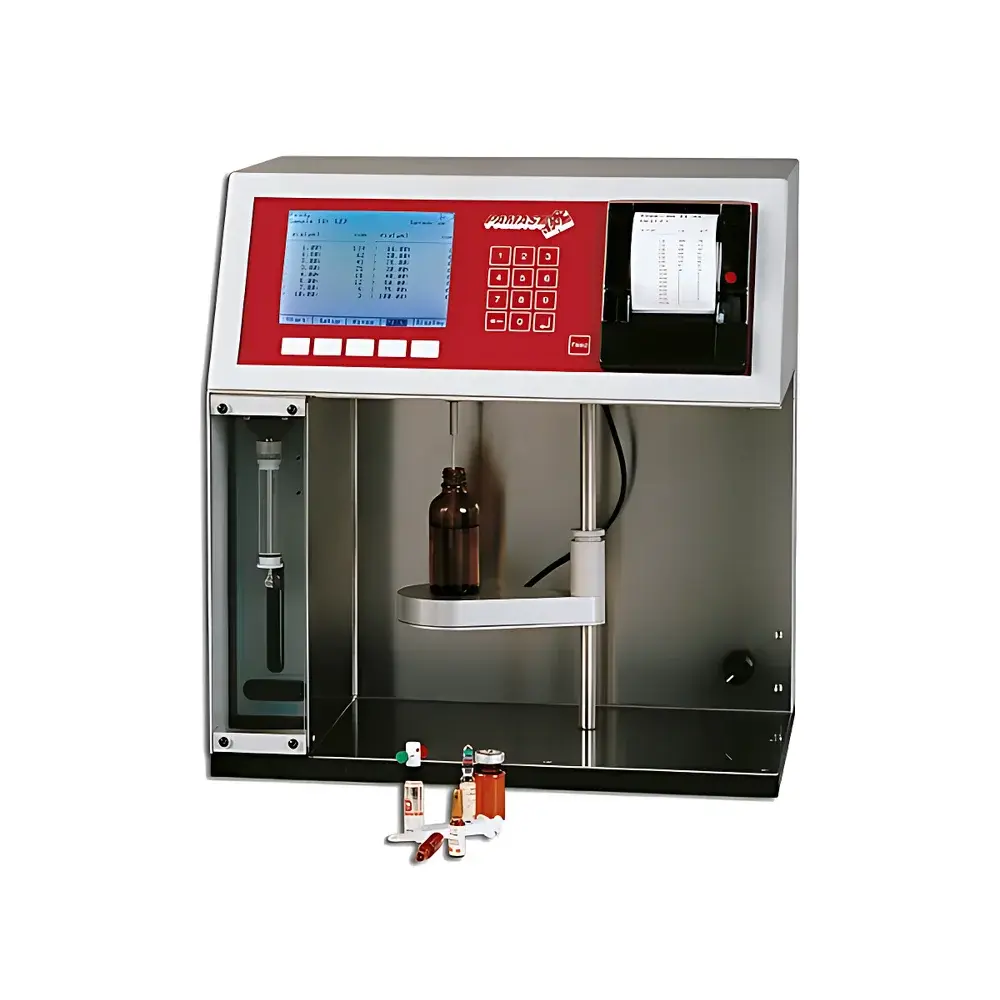
PAMAS SVSS Optical Particle Counter for Injectable Solutions and Low-Viscosity Liquids
| Brand | PAMAS |
|---|---|
| Origin | Germany |
| Model | SVSS |
| Instrument Type | Optical Particle Counter |
| Sample Volume Range | 50–1000 µL (analysis), 250–2000 µL (container capacity) |
| Adjustable Size Channels | 32 |
| Flow Rate Control | Constant, Volume-Selectable (1 mL / 10 mL / 25 mL modes) |
| Threshold Adjustment | Digital-to-Analog Converter (DAC)-Based Gate Setting |
Overview
The PAMAS SVSS Optical Particle Counter is a high-precision, laboratory-grade instrument engineered for quantitative particle contamination analysis in injectable pharmaceutical solutions, ophthalmic preparations, low-viscosity solvents, and other critical clear liquids. It operates on the principle of light extinction (also known as single-particle optical sensing, or SPOS), where individual particles suspended in a laminar liquid stream pass through a focused collimated light beam; each particle generates a transient shadow pulse proportional to its projected area. These pulses are detected by a high-speed photodiode sensor and converted into digital signals via a calibrated analog-to-digital pathway. The system’s optical design minimizes Mie scattering interference and ensures robust sizing accuracy for spherical and near-spherical contaminants in the range of 1.5 µm to 100 µm — fully compliant with ISO 21501-4 and USP requirements for subvisible particle testing.
Key Features
- Integrated vacuum-assisted sample preconditioning module eliminates air bubble entrapment and ensures consistent priming prior to analysis — critical for low-viscosity, volatile, or degassing-prone fluids.
- 32 independently configurable particle size channels enable granular histogram generation and flexible binning strategies aligned with pharmacopoeial thresholds (e.g., ≥10 µm, ≥25 µm per USP ).
- Stepper-motor-controlled syringe drive delivers exceptional volumetric repeatability (<±0.5% CV at 100 µL injections) and maintains constant flow velocity across varying viscosities (0.8–2.5 cP typical range).
- Multi-volume aspiration modes (1 mL, 10 mL, 25 mL) support both rapid screening and statistically robust counting per ISO 11171 calibration protocols.
- DAC-based threshold adjustment allows fine-grained optimization of detection sensitivity without hardware recalibration — essential for method transfer between labs or matrix-specific validation.
- Compact benchtop footprint (W320 × D410 × H280 mm) with CE-marked electrical architecture and IP20-rated enclosure for controlled laboratory environments.
Sample Compatibility & Compliance
The SVSS is validated for use with aqueous buffers, saline solutions, ethanol/water mixtures, silicone oil dilutions, and other optically transparent liquids with refractive index differences ≥0.02 relative to the continuous phase. It supports direct analysis of filled vials, ampoules, and syringes via optional adapter kits. All measurement procedures adhere to the data integrity requirements of FDA 21 CFR Part 11 when paired with PAMAS’ certified software suite (version 5.2+), including electronic signatures, audit trails, and user-access-level controls. The system meets ISO 21501-4:2018 for light extinction particle counters and supports full traceability to NIST-traceable latex sphere standards (e.g., Duke Scientific 3000 series).
Software & Data Management
PAMAS LabSoft™ SVSS Edition provides a validated Windows-based platform for instrument control, real-time particle event visualization, histogram export (CSV, PDF, XML), and automated report generation compliant with ALCOA+ principles. Raw pulse data is stored with metadata (date/time, operator ID, method name, environmental conditions). Batch processing mode enables retrospective re-analysis using updated thresholds or binning logic without re-running samples. Data backups are encrypted and time-stamped; all modifications generate immutable audit trail entries synchronized with system clock and domain authentication servers.
Applications
- Final container testing of sterile injectables (IV bags, pre-filled syringes, vials) per USP , Ph. Eur. 2.9.19, and JP 6.07.
- Filter integrity verification and extractables/leachables screening during process development.
- Stability-indicating monitoring of protein therapeutics and mRNA-LNP formulations under accelerated storage conditions.
- Raw material qualification of excipients (e.g., polysorbates, PEGs) and solvent batches used in aseptic manufacturing.
- QC release testing in contract manufacturing organizations (CMOs) operating under GMP Annex 1 and ICH Q5C guidelines.
FAQ
What regulatory standards does the SVSS comply with for pharmaceutical particle testing?
The SVSS meets ISO 21501-4:2018 for optical particle counter performance verification and supports method implementation aligned with USP , Ph. Eur. 2.9.19, and JP 6.07. When operated with validated methods and LabSoft™ software, it satisfies data integrity expectations under FDA 21 CFR Part 11 and EU Annex 11.
Can the SVSS analyze viscous samples such as concentrated monoclonal antibody formulations?
The SVSS is optimized for low-viscosity liquids (≤2.5 cP). For higher-viscosity biologics (>5 cP), PAMAS recommends the SBSS or CDV series with pressure-driven flow cells and heated sample modules.
Is hardware recalibration required when changing particle size thresholds?
No. Thresholds are adjusted digitally via DAC circuitry; only periodic verification using certified reference standards (e.g., NIST-traceable 10 µm and 25 µm spheres) is required per ISO 21501-4 Annex B.
How is sample carryover mitigated between runs?
The system performs an automated 3-stage rinse cycle (air purge → solvent flush → final air dry) after each analysis, programmable per SOP. Rinse efficiency is verified daily using blank injection protocols.
Does the SVSS support 21 CFR Part 11-compliant electronic records out-of-the-box?
Yes — when deployed with LabSoft™ SVSS Edition v5.2 or later, configured with domain-authenticated user roles, timestamped audit logs, and encrypted database storage, the system fulfills core Part 11 requirements for electronic records and signatures.



