
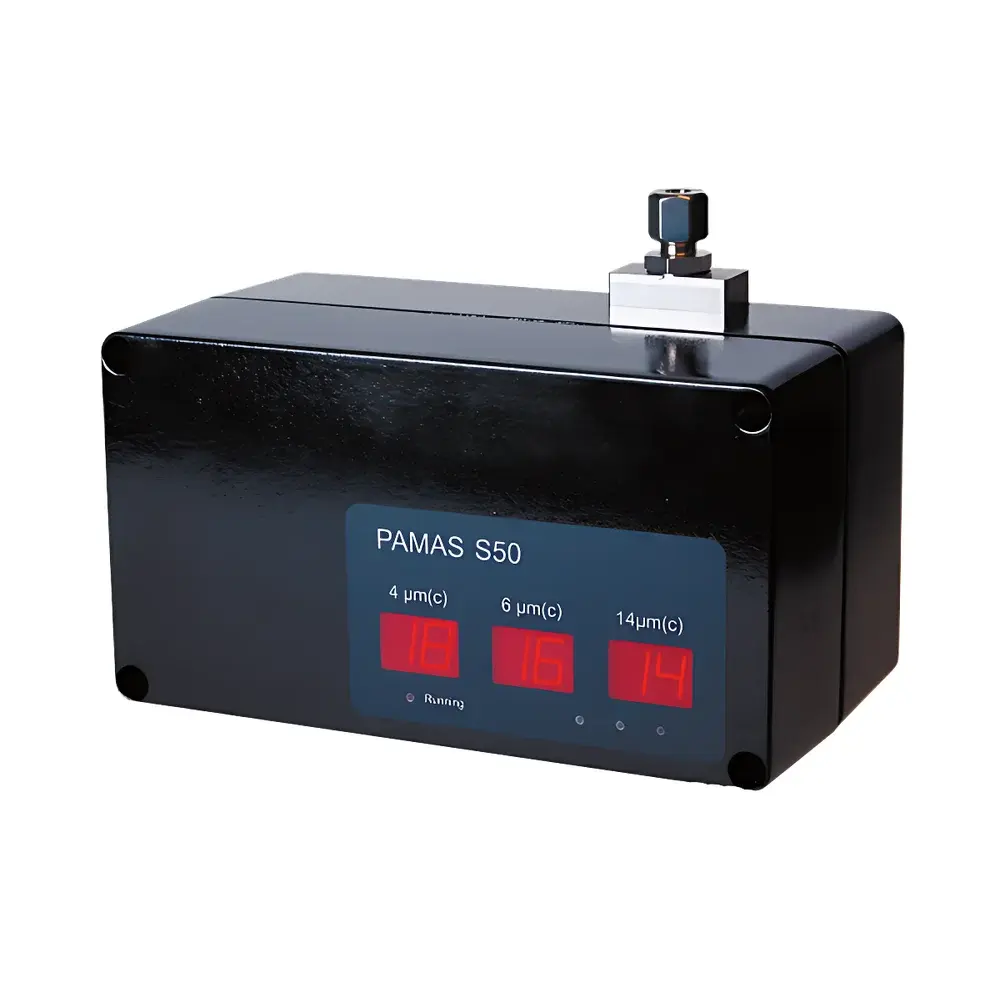
PAMAS SBSS S50 Automatic Online Particle Counter
| Brand | PAMAS |
|---|---|
| Origin | Germany |
| Model | SBSS S50 |
| Instrument Type | Optical Particle Counter |
| Measurement Range | 1–200 µm |
| Channel Sizes (c) | >4, >6, >10, >14, >21, >25, >38, >70 µm |
| Particle Count Range | 0–24,000 particles/mL |
| ISO 4406 Code Display | 0/0/0 to 24/23/22 |
| Operating Pressure | 0.2–20 bar (standard), 5–400 bar (optional), 0–6 bar (S50P variant) |
| Max. Fluid Viscosity | 1000 cSt (pressure-dependent) |
| Interfaces | USB, RS-485 (standard), optional RS-232 or external RS-485 |
Overview
The PAMAS SBSS S50 is an automatic online optical particle counter engineered for continuous, real-time monitoring of particulate contamination in industrial lubricating oils, hydraulic fluids, and turbine oils. Based on the principle of light extinction (also known as single-particle optical sensing), the instrument detects and sizes individual particles suspended in fluid by measuring the reduction in transmitted laser intensity as each particle passes through a precisely defined optical sensing zone. This method delivers high reproducibility and traceable quantification aligned with ISO 11171 and ISO 4402 calibration standards. Designed for permanent installation in circulating systems, the SBSS S50 supports predictive maintenance programs by delivering statistically robust particle count data directly from operational lines—eliminating manual sampling bias and enabling trend-based condition assessment per ISO 4406:2017 and NAS 1638.
Key Features
- Automated digital flow control ensures constant volumetric throughput (typically 20–60 mL/min), critical for repeatable particle concentration calculations per unit volume.
- Dual operational modes: The standard SBSS S50 integrates into pressurized return or bypass lines; the SBSS S50P variant includes an integrated diaphragm pump for direct sampling from low-pressure or atmospheric reservoirs (0–6 bar).
- Eight calibrated size channels (>4, >6, >10, >14, >21, >25, >38, >70 µm) support multi-level cleanliness grading and enable differential analysis of wear debris populations.
- Extended pressure capability up to 400 bar (with optional high-pressure module) permits deployment in demanding applications such as gas turbine lube systems and high-pressure hydraulic manifolds.
- Viscosity tolerance up to 1000 cSt at operating pressure ensures compatibility with heavy-duty gear oils and transformer fluids without dilution or heating.
- Robust stainless-steel wetted parts (316L) and sapphire optical windows provide long-term chemical and abrasion resistance in aggressive hydrocarbon environments.
Sample Compatibility & Compliance
The SBSS S50 is validated for use with mineral oils, synthetic esters, polyalphaolefins (PAOs), and phosphate ester fire-resistant fluids. It complies with key international standards governing fluid cleanliness measurement, including ISO 4406:2017 (fluid contamination coding), ISO 11171 (calibration particle certification), and ASTM D6786 (standard test method for determining particle contamination in aviation turbine fuels). Its design supports GLP/GMP-aligned data integrity requirements: all measurements are time-stamped, system-configurable, and stored with full audit trail metadata when interfaced with compliant SCADA or LIMS platforms. Optional firmware modules support FDA 21 CFR Part 11-compliant electronic signatures and user-access controls.
Software & Data Management
Data acquisition and visualization are managed via PAMAS’ proprietary PC-based software, compatible with Windows 10/11. The interface provides real-time particle count histograms, ISO code evolution charts, alarm thresholds per channel, and automated report generation (PDF/CSV). Communication is supported over USB (local configuration) and RS-485 (industrial fieldbus integration); optional RS-232 or Ethernet-to-RS-485 gateways allow connection to PLCs, DCS systems, or cloud-based CMMS platforms. All raw count data—including timestamp, temperature (via optional PT100 input), pressure, and flow rate—is logged with millisecond resolution. Export formats include ANSI-standard .txt and industry-specific .csv templates compliant with OEM service documentation requirements.
Applications
- Continuous monitoring of hydraulic system cleanliness in wind turbine pitch/yaw systems and offshore drilling equipment.
- Real-time contamination trending in steam turbine lube oil circuits to prevent bearing micropitting and varnish formation.
- Verification of filter performance during commissioning and periodic validation of offline filtration units.
- Condition-based oil change scheduling in marine main engine lubrication systems per Class Society guidelines (e.g., DNV, ABS).
- Supporting ISO 17025-accredited laboratory workflows where online counters supplement offline membrane filter analysis.
- Integration into digital twin frameworks for asset health modeling using historical particle count datasets.
FAQ
Does the SBSS S50 require regular recalibration?
Yes—annual recalibration against NIST-traceable ISO MTD calibration particles (ISO 11171) is recommended to maintain measurement traceability. Field verification using certified reference emulsions can be performed quarterly.
Can the instrument measure water droplets or air bubbles?
No—the SBSS S50 is optimized for solid particulates. Water-in-oil emulsions and entrained air may cause false counts; upstream coalescers or degassing modules are advised for such matrices.
Is the device suitable for use with biodegradable hydraulic fluids?
Yes, provided fluid compatibility with 316L stainless steel and sapphire optics is confirmed; PAMAS provides a chemical resistance matrix covering >120 common industrial fluids.
How is sample representativeness ensured during online operation?
Representative sampling is achieved via turbulent flow conditioning upstream of the sensor inlet and adherence to ISO 4021 sampling protocols—including minimum residence time, flow velocity >1 m/s, and avoidance of dead-legs or sediment traps.
What cybersecurity provisions exist for network-connected units?
RS-485 communication is inherently isolated; when connected via optional Ethernet gateways, role-based access control, TLS 1.2 encryption, and configurable firewall rules align with IEC 62443-3-3 requirements for industrial control systems.



