
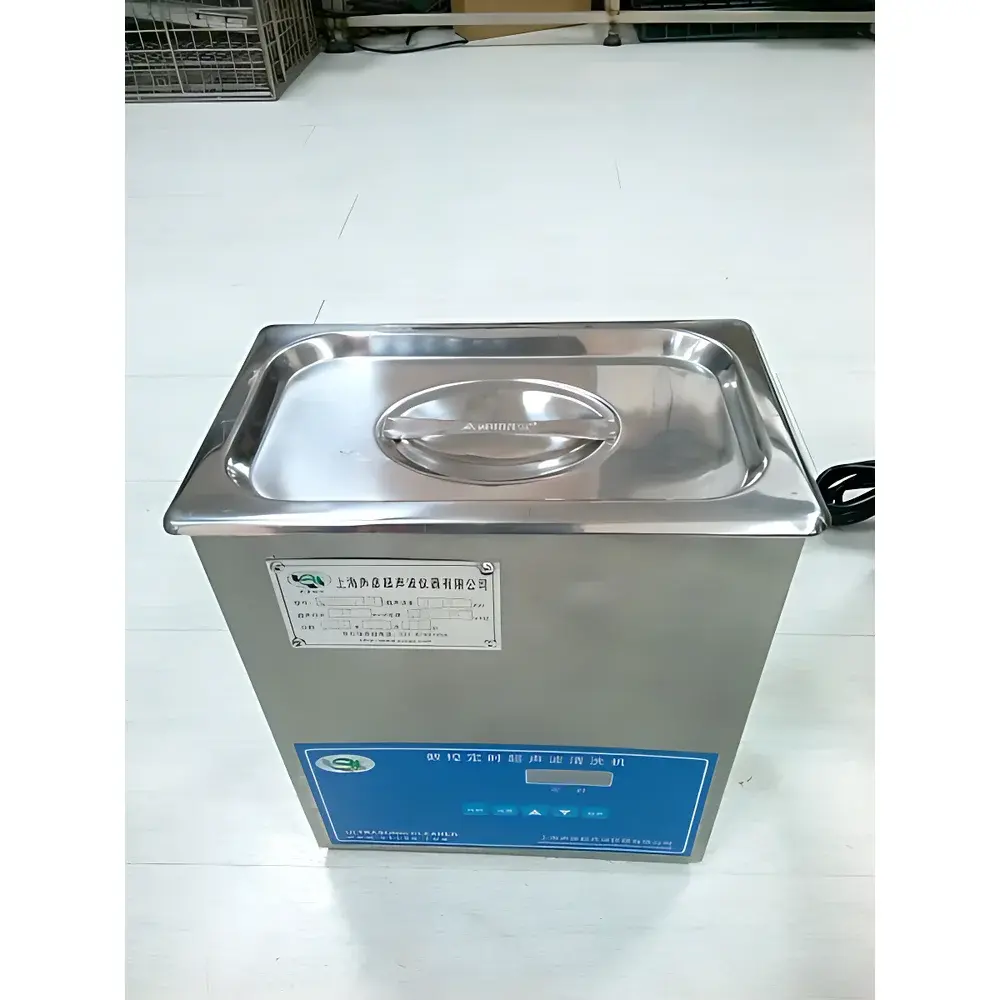
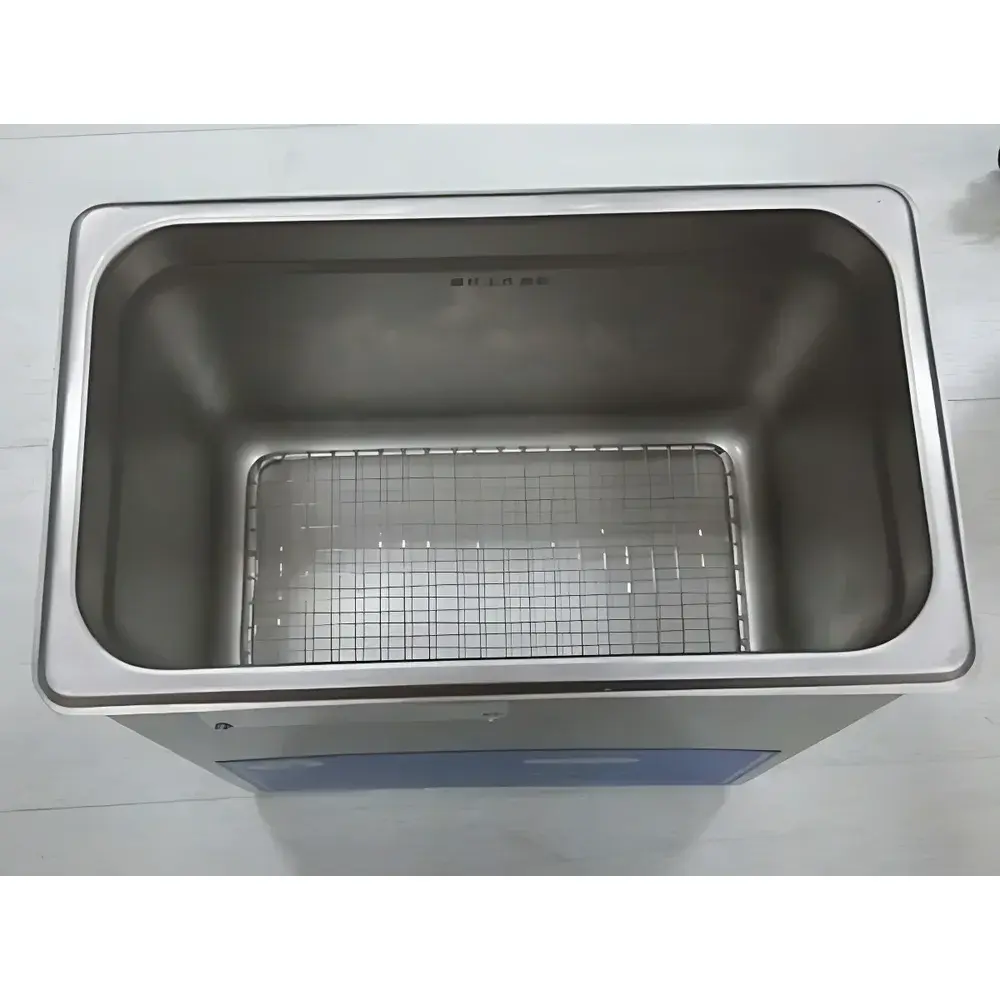
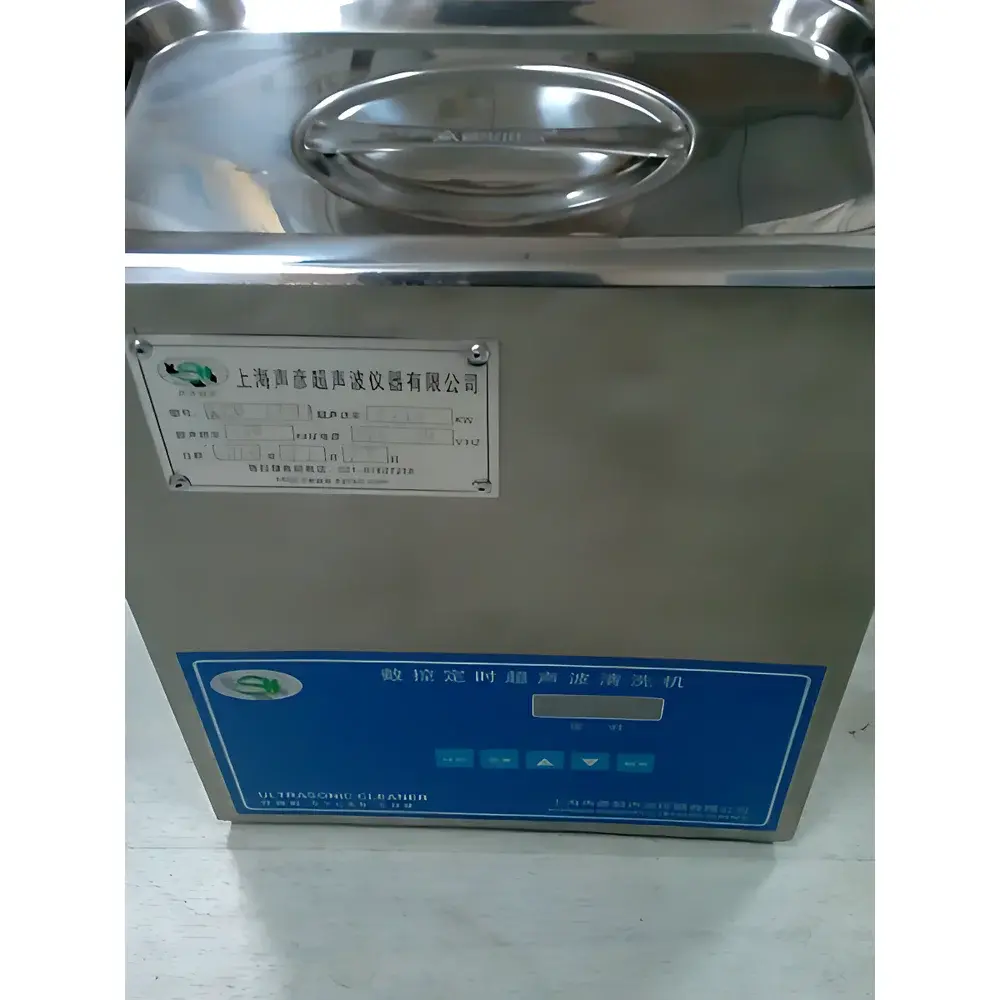
SYCS SCQ-2211A Digital Ultrasonic Cleaner
| Brand | SYCS (Shengyan Ultrasonics) |
|---|---|
| Origin | Shanghai, China |
| Model | SCQ-2211A |
| Tank Capacity | 4 L |
| Internal Tank Dimensions | 230 × 140 × 150 mm |
| Ultrasonic Frequency Options | 20 / 40 / 60 kHz (factory-set single frequency per unit) |
| Ultrasonic Power Output | 150 W (fixed, non-adjustable) |
| Timer Range | 1–600 min (digital preset with cumulative runtime display) |
| Lid | Sound-dampening cover included |
| Drain | Manual valve |
| Heating Function | None |
| Temperature Control | Not available |
| Power Adjustment | Not available |
| Rack | Stainless steel mesh basket included |
| Compliance | CE-marked design principles |
Overview
The SYCS SCQ-2211A Digital Ultrasonic Cleaner is a benchtop, fixed-frequency ultrasonic cleaning system engineered for reproducible, high-efficiency removal of particulate, organic, and oily contaminants from precision components and laboratoryware. It operates on the principle of acoustic cavitation: a 150 W ultrasonic generator delivers stable high-frequency oscillations to piezoelectric transducers bonded to the stainless steel tank base. These transducers convert electrical energy into mechanical vibrations at a selected frequency—20 kHz (for heavy-duty degreasing), 40 kHz (standard for general-purpose cleaning), or 60 kHz (optimized for delicate substrates and fine particulates). The resulting pressure waves propagate through aqueous or solvent-based cleaning media, inducing transient microbubble formation and violent implosion in the negative-pressure half-cycle. Each collapse generates localized shockwaves exceeding 1,000 atm and micro-jets reaching >400 m/s, enabling non-contact mechanical disruption of surface adhesion bonds—even within blind holes, capillary channels, and micro-textured geometries where conventional rinsing fails. Unlike thermal or abrasive methods, this process imposes no thermal stress or dimensional alteration on substrates, preserving metrological integrity of calibration standards, optical elements, and MEMS devices.
Key Features
- Digital microprocessor-controlled timer with 1–600 minute range and cumulative runtime logging—enabling traceable cleaning cycle documentation per GLP/GMP requirements
- Fixed-output 150 W ultrasonic power delivery ensures consistent energy density across the entire 4 L working volume (230 × 140 × 150 mm tank)
- Factory-configured single-frequency operation (20 / 40 / 60 kHz) eliminates cross-frequency interference and simplifies method validation
- Integrated sound-dampening lid reduces ambient noise to ≤55 dB(A) at 1 m distance—compliant with OSHA 29 CFR 1910.95 workplace exposure limits
- Stainless steel (304-grade) tank and mesh basket resist corrosion from common alkaline, neutral, and mild acidic cleaning solutions
- Real-time fault diagnostics: LED indicators for low liquid level, over-temperature (thermal cutoff at 85 °C), and over-current protection
- No heating element or temperature regulation circuitry—eliminates thermal drift artifacts during time-sensitive analytical sample prep
Sample Compatibility & Compliance
The SCQ-2211A accommodates a broad spectrum of sample types without risk of substrate damage, including but not limited to: silicon wafers, quartz cuvettes, stainless steel surgical instruments, tungsten carbide cutting tools, borosilicate glassware, titanium orthopedic implants, and polymer-based microfluidic chips. Its non-thermal, non-abrasive mechanism meets ASTM D4169 and ISO 13485 requirements for pre-sterilization cleaning validation. When used with validated cleaning agents (e.g., Alconox® Liquinox®, or Tergazyme®), it supports USP cleaning verification protocols. Units are assembled under ISO 9001-certified manufacturing controls; electrical safety conforms to IEC 61010-1:2010 Ed.3 for laboratory equipment.
Software & Data Management
As a standalone hardware platform, the SCQ-2211A does not incorporate embedded software or network connectivity. All operational parameters—including elapsed time, set duration, and fault status—are displayed via a 4-digit LED interface. Cumulative runtime data is retained in non-volatile memory across power cycles, supporting maintenance scheduling and audit readiness. For laboratories requiring electronic recordkeeping, integration with external Lab Information Management Systems (LIMS) is achievable via optional RS-232 or USB-to-serial adapters (sold separately), enabling timestamped export of cycle logs compatible with 21 CFR Part 11-compliant electronic signatures when paired with validated middleware.
Applications
- Pre-analytical sample preparation: removal of residual solvents, fingerprints, and polishing compounds from HPLC vials, GC liners, and ICP-MS nebulizer cones
- Microelectronics: post-etch residue clearance from photomasks, bond pads, and flip-chip substrates
- Medical device reprocessing: biofilm detachment from endoscopic channels and dental handpieces prior to sterilization
- Materials science: dispersion stabilization of nanomaterials (e.g., graphene oxide, TiO₂ nanoparticles) in aqueous colloids
- Life sciences: cell lysis optimization for protein extraction, DNA shearing control in ATAC-seq workflows, and degassing of cell culture media
- Quality control labs: cleaning of reference standards, gauge blocks, and profilometer tips to maintain NIST-traceable measurement fidelity
FAQ
Is the ultrasonic frequency user-selectable after purchase?
No. The SCQ-2211A is factory-configured for a single fixed frequency (20, 40, or 60 kHz). Frequency selection must be specified at time of order.
Can this unit be used with flammable solvents?
Not recommended. The device lacks explosion-proof certification (ATEX/IECEx) and uses standard electrical components unsuitable for Class I, Division 1 hazardous locations.
What is the maximum allowable operating temperature of the cleaning solution?
The unit has no active heating; ambient solution temperature must remain below 85 °C to prevent automatic shutdown due to thermal cutoff activation.
Does the mesh basket affect cavitation uniformity?
Yes—placement directly on the tank bottom maximizes energy transfer. Suspension above the transducer plane reduces effective power density by up to 35% as measured per ASTM E1727.
Is deionized water required for optimal performance?
While tap water may be used, conductivity below 5 µS/cm (achieved with DI or distilled water) significantly enhances cavitation intensity and extends transducer service life.



