
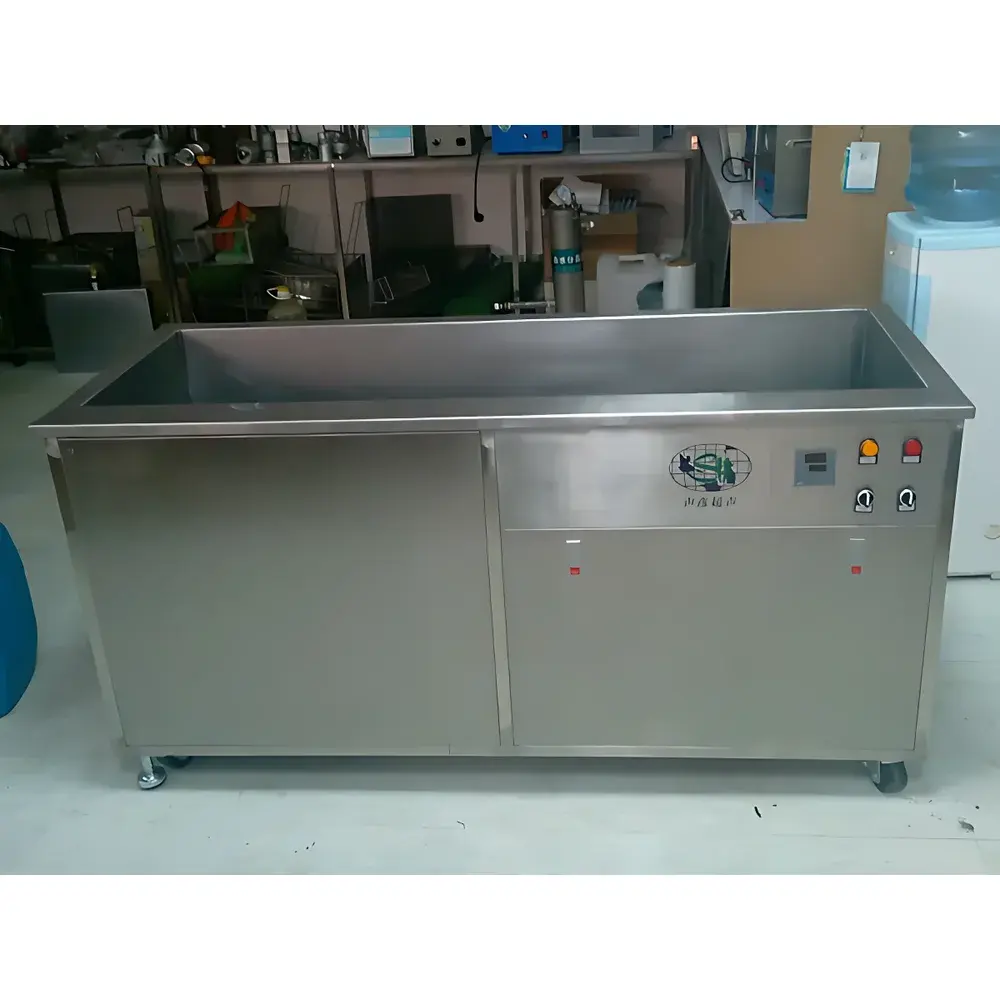
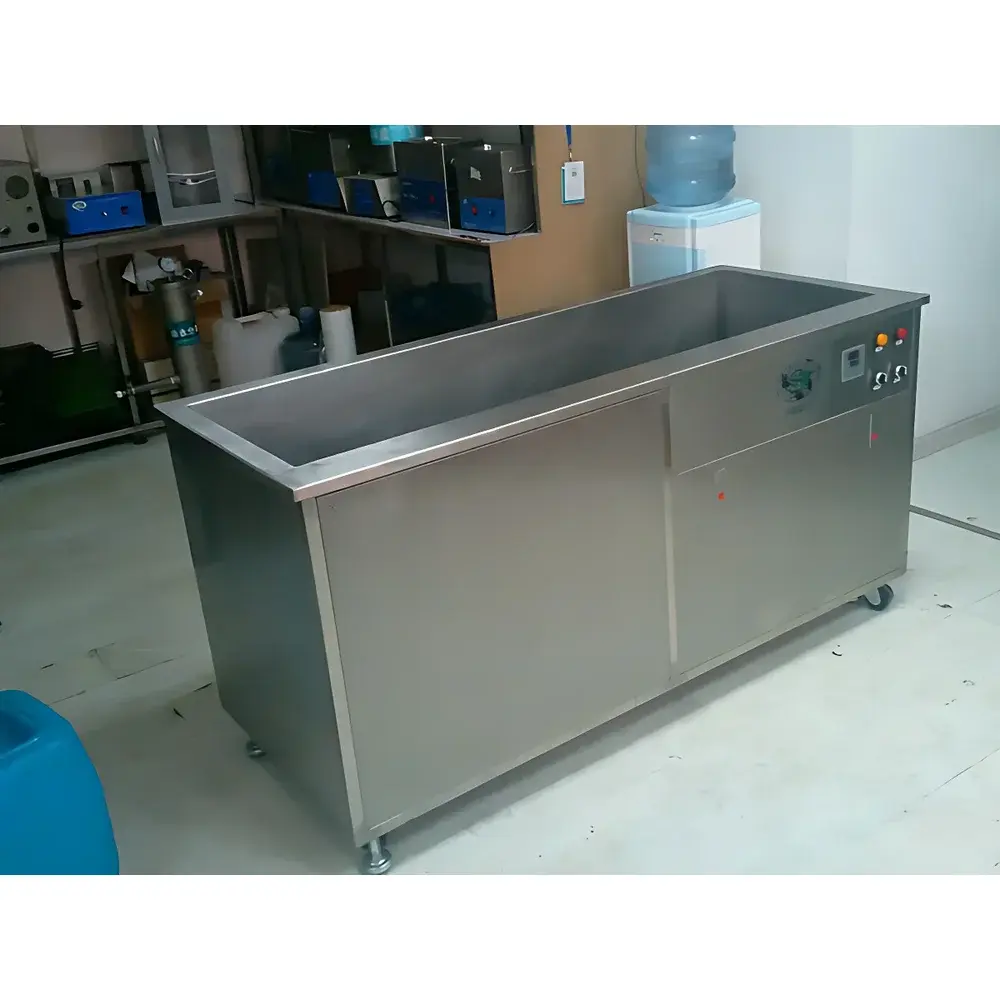
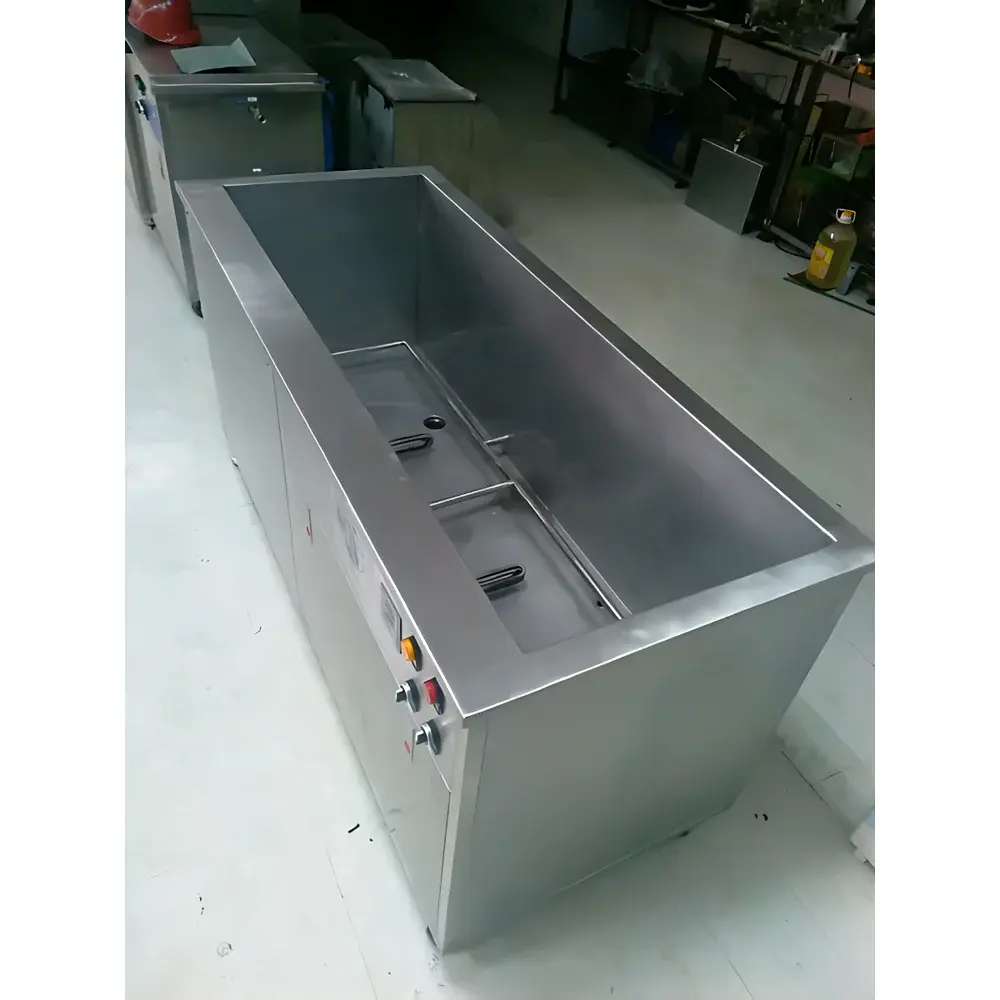
SYCS SCQ-150330 Industrial Ultrasonic Cleaning System
| Brand | SYCS (Shengyan Ultrasonics) |
|---|---|
| Origin | Shanghai, China |
| Model | SCQ-150330 |
| Tank Capacity | 375 L |
| Ultrasonic Power Output | 8000 W |
| Frequency Selection | Multiple options available (default: 40 kHz) |
| Temperature Range | Ambient to 80 °C |
| Timer Range | 1 s – 600 min (programmable in 1-second increments) |
| Heating Power | 8000 W (dual SUS316 heating elements) |
| Construction | Full SUS304 stainless steel tank and housing (2.0 mm thickness) |
| External Dimensions | Approx. 1600 × 600 × 750 mm |
| Internal Tank Dimensions | 1500 × 500 × 500 mm |
| Water Inlet/Outlet | Yes (1/2″ inlet, 1–1/2″ outlet) |
| Air Sparging Port | Yes (3/8″ fitting |
| Casters | Four locking industrial casters |
| Power Supply | 380 V AC / 50 Hz |
| Insulation | Integrated thermal insulation layer for energy efficiency |
| Protection Features | Over-temperature, over-voltage, over-current, low-water-level, and dry-run safeguards |
| Display | Digital LED interface with real-time monitoring of temperature, elapsed time, set parameters, and fault diagnostics |
| Control System | Embedded microcontroller-based firmware with non-volatile parameter memory |
Overview
The SYCS SCQ-150330 is an industrial-grade, large-volume ultrasonic cleaning system engineered for high-reliability operation in demanding laboratory, R&D, and light-manufacturing environments. It operates on the principle of acoustic cavitation: a high-frequency electrical signal from the ultrasonic generator is converted into mechanical vibrations via piezoelectric transducers bonded to the tank bottom and side walls. These vibrations propagate through the cleaning medium—typically aqueous or solvent-based solutions—generating alternating compression and rarefaction cycles. During rarefaction, transient microbubbles nucleate and grow; during compression, they collapse violently, producing localized pressures exceeding 1,000 atm and temperatures up to 5,000 K. This controlled cavitation imparts intense micro-scrubbing action across all submerged surfaces—including blind holes, threaded features, microchannels, and porous matrices—without mechanical abrasion or dimensional alteration. Unlike benchtop units, the SCQ-150330 employs tri-directional transducer mounting (bottom + two lateral walls), ensuring uniform energy distribution throughout its 375 L working volume and eliminating standing-wave dead zones.
Key Features
- Robust 375 L capacity stainless steel tank fabricated from 2.0 mm-thick SUS304 sheet, fully welded and passivated for corrosion resistance against aggressive alkaline, acidic, and organic cleaning agents.
- Dual SUS316 tubular heating elements (total 8,000 W) enable precise, stable temperature control from ambient to 80 °C—critical for thermally activated detergent performance and residue solubilization.
- Integrated thermal insulation layer minimizes heat loss, reducing energy consumption by up to 22% compared to uninsulated systems under continuous operation.
- Microprocessor-controlled digital interface displays real-time bath temperature, cumulative operating time, set timer value, and active fault codes—including over-temperature, low liquid level, over-current, and dry-run conditions.
- Programmable timer supports resolution down to 1 second, with full range from 1 s to 600 min (9 h 59 min 59 s), enabling reproducible process validation per ISO 13485 or ASTM F2763 protocols.
- Standard 3/8″ air sparging port allows integration with external compressed air or inert gas sources for enhanced degassing, foam suppression, or agitation-assisted cleaning.
- Four heavy-duty locking casters facilitate safe repositioning within shared lab spaces or production floors without disassembly.
Sample Compatibility & Compliance
The SCQ-150330 accommodates a broad spectrum of substrates—including silicon wafers, optical lenses, surgical instruments, precision machined components (e.g., fuel injectors, hydraulic valves), ceramic filters, and polymer-based medical devices—without risk of surface pitting, etching, or dimensional drift. Its non-contact cleaning mechanism preserves micron-level tolerances and surface finishes (Ra < 0.2 µm). The system complies with general safety requirements outlined in IEC 61010-1 (Electrical Equipment for Laboratory Use) and incorporates grounding continuity, double-insulated wiring, and thermal cutoffs aligned with EN 60529 (IP22 ingress protection). While not certified to FDA 21 CFR Part 11 out-of-the-box, its parameter logging capability (via optional RS485/Modbus interface) supports audit-ready data capture for GLP/GMP-aligned workflows when integrated with validated LIMS or ELN platforms.
Software & Data Management
The embedded control firmware retains user-defined settings—including temperature setpoint, timer duration, and power-on defaults—across power cycles using non-volatile EEPROM memory. All operational events (start/stop timestamps, temperature excursions, fault triggers) are timestamped and stored in a circular buffer (last 1,024 entries). Optional serial communication (RS485) enables remote parameter readout, script-based batch execution, and synchronization with centralized lab automation systems. Data export is supported in CSV format via USB host interface (firmware update v2.3+), facilitating traceability in regulated environments where SOP adherence and process repeatability are auditable requirements.
Applications
This system serves dual-purpose roles across analytical, clinical, and engineering laboratories. In materials science, it removes polishing compounds and organic residues from metallographic samples prior to SEM/EDS analysis. In pharmaceutical development, it cleans stainless-steel reactor parts, filter housings, and filling nozzles in accordance with USP cleaning validation guidelines. In electronics manufacturing, it eliminates flux residues from PCB assemblies before AOI inspection. Additional validated use cases include cell lysis for protein extraction (sonication amplitude modulated at 20–40 kHz), nanoparticle dispersion stabilization, degassing of HPLC mobile phases, and removal of biofilm from endoscope channels per AAMI ST91 recommendations. Its large internal dimensions (1500 × 500 × 500 mm) accommodate trays, baskets, or custom fixtures holding >200 standard Petri dishes or 12 full-size semiconductor carriers.
FAQ
What ultrasonic frequencies are available for the SCQ-150330?
Standard configurations ship with 40 kHz transducers; optional frequency modules include 28 kHz (for heavy particulate removal), 68 kHz (for delicate optics), and 130 kHz (for sub-micron particle detachment). Frequency selection must be specified at order entry.
Is the unit suitable for use with flammable solvents?
No. The SCQ-150330 is rated for aqueous and water-miscible solutions only. Use with flammable or chlorinated solvents requires explosion-proof certification (ATEX/IECEx), which this model does not possess.
Can the heating function operate independently of ultrasonic activation?
Yes. Temperature control and ultrasonic generation are decoupled subsystems; either may be enabled or disabled independently via the front-panel interface.
Does the system support automatic fill/drain cycles?
Manual fill and drain are standard. Automated fluid handling requires third-party PLC integration via dry-contact I/O terminals (available as factory option SCQ-AUTO-IO).
What maintenance intervals are recommended for sustained performance?
Transducer impedance verification and tank weld integrity inspection every 12 months; heating element resistance check every 6 months; ultrasonic output calibration using hydrophone-based measurement per ASTM E1065 annually or after 2,000 operational hours.



