
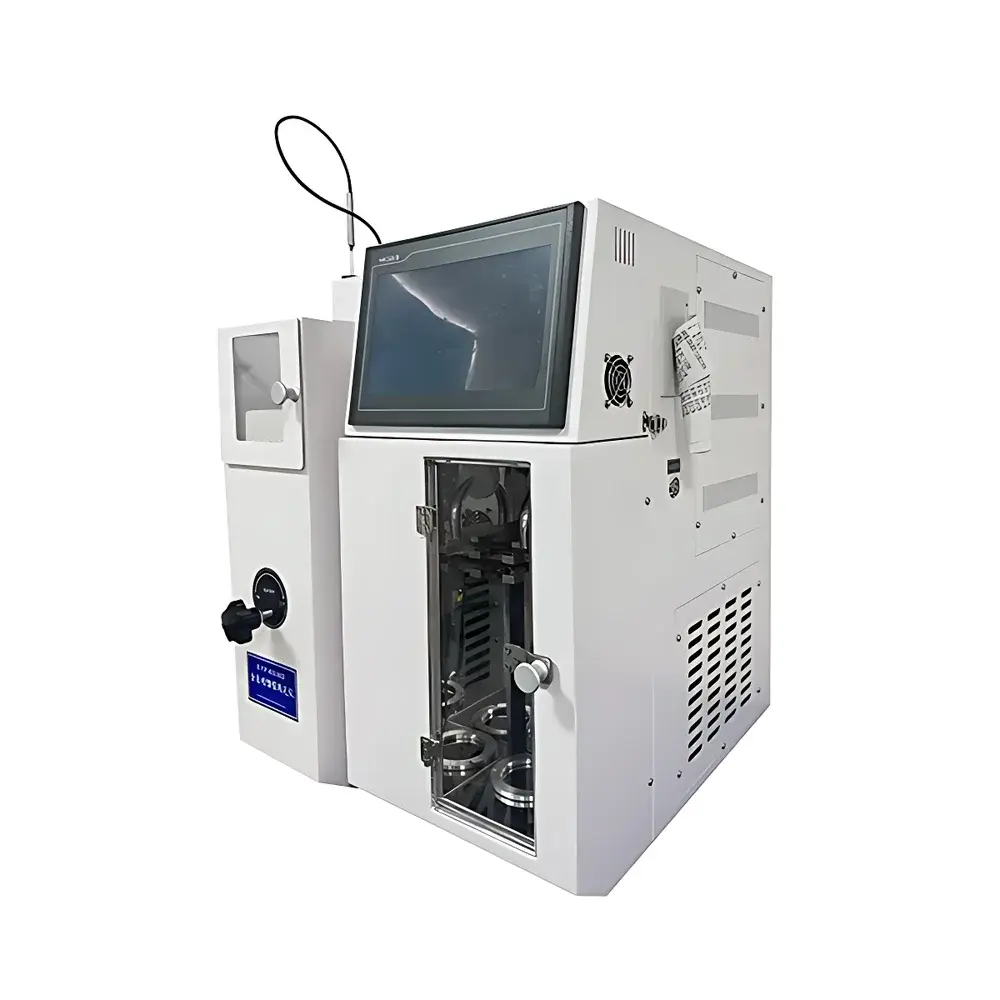
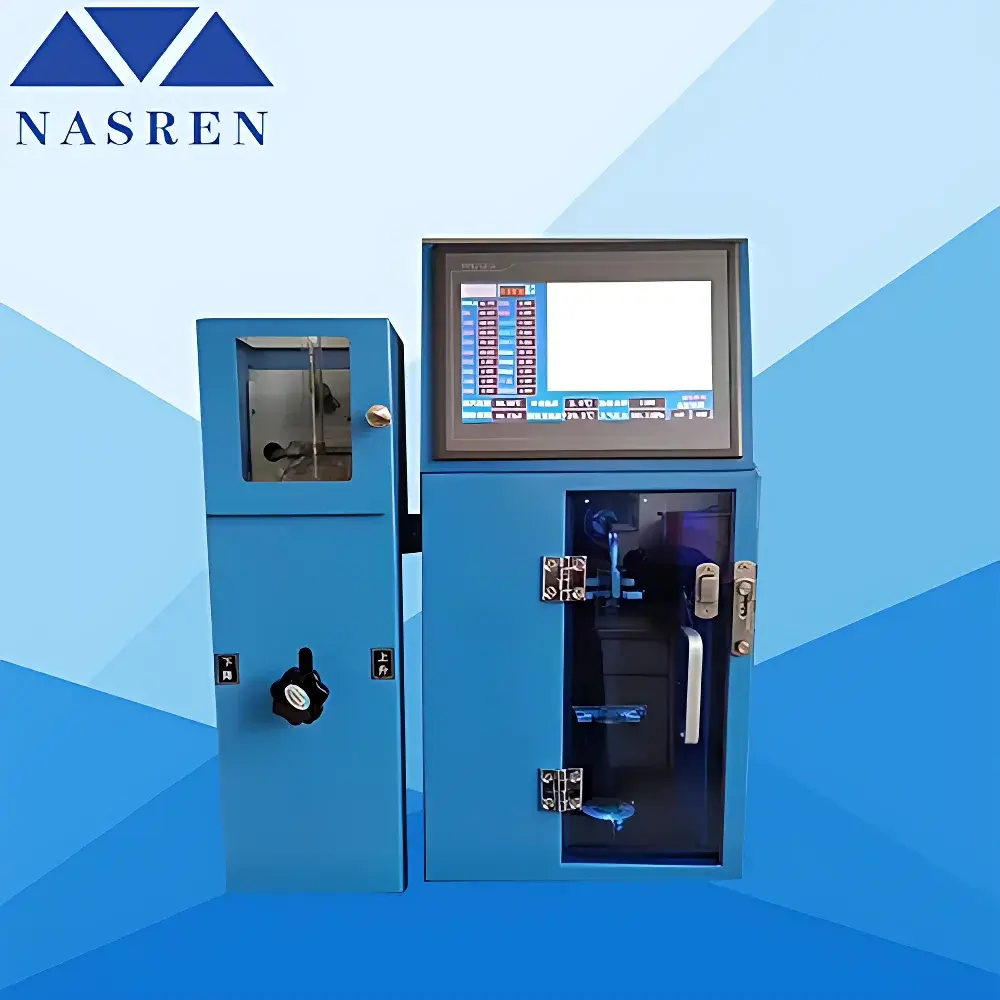
MITONG SYP-7534B Automatic Methanol Boiling Range Analyzer
| Brand | MITONG (Shanghai Mitong Instrument Co., Ltd.) |
|---|---|
| Model | SYP-7534B |
| Origin | Shanghai, China |
| Construction | Quartz-glass distillation apparatus |
| Cold Bath Temperature Control Range | −10 °C to +70 °C |
| Condensate Cylinder Temperature Control Range | −10 °C to +60 °C |
| Volume Detection Range | 0–100 mL (0.01 mL resolution) |
| Volume Measurement Accuracy | < 0.1 mL |
| Distillation Rate | 4–5 mL/min |
| Heating Power | Up to 1200 W (programmable ramp control) |
| Refrigeration | Imported German compressor |
| Temperature Sensor | Pt100 glass probe (IEC 60751 Class A) |
| Liquid Level Detection | Infrared photoelectric system |
| Display | 12.1″ embedded color touch screen |
| Data Storage | 100 test records |
| Power Supply | AC 220 V, 50 Hz |
| Max. Power Consumption | 1500 W |
| Operating Ambient | 10–40 °C |
| Storage Ambient | 0–50 °C |
| Atmospheric Pressure Compensation | Integrated barometric sensor with real-time correction |
| Safety Features | Flame detector with automatic fire suppression |
| Compliance Standards | GB/T 7534, GB/T 615, GB 338–2011, GB/T 6536 |
Overview
The MITONG SYP-7534B Automatic Methanol Boiling Range Analyzer is a precision-engineered distillation apparatus designed for the standardized determination of boiling range distributions in volatile organic liquids—particularly industrial-grade methanol and related alcohols—according to Chinese national standards GB 338–2011, GB/T 7534, GB/T 615–2006, and GB/T 6536. It operates on the principle of atmospheric-pressure batch distillation under controlled heating and condensation conditions, enabling reproducible measurement of initial boiling point (IBP), final boiling point (FBP), and percentage recovery at defined temperature intervals. The instrument integrates quartz-glass distillation components to ensure chemical inertness and thermal stability during repeated exposure to methanol vapors and elevated temperatures. Its architecture conforms to fundamental ASTM D86 and ISO 3405 methodology frameworks—adapted for regulatory compliance in quality control laboratories handling bulk solvents, petrochemical intermediates, and reagent-grade alcohols.
Key Features
- Embedded 12.1-inch industrial-grade touchscreen interface with intuitive HMI navigation, eliminating external PC dependency
- Full automation of distillation sequence: programmable heating ramp, active cooling control, real-time vapor and heater temperature monitoring, dynamic distillate volume tracking, and auto-printed test reports
- Triple real-time curve display: vapor temperature, heater surface temperature, and distillation rate—enabling immediate verification against standard-defined rate tolerances (e.g., 4–5 mL/min per GB/T 7534)
- Pt100 Class A glass temperature sensors (certified to IEC 60751) with built-in calibration offset compensation for traceable thermal accuracy
- Infrared-based 0.01 mL-resolution volume detection system (US-sourced optical cylinder reader) with <0.1 mL volumetric repeatability across 100 mL range
- Integrated barometric pressure sensor with automatic vapor temperature correction—ensuring consistent IBP/FBP values regardless of local altitude or daily atmospheric fluctuations
- Dual-zone thermostatic control: independently regulated cold bath (−10 to +70 °C) and condensate cylinder chamber (−10 to +60 °C), equipped with internal circulation fans and sealed airflow management to minimize convective interference
- Fail-safe flame detection module coupled with automatic extinguishing protocol—meeting essential laboratory safety requirements for flammable solvent analysis
- Onboard data storage for 100 complete test records, including raw time-temperature-volume datasets, user annotations, and environmental metadata (ambient T, pressure, operator ID)
Sample Compatibility & Compliance
The SYP-7534B is validated for use with methanol, ethanol, isopropanol, acetone, and other low-boiling organic liquids exhibiting boiling points between 30 °C and 120 °C. Its quartz-glass distillation train resists corrosion from acidic or basic impurities commonly found in technical-grade feedstocks. The system supports method customization via user-loaded protocols aligned with GB/T 6536 (petroleum distillation), USP <721>, and ASTM D1078 (volatility of volatile liquids). All temperature and volume measurements are traceable to NIM (National Institute of Metrology, China) reference standards. The instrument’s firmware implements audit-trail logging for GLP-compliant environments, recording operator actions, parameter changes, and calibration events with timestamp and user identification.
Software & Data Management
The embedded control software provides full method lifecycle management: pre-configured templates for GB 338–2011 methanol testing, editable distillation profiles (heating rate, hold times, cut-point thresholds), and export-ready CSV output compatible with LIMS integration. Data integrity safeguards include password-protected method editing, electronic signature prompts for report approval, and non-volatile memory retention—even during power interruption. Optional USB export enables offline statistical review (e.g., Shewhart X-bar/R charts for process consistency monitoring). No proprietary drivers or cloud dependencies are required; all operations execute locally on the industrial-grade ARM-based controller.
Applications
- QC release testing of industrial methanol per GB 338–2011 specifications (e.g., ≤0.1% residue at 100 °C, IBP ≥64.0 °C, FBP ≤65.5 °C)
- Batch-to-batch consistency verification in solvent manufacturing and recovery units
- Impurity profiling in pharmaceutical-grade alcohol synthesis (supporting ICH Q5 and Q7 documentation requirements)
- Educational labs requiring hands-on instruction in standardized distillation methodology per ISO/IEC 17025 training modules
- Third-party certification labs performing accredited testing under CNAS accreditation scope (CNAS-CL01:2018)
FAQ
Does the SYP-7534B comply with international distillation standards such as ASTM D86 or ISO 3405?
Yes—the instrument’s thermal control fidelity, volume resolution, and procedural logic align with the physical principles and operational constraints defined in ASTM D86 and ISO 3405. While its factory calibration references GB-series standards, method adaptation for ASTM/ISO execution is supported via configurable ramp profiles and data export for external validation.
Can the system be integrated into an existing LIMS environment?
Yes—CSV-formatted test reports include all raw and derived parameters (time-stamped T/vol pairs, IBP/FBP, % recovery at 5 °C increments) and are structured for direct ingestion by common LIMS platforms without transformation.
Is third-party calibration certification available?
MITONG provides optional NIST-traceable calibration certificates (per ISO/IEC 17025) for temperature sensors and volume detection subsystems, issued by CNAS-accredited calibration laboratories.
What maintenance is required for long-term reliability?
Routine maintenance includes quarterly cleaning of quartz condenser surfaces, annual verification of Pt100 sensor drift (<±0.15 °C), and biannual refrigerant pressure checks. No consumables beyond standard lab-grade antifreeze solution (for cold bath) are required.
How does the system handle samples with suspended particulates or high water content?
Pre-filtration (≤5 µm) is recommended for particulate-laden feeds. For aqueous methanol mixtures, the instrument accurately reports total distillate volume but does not differentiate azeotropic behavior; users should refer to GB/T 7534 Annex B for guidance on interpreting water-co-distillation effects.



