
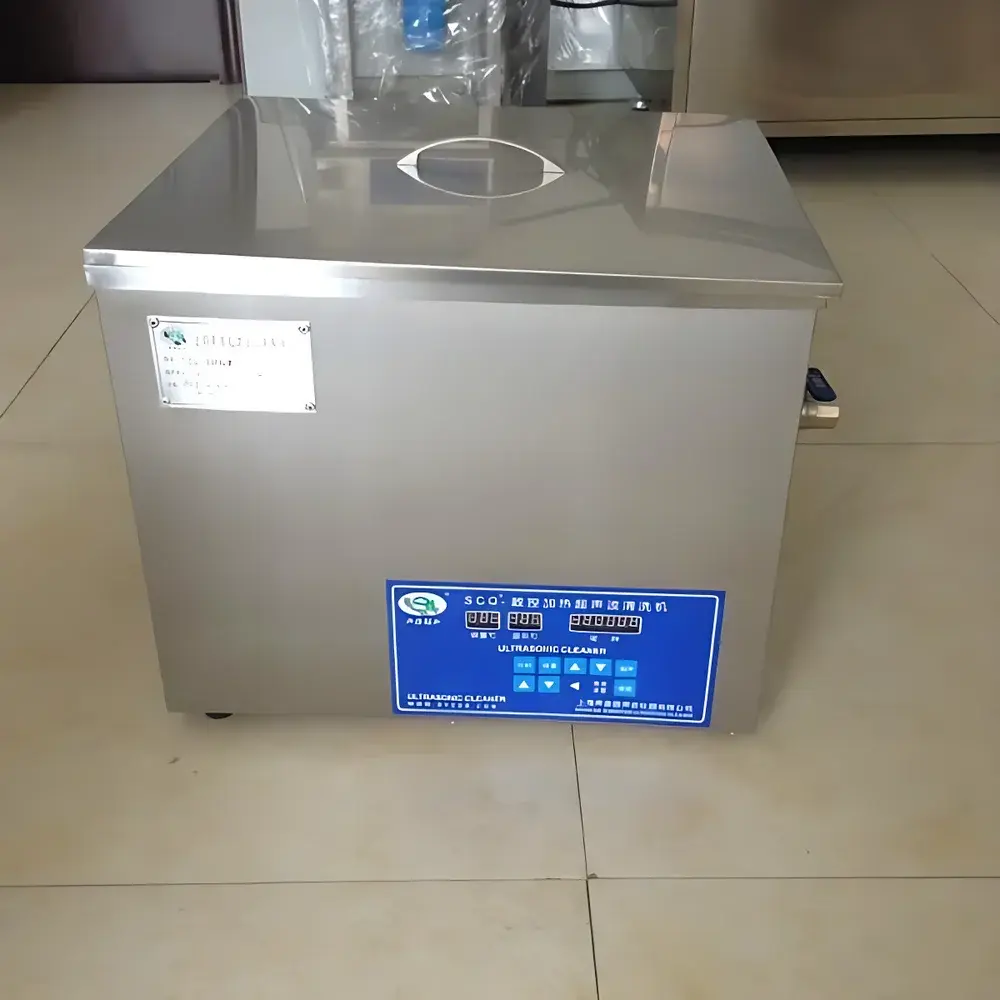
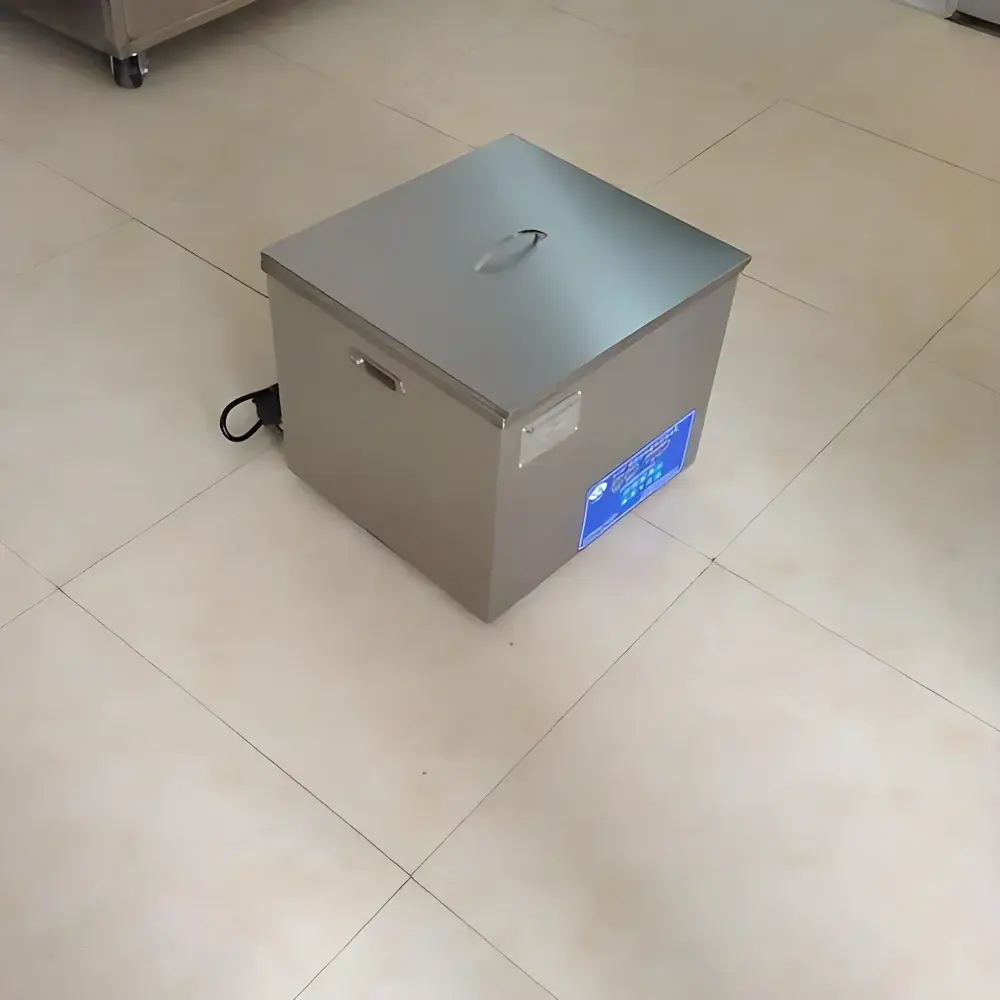
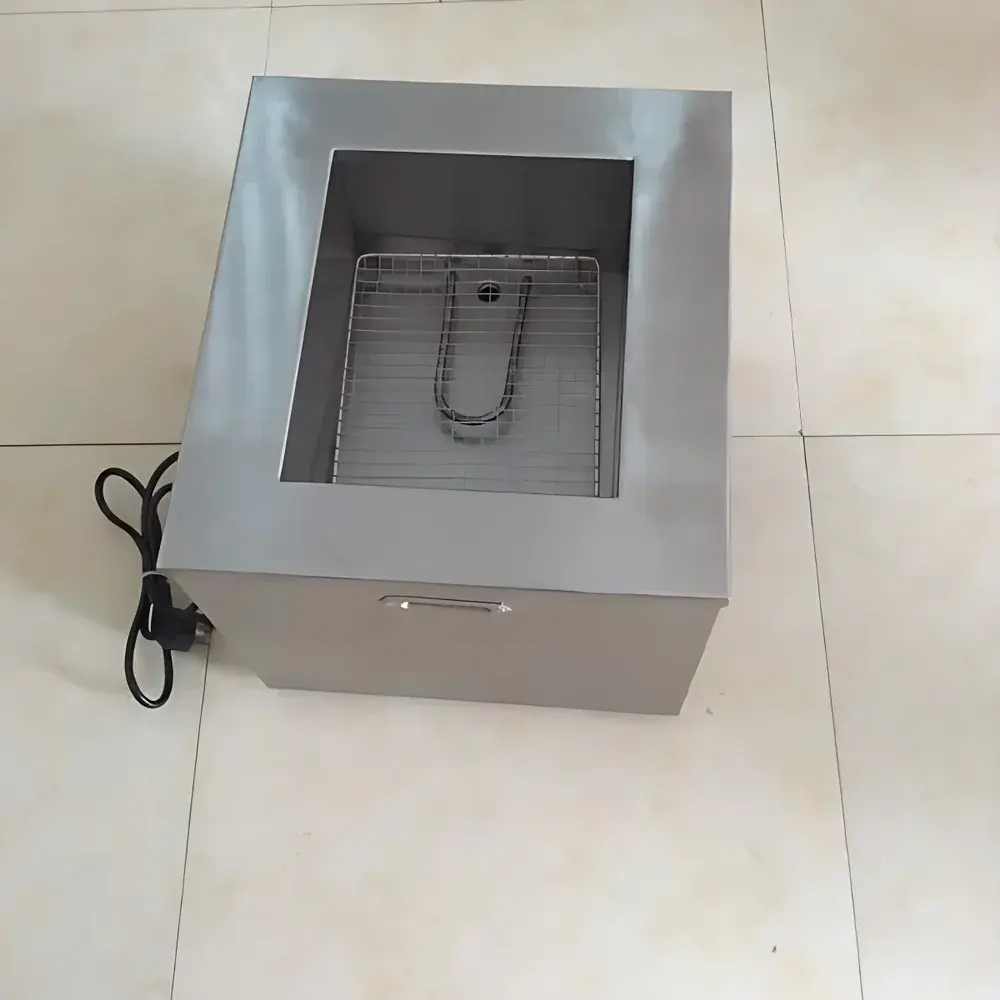
Shengyan SCQ-131129 Digital Programmable Heated Ultrasonic Extractor
| Brand | Shengyan Ultrasonics (SYCS) |
|---|---|
| Origin | Shanghai, China |
| Model | SCQ-131129 |
| Tank Capacity | 9.46 L |
| Ultrasonic Frequency | 40 kHz |
| Ultrasonic Power | 300 W |
| Heating Power | 600 W |
| Temperature Range | Ambient to 80 °C |
| Timer Range | 1–600 min |
| Sound-Dampening Lid | Yes |
| Manual Drain Valve | Yes |
| Tank Material | SUS304 Stainless Steel (2.0 mm thickness) |
| External Dimensions (L×W×H) | 406 × 394 × 368 mm |
| Internal Tank Dimensions (L×W×H) | 292 × 241 × 152 mm |
| Power Supply | 220 V / 50 Hz |
Overview
The Shengyan SCQ-131129 Digital Programmable Heated Ultrasonic Extractor is a benchtop ultrasonic system engineered for controlled solid–liquid extraction and sample preparation in analytical, pharmaceutical, and quality control laboratories. It operates on the principle of acoustic cavitation—where high-frequency sound waves (40 kHz) generate transient microbubbles in the cleaning or extraction medium; their collapse produces localized high pressure and temperature gradients, enhancing mass transfer and disrupting matrix–analyte interactions. Unlike general-purpose ultrasonic cleaners, this unit integrates precise digital temperature control (ambient to 80 °C), extended programmable timing (up to 600 minutes), and a robust stainless-steel tank (SUS304, 2.0 mm wall thickness), making it suitable for thermally assisted extraction protocols such as herbal active compound isolation, pesticide residue recovery, or metal leaching from environmental samples.
Key Features
- Digital microprocessor-controlled timer with 1-second resolution across a 1–600 minute range (equivalent to 0:01–9:59:59), supporting reproducible process replication under standardized operating conditions.
- Integrated heating module (600 W) enables precise thermal regulation from ambient temperature up to 80 °C, facilitating temperature-dependent extraction kinetics without requiring external water baths.
- SUS304 stainless-steel tank (292 × 241 × 152 mm internal dimensions; 9.46 L volume) ensures chemical resistance against common organic solvents (e.g., ethanol, methanol, acetone) and aqueous buffers, minimizing cross-contamination and corrosion over extended operational cycles.
- Acoustically optimized transducer array delivers uniform 300 W ultrasonic power at a fixed 40 kHz frequency—ideal for routine applications where consistency outweighs multi-frequency flexibility.
- Sound-dampening lid reduces airborne noise to ≤55 dB(A) at 1 m distance, improving ergonomic compliance in shared laboratory environments.
- Manual drain valve and removable stainless-steel mesh basket support efficient post-extraction handling and residue-free tank maintenance.
Sample Compatibility & Compliance
The SCQ-131129 accommodates a broad range of sample types—including plant tissues, soil matrices, biological tissues, and industrial particulates—when suspended in compatible solvents. Its design conforms to standard laboratory safety practices for Class II ultrasonic equipment per IEC 61000-6-3 (EMC emissions) and IEC 61000-6-2 (immunity). While not certified for GMP or FDA 21 CFR Part 11 compliance out-of-the-box, its repeatable timing and temperature parameters allow integration into validated SOPs for GLP-compliant workflows when paired with documented calibration procedures (e.g., using calibrated thermistors and stopwatch verification). The unit meets CE marking requirements for electrical safety (EN 61010-1) and is suitable for use in ISO/IEC 17025-accredited testing laboratories under defined method validation.
Software & Data Management
This model operates via an embedded digital interface with LED display and tactile membrane keypad—no external software, drivers, or PC connectivity are required. All operational parameters (time, temperature) are set and retained locally; no data logging, audit trail, or electronic record functionality is included. For regulated environments requiring traceability, users must implement manual logbook entries aligned with internal QA documentation standards. Optional external temperature dataloggers (e.g., compliant with ASTM E2850) may be deployed to independently verify thermal profiles during validation studies.
Applications
- Accelerated extraction of alkaloids, flavonoids, and terpenoids from botanical materials in natural product research.
- Residue analysis workflows—including organophosphate and pyrethroid pesticide recovery from food commodities per AOAC 2007.01 and EN 15662 methods.
- Preparation of reference standards for ICP-MS or AAS analysis via acid digestion support (using compatible Teflon-lined vessels placed inside the tank).
- Cleaning and degassing of HPLC vials, GC autosampler inserts, and filtration apparatus prior to trace-level analysis.
- Dispersion stabilization of nanomaterial suspensions (e.g., TiO₂, SiO₂) for DLS or UV-Vis characterization.
FAQ
Is the ultrasonic frequency adjustable?
No. The SCQ-131129 operates exclusively at a fixed 40 kHz frequency, optimized for general-purpose cavitation efficiency and mechanical stability.
Can this unit be used with flammable solvents?
It is not intrinsically safe for use with highly volatile or flammable solvents (e.g., diethyl ether, hexane) due to absence of explosion-proof certification. Ethanol and isopropanol may be used with adequate ventilation and adherence to local fire safety codes.
Does the unit include temperature calibration documentation?
Factory calibration certificates are not supplied by default. Users should perform periodic verification using NIST-traceable thermometers prior to critical extractions.
What is the expected service life of the transducers under continuous operation?
With proper maintenance (deionized water use, avoidance of dry operation, and regular descaling), transducers typically maintain ≥90% nominal output for 5,000–7,000 hours of cumulative runtime.
Is the drain valve compatible with standard laboratory tubing?
Yes—the 8 mm OD manual drain port accepts common silicone or PVC tubing (ID 6–8 mm) for gravity-fed waste collection into secondary containment vessels.



