
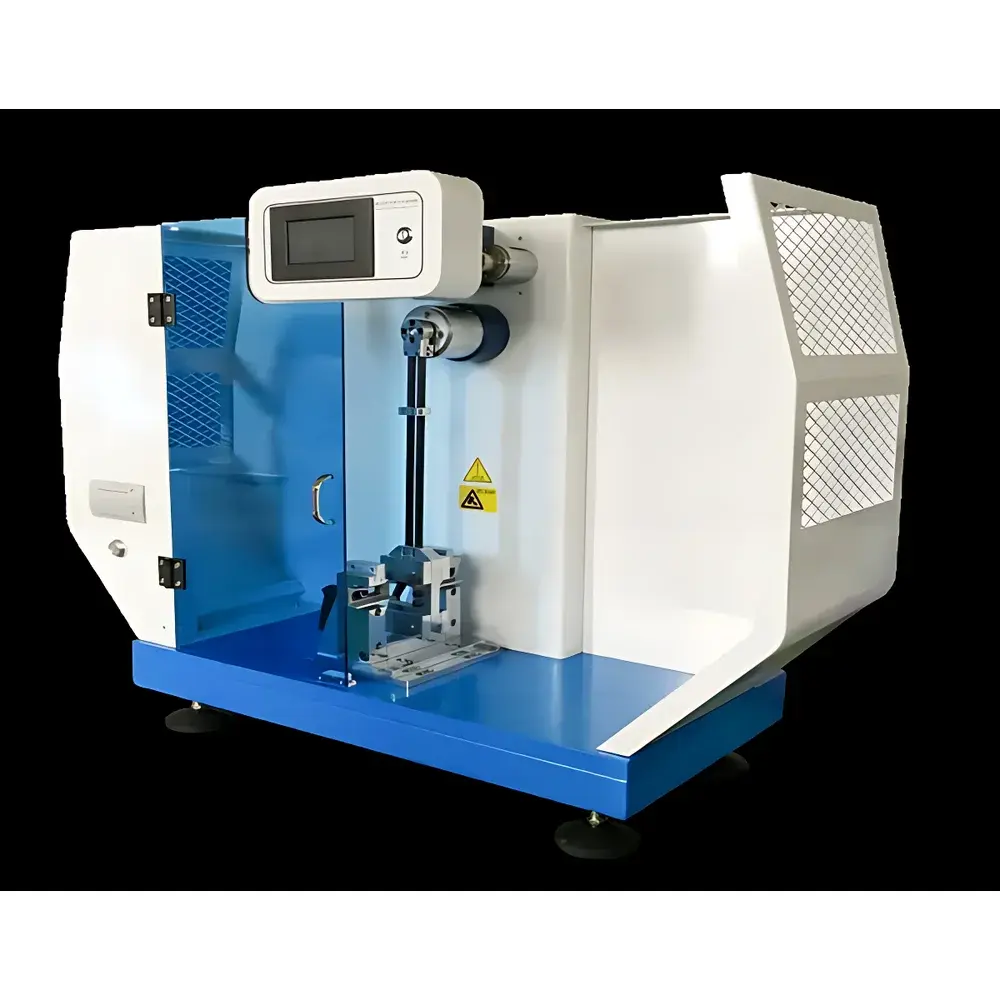
TY-4020 Charpy-Type Simply Supported Beam Impact Tester
| Brand | TianYuan |
|---|---|
| Origin | Jiangsu, China |
| Manufacturer Type | Direct Manufacturer |
| Model | TY-4020 |
| Impact Energy Range | 2 J, 4 J, 5 J, 7.5 J, 15 J, 25 J, 50 J |
| Impact Velocity | 2.9 m/s or 3.8 m/s |
| Pendulum Moment (Impact Constant) | 150° lift angle |
| Distance from Pendulum Center to Specimen Center | 221 mm / 380 mm (mechanical design) |
| Pendulum Lift Angle | 150° |
| Support Span Options | 40 mm, 60 mm, 70 mm, 95 mm |
| Support Blade Radius | R = 1 mm |
| Impact Blade Angle | 30° |
| Impact Blade Radius | R = 2.0 ± 0.5 mm |
| Angular Resolution | 0.01° (Omron rotary encoder) |
| Energy Resolution | 0.01 J |
| Display | Color TFT touchscreen (bilingual UI) |
| Data Storage | Up to 12 test records with auto-averaging |
| Output Units | J/m, kJ/m², kg·cm/cm, ft·lb/in |
Overview
The TY-4020 Charpy-Type Simply Supported Beam Impact Tester is a precision-engineered pendulum impact system designed for determining the impact resistance and notch sensitivity of rigid non-metallic materials under standardized three-point bending conditions. Based on the classical simply supported beam configuration, it applies a controlled kinetic energy impulse via a calibrated swinging pendulum to a notched or unnotched specimen resting on two parallel supports. The instrument operates in strict compliance with ISO 179-1:2019 (Plastics — Determination of Charpy impact properties — Part 1: Non-instrumented impact testing), GB/T 1043.1–2023 (Chinese national standard equivalent), and ASTM D6110 (Standard Test Method for Determining the Notched Izod Impact Resistance of Plastics). Unlike instrumented drop-weight systems, the TY-4020 delivers high reproducibility through mechanical energy conservation principles, making it suitable for routine quality control in polymer manufacturing, composite R&D, and third-party certification laboratories.
Key Features
- Patented carbon-fiber pendulum arm: Reduces torsional flexure during impact, centers mass inertia at the pendulum’s geometric centroid, and eliminates post-impact oscillation—enhancing repeatability and extending service life.
- High-stability angular measurement: Integrated Omron absolute rotary encoder with 0.01° resolution ensures traceable, drift-free determination of pre- and post-impact angles for precise energy calculation (E = mgL(cosα₁ − cosα₂)).
- Dual-velocity operation: Configurable impact speeds of 2.9 m/s (standard for ISO 179-1 Mode I) and 3.8 m/s (for elevated-energy protocols or specialized material screening).
- Bilingual touchscreen interface: Full-color 7-inch TFT display supports real-time parameter configuration, live energy readout, and on-device statistical analysis (mean, SD, CV%) across up to 12 stored tests.
- Modular support and striker assembly: Interchangeable anvil sets accommodate standard span lengths (40 mm, 60 mm, 70 mm, 95 mm) and comply with ISO-defined blade geometry (30° included angle, R = 2.0 ± 0.5 mm tip radius; support blade R = 1.0 mm).
- Integrated thermal printer: Outputs calibrated test reports including specimen ID, energy absorption, calculated impact strength (J/m), operator name, date/time stamp, and compliance reference.
Sample Compatibility & Compliance
The TY-4020 accepts rectangular bars (typically 80 × 10 × 4 mm per ISO 179-1) and tubular specimens per GB/T 18743–2002. It is validated for thermoplastics (e.g., ABS, PC, PP), fiber-reinforced composites (glass/CF/Nylon), ceramics, electrical insulators, and rigid elastomers. All mechanical dimensions—including pendulum center-to-specimen distance (230 mm / 395 mm), support spacing tolerances (±0.1 mm), and blade radii—are verified against ISO/IEC 17025-accredited calibration procedures. The system meets requirements for GLP-compliant data integrity: all test events are time-stamped, non-editable, and retain full audit trail metadata within internal memory.
Software & Data Management
While the TY-4020 operates as a stand-alone instrument, its embedded firmware supports USB export of CSV-formatted datasets (including raw angle traces, calculated energies, and derived strength values) for integration into LIMS or statistical process control platforms. Data fields conform to ASTM E1447 and ISO/IEC 17025 Annex A3 formatting conventions. Optional PC-based software (sold separately) enables advanced curve fitting, Weibull distribution analysis, and automated report generation compliant with FDA 21 CFR Part 11 (electronic signatures, audit logs, role-based access). No cloud connectivity or remote telemetry is implemented—ensuring full data sovereignty and network isolation for regulated environments.
Applications
- Quality assurance of injection-molded plastic components in automotive and electronics supply chains.
- Comparative evaluation of toughening agents (e.g., rubber modifiers, nanofillers) in polymer formulations.
- Validation of thermal aging effects on impact performance per ISO 188 or ASTM D746.
- Third-party certification testing for CE marking (EN ISO 179-1), UL recognition, and RoHS-compliant material declarations.
- Educational use in university polymer science labs for hands-on demonstration of fracture mechanics fundamentals (stress intensity factor, crack propagation energy).
FAQ
What standards does the TY-4020 fully support out-of-the-box?
ISO 179-1:2019, GB/T 1043.1–2023, ASTM D6110, JB/T 8762–1998, and GB/T 18743–2002.
Can the TY-4020 test notched and unnotched specimens interchangeably?
Yes—equipped with dual striker assemblies: one for standard notched Charpy beams (ISO-defined V-notch), another for unnotched configurations per ISO 179-1 Annex B.
Is calibration traceable to national metrology institutes?
Yes—factory calibration includes NIST-traceable pendulum moment verification using certified reference masses and laser-interferometric angular displacement validation.
Does the system meet FDA 21 CFR Part 11 requirements for electronic records?
The base unit provides secure, non-erasable local storage; full Part 11 compliance requires optional validated PC software with user authentication, electronic signatures, and audit trail generation.
What maintenance intervals are recommended for long-term accuracy?
Biannual verification of pendulum axis alignment, bearing preload, and encoder linearity is advised; annual recalibration by an ISO/IEC 17025-accredited lab is required for GLP/GMP-regulated use.
Related Products



