
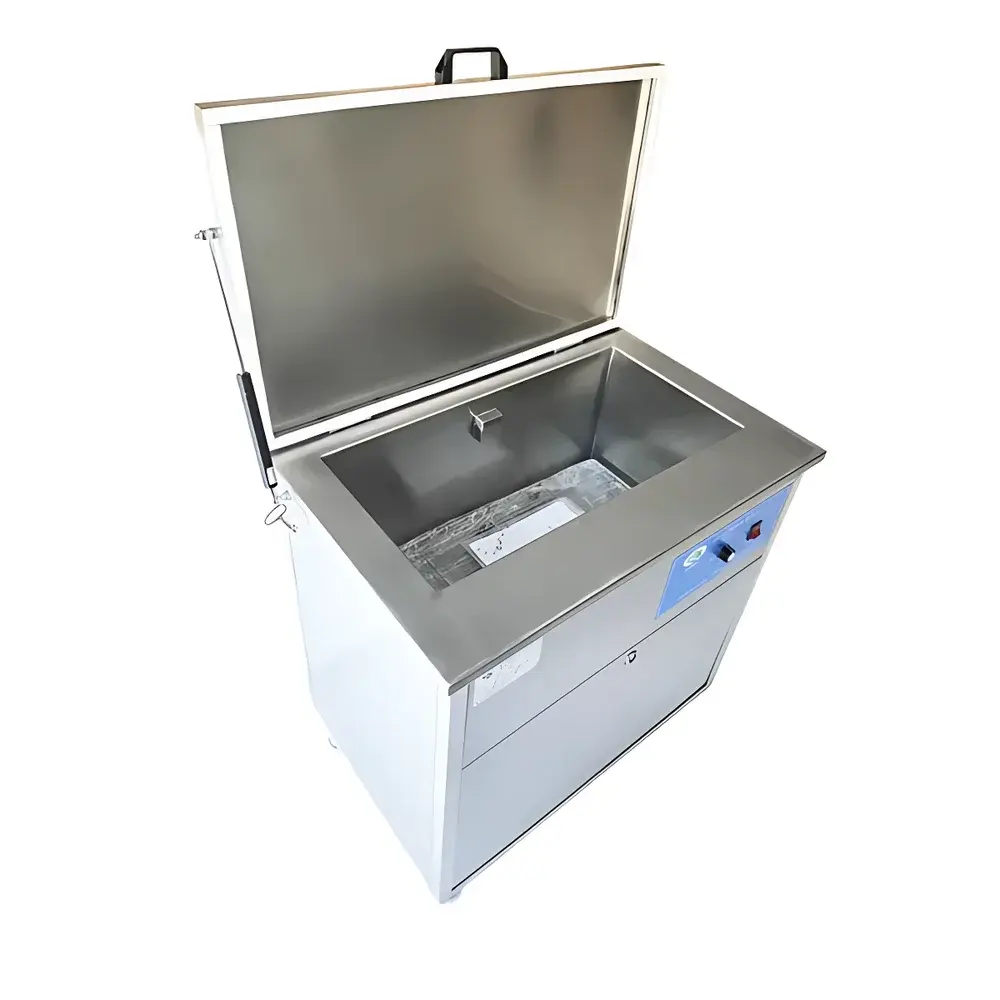
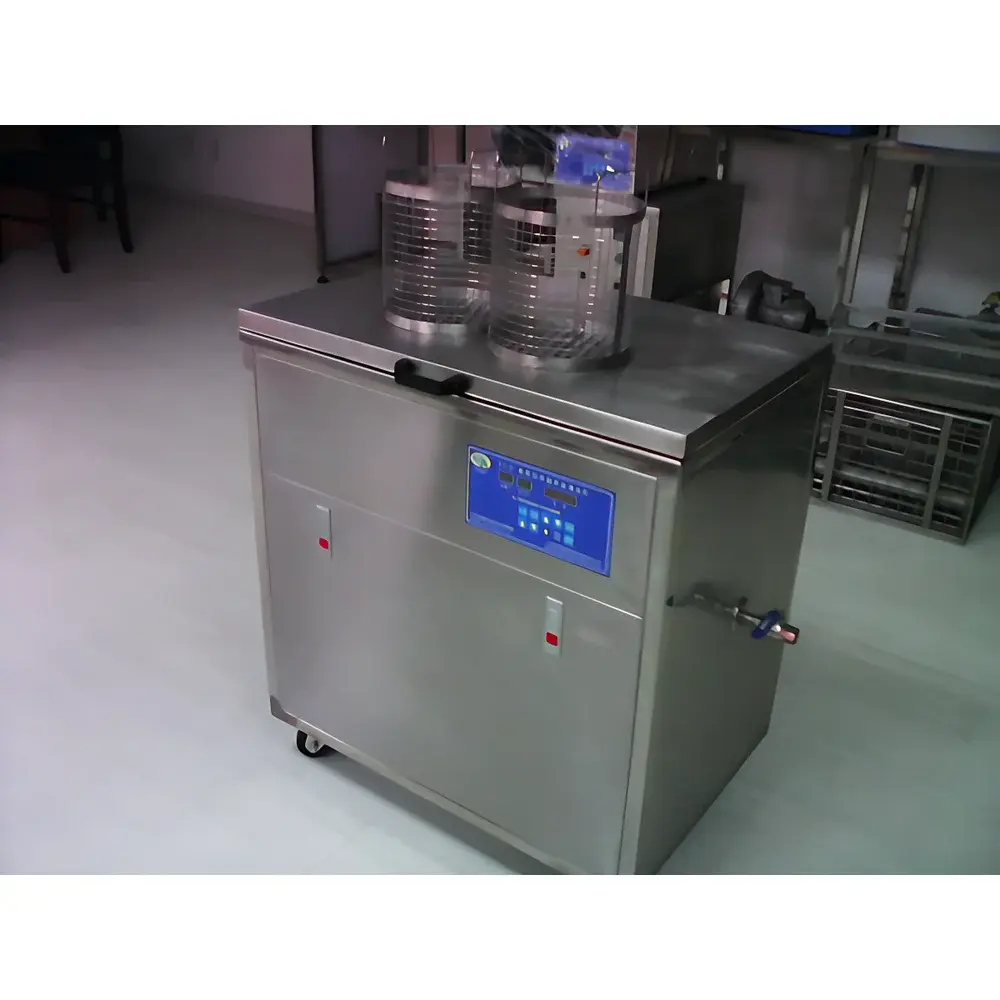
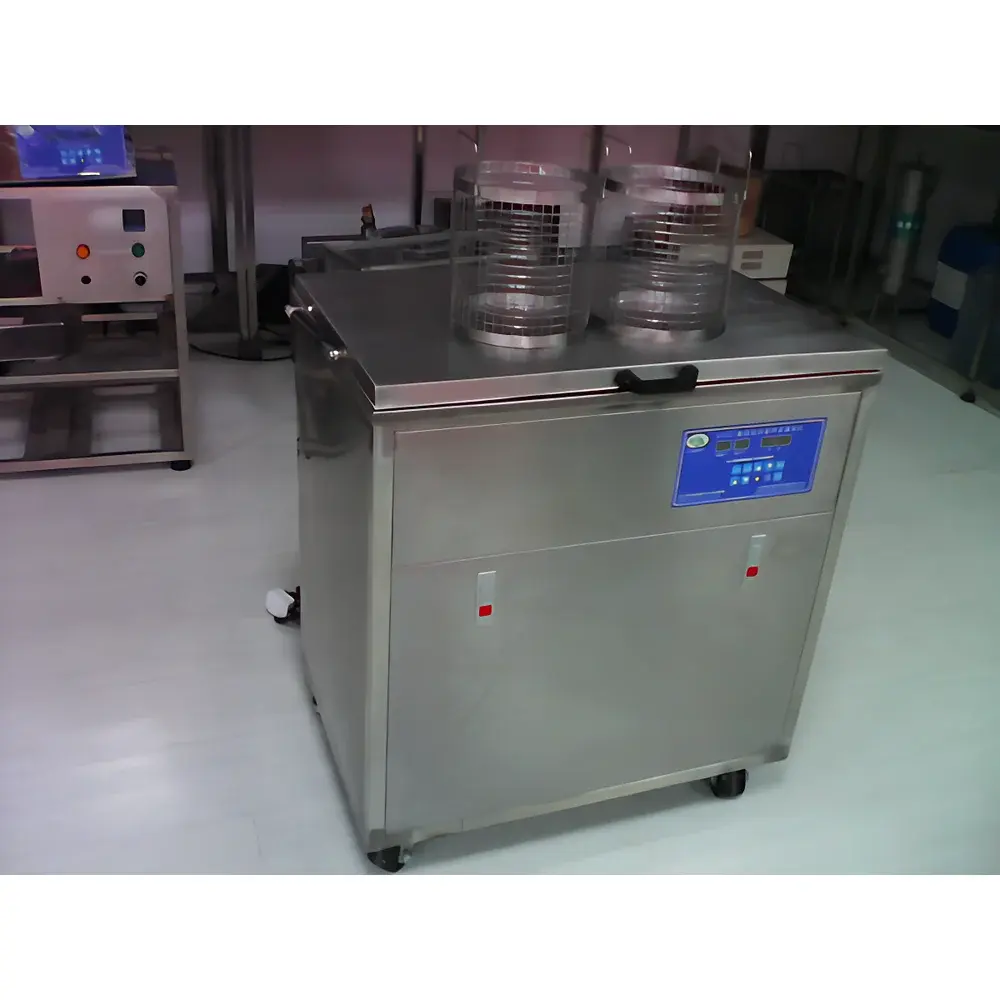
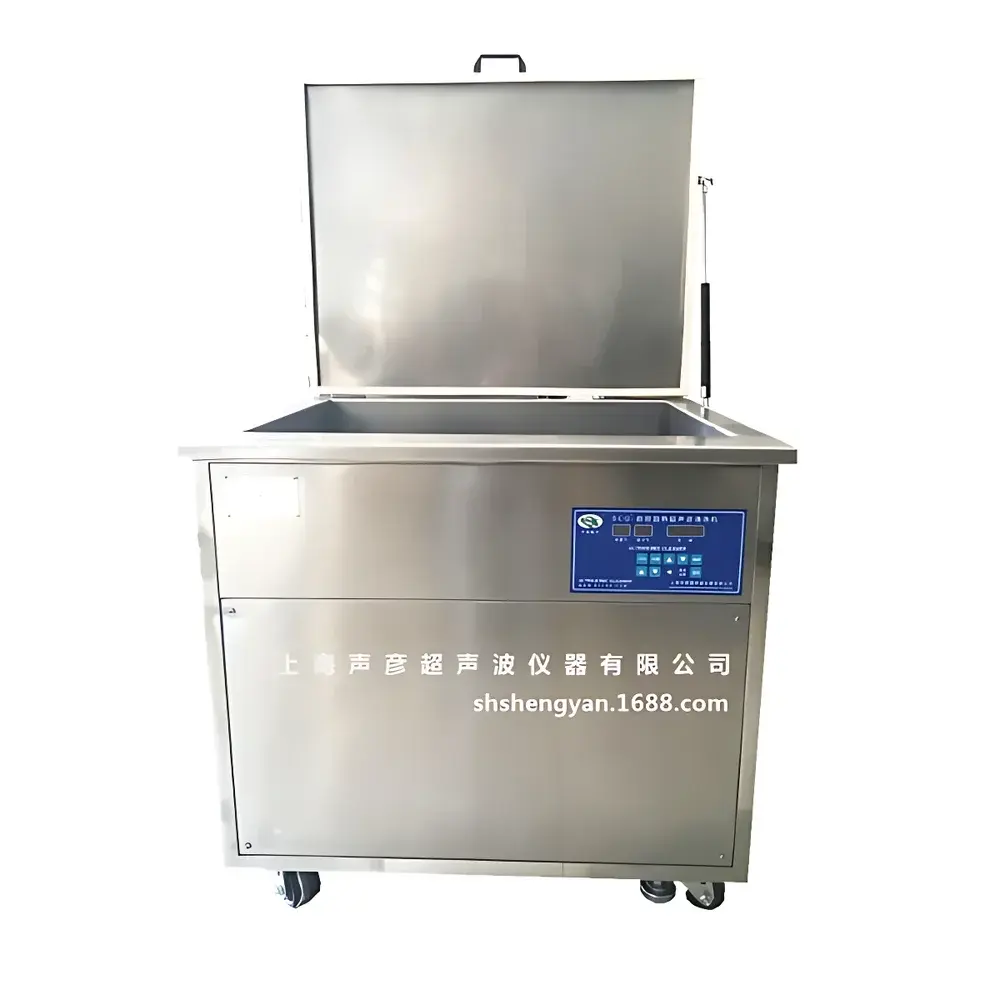
Shengyan SCQ-1000B Tri-Sided Ultrasonic Cleaner
| Brand | Shengyan Ultrasonics (SYCS) |
|---|---|
| Origin | Shanghai, China |
| Model | SCQ-1000B Tri-Sided Vibration |
| Tank Capacity | 54 L |
| Ultrasonic Frequency | 29 kHz |
| Ultrasonic Power Output | 2800 W |
| Adjustable Power | No |
| Temperature Range | Ambient to 80 °C |
| Heating Power | 1200 W |
| Timer Range | 1–600 min |
| Sound-Dampening Lid | Included |
| Manual Fill/Drain | Yes |
| Tank Dimensions (L×W×H) | 600 × 300 × 300 mm |
| Tank Material | SUS316L Stainless Steel |
| Power Supply | 220 V / 50 Hz |
Overview
The Shengyan SCQ-1000B Tri-Sided Ultrasonic Cleaner is an industrial-grade benchtop ultrasonic cleaning system engineered for high-efficiency, reproducible removal of particulate, organic, and inorganic contaminants from complex geometries. It operates on the principle of acoustic cavitation: a 29 kHz high-power ultrasonic generator drives piezoelectric transducers mounted on three internal tank walls (front, left, and right), generating uniform longitudinal pressure waves throughout the cleaning bath. These waves induce transient microcavitation—formation, growth, and implosive collapse of vacuum bubbles in the liquid medium—producing localized shockwaves exceeding 1000 atm. This physical mechanism enables deep penetration into blind holes, threaded features, microchannels, and porous substrates without mechanical abrasion or thermal degradation. Unlike lower-frequency units optimized for heavy-duty degreasing, the 29 kHz frequency balances energy density and bubble collapse intensity, making it particularly effective for precision components requiring both aggressive soil removal and surface integrity preservation.
Key Features
- Tri-sided transducer array ensures homogeneous energy distribution across the full 54 L working volume, minimizing standing wave nodes and dead zones commonly observed in single- or dual-sided configurations.
- SUS316L stainless steel tank and chamber construction provides exceptional resistance to corrosion from aqueous, alkaline, acidic, and mild solvent-based cleaning solutions—critical for long-term stability in QC labs and R&D environments handling diverse sample matrices.
- Digital microprocessor control system with real-time display of elapsed time, set time (1–600 min), bath temperature (ambient to 80 °C), and actual temperature; supports programmable heating ramping and hold functions.
- Integrated safety architecture includes over-temperature, over-current, and low-water-level detection with automatic shutdown and visual alarm indicators—compliant with IEC 61010-1 requirements for laboratory electrical equipment.
- Sound-dampening lid reduces ambient noise to ≤65 dB(A) at 1 m distance, supporting ISO 140-4-compliant acoustic management in shared laboratory spaces.
- Stainless steel mesh basket included for secure part suspension; manual drain valve and fill port facilitate rapid solution exchange between cleaning cycles.
Sample Compatibility & Compliance
The SCQ-1000B accommodates a broad range of substrates including stainless steel, titanium, silicon wafers, optical glass, ceramic filters, polymer injection molds, and medical-grade alloys. Its non-contact cleaning action preserves dimensional tolerances and surface finish (Ra < 0.2 µm) on machined, polished, or coated parts. The unit meets general-purpose laboratory safety standards per IEC 61010-1 and supports GLP-aligned documentation through its digital timer and temperature logging capability. While not certified to FDA 21 CFR Part 11 out-of-the-box, audit trails for time/temperature settings can be manually recorded for traceability in regulated environments (e.g., ISO 13485-certified device manufacturing or USP compounding support). It is routinely deployed in accordance with ASTM D2603 (ultrasonic cleaning validation for electronic assemblies) and ISO 14001 environmental management protocols due to its closed-loop operation and absence of volatile organic compound emissions.
Software & Data Management
The SCQ-1000B employs embedded firmware based on a dedicated 8-bit microcontroller architecture—no external PC interface or proprietary software required. All operational parameters are stored in non-volatile memory, retaining user-defined settings (timer duration, target temperature) across power cycles. The front-panel LCD displays cumulative operating hours—a maintenance indicator aligned with preventive service intervals recommended by transducer manufacturers (typically every 5,000–8,000 hours). Though lacking Ethernet or USB connectivity, the unit’s deterministic behavior and repeatable parameter recall support SOP-driven workflows in ISO/IEC 17025-accredited testing laboratories where instrument qualification (IQ/OQ) relies on functional verification rather than digital data export.
Applications
This system serves dual roles across analytical and preparative workflows: as a high-throughput cleaning platform for pre-analysis sample preparation (e.g., residue removal from HPLC vials, GC injectors, or ICP-MS nebulizers), and as an extraction/enhancement tool in life science applications. In pharmaceutical development, it accelerates solid-phase extraction cartridge conditioning and dissolution tablet disintegration studies. In materials science, it supports dispersion of nanomaterials (e.g., graphene oxide, metal oxides) prior to TEM grid preparation. Its consistent 29 kHz output enhances cell lysis efficiency in microbial viability assays and improves yield in botanical extraction protocols (e.g., polyphenol recovery from plant matrices) when used with ethanol/water co-solvents. The absence of adjustable power permits standardized method transfer between sites using identical SCQ-series instruments.
FAQ
Is the ultrasonic frequency fixed at 29 kHz, and can it be changed?
Yes—the SCQ-1000B operates exclusively at 29 kHz. Frequency selection is hardware-determined during transducer assembly and cannot be modified post-manufacture.
Does the unit support continuous operation beyond 600 minutes?
No—the maximum timer setting is 600 minutes (10 hours); extended cleaning requires manual reset. Continuous duty cycle is limited to 8 hours per session to maintain transducer thermal stability.
Can deionized water or flammable solvents be used safely?
Deionized water is fully compatible. Flammable solvents (e.g., acetone, ethanol) may only be used in explosion-proof variants—not this model. Always consult the Safety Data Sheet of the cleaning solution prior to use.
What maintenance is required for sustained performance?
Transducer coupling integrity should be verified quarterly via impedance measurement; tank interior must be inspected for pitting or weld seam erosion annually. Replace the heater element if temperature deviation exceeds ±2 °C after calibration.
Is the SUS316L tank suitable for chlorinated alkaline solutions?
Yes—SUS316L offers superior resistance to chloride-induced stress corrosion cracking compared to 304 stainless steel, enabling safe use with sodium hypochlorite or trisodium phosphate-based formulations at temperatures ≤60 °C.



