
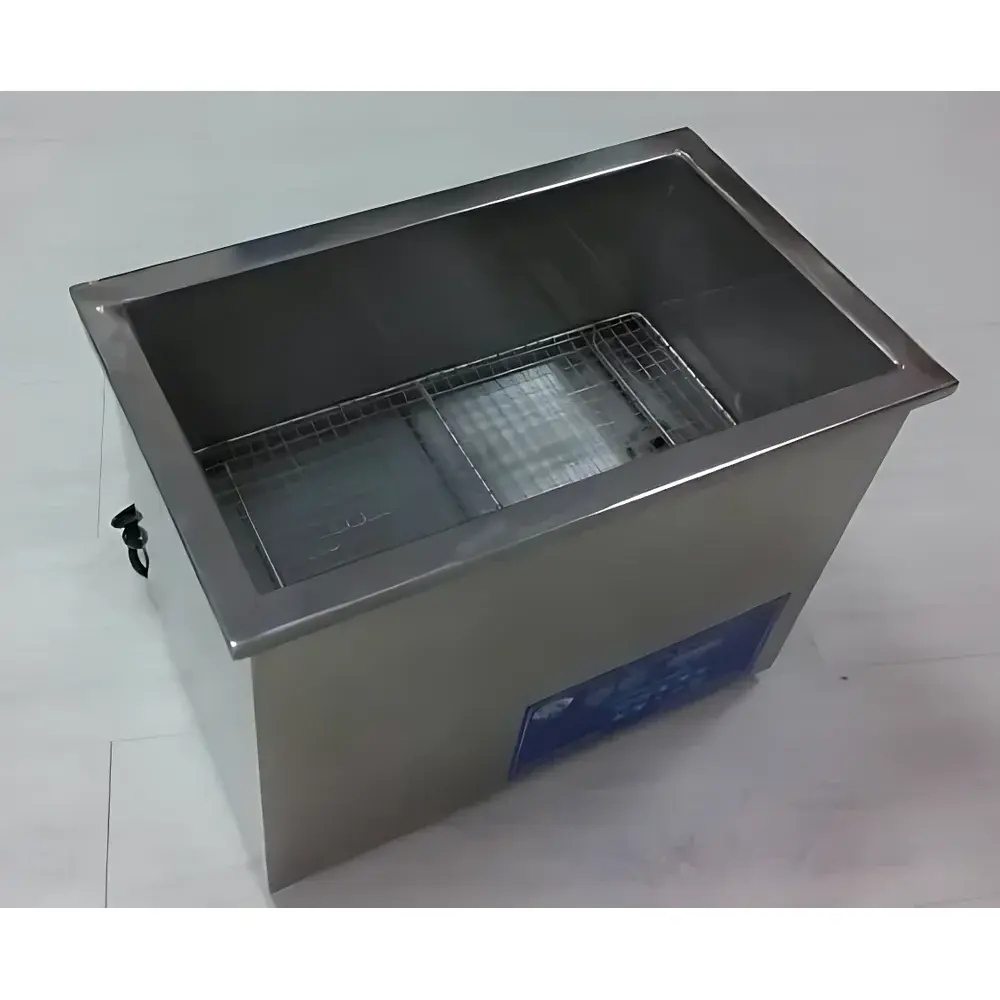
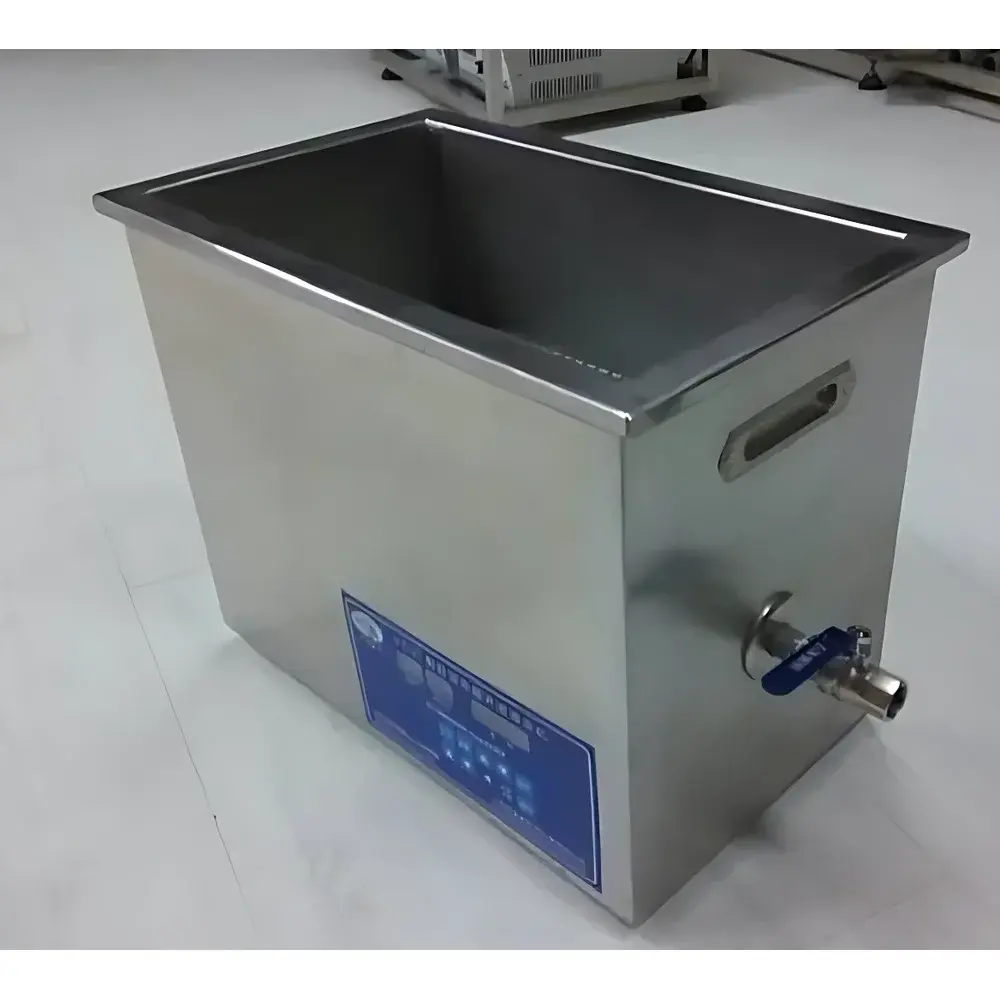
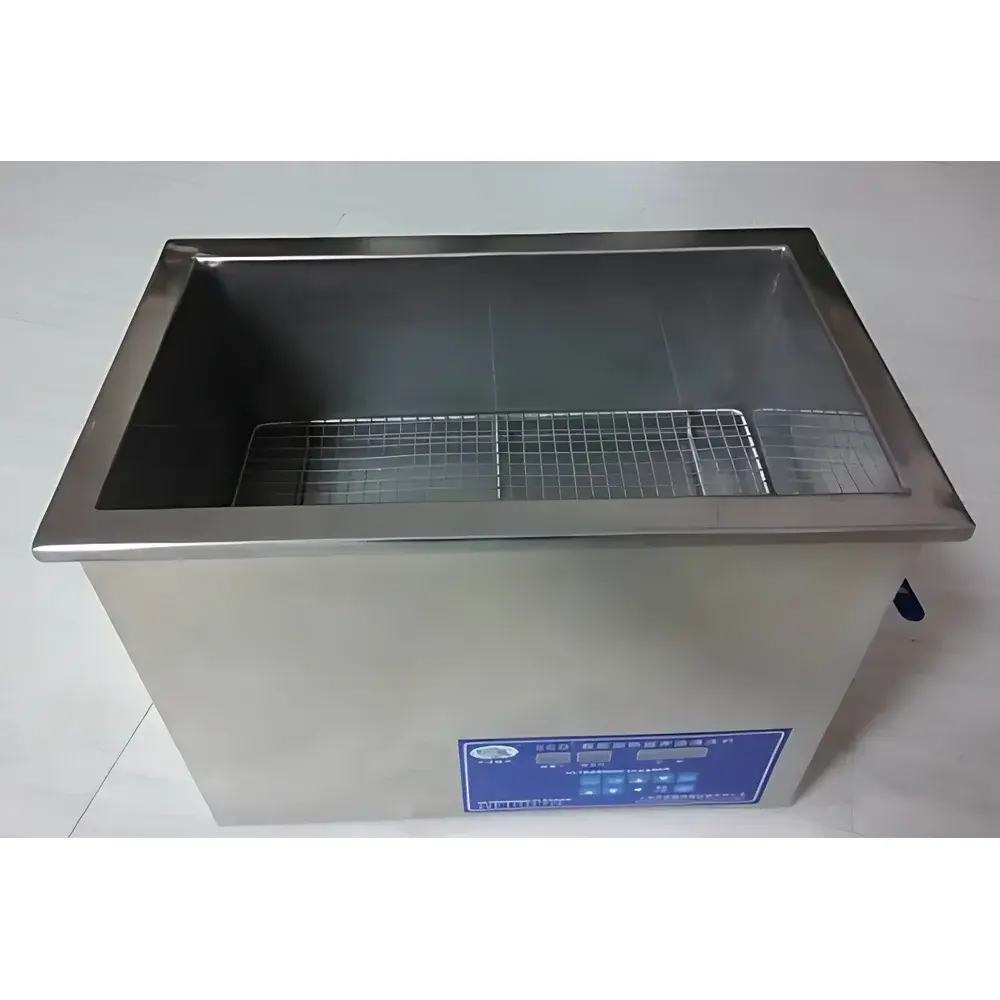
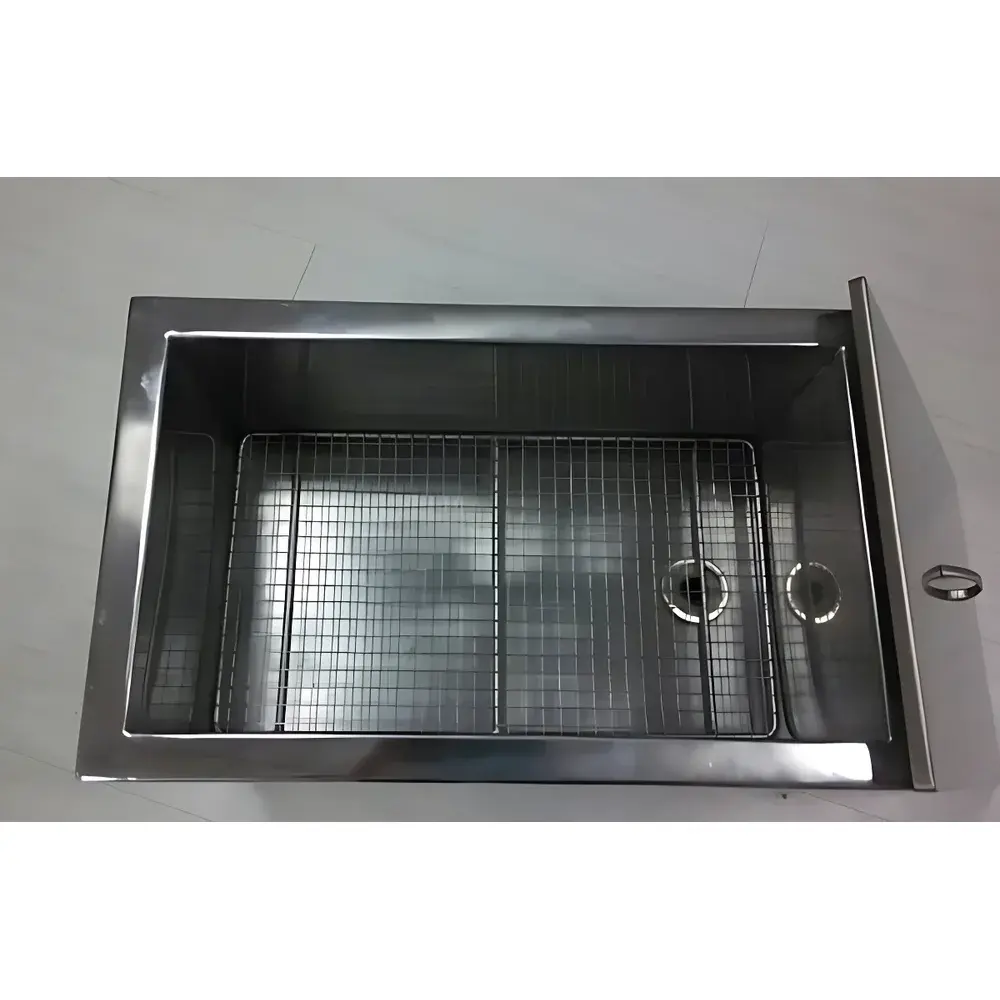
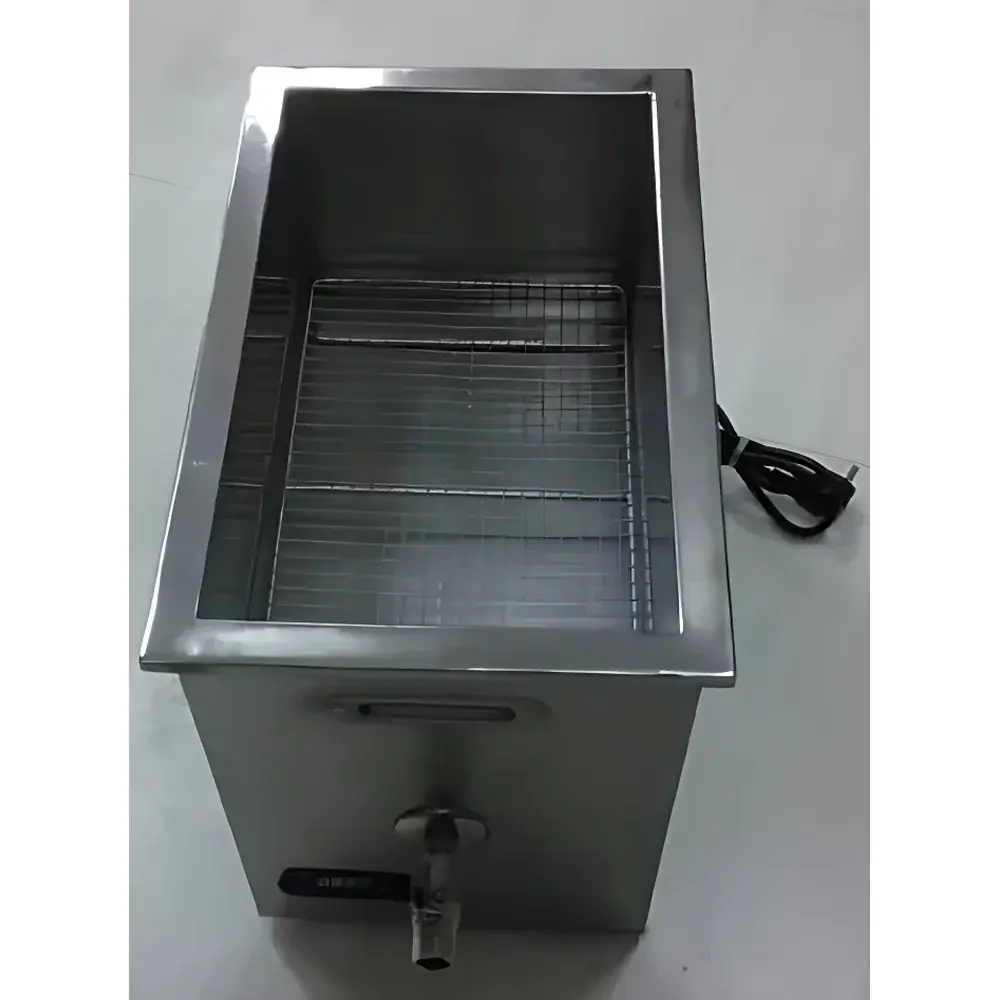
Shengyan SCQ-7201A 18L Digital Ultrasonic Cleaner
| Brand | Shengyan Ultrasonics (SYCS) |
|---|---|
| Origin | Shanghai, China |
| Model | SCQ-7201A |
| Capacity | 18 L |
| Inner Tank Dimensions | 420 × 240 × 180 mm |
| Ultrasonic Frequency Options | 25 kHz / 35 kHz / 40 kHz / 60 kHz (single-frequency selectable) |
| Total Ultrasonic Power | 400 W |
| Power Adjustment | Not adjustable |
| Temperature Control | Not available (ambient operation only) |
| Timer Range | 1–600 min (LED digital countdown, 1-second resolution) |
| Lid | Sound-dampening cover included |
| Drain Valve | Manual hand-controlled valve |
| Construction | SUS304 stainless steel tank and basket (TIG-welded), brushed stainless steel housing |
| Transducer Configuration | Eight 50-W piezoelectric transducers (total 400 W) |
| Electrical Safety | CE-compliant design per IEC 61010-1 |
| Compliance | Designed for laboratory use under ISO/IEC 17025-supportive workflows |
Overview
The Shengyan SCQ-7201A is a benchtop digital ultrasonic cleaner engineered for precision cleaning of delicate and complex components in research laboratories, quality control environments, and industrial R&D settings. It operates on the principle of cavitation—high-frequency acoustic energy (25–60 kHz) induces microscopic bubble formation and implosion within the cleaning fluid, generating localized shear forces that dislodge particulate contaminants, organic residues, and surface films from substrates without mechanical abrasion or dimensional alteration. Unlike immersion or agitation-based methods, ultrasonic cleaning achieves uniform decontamination across recessed features—including blind holes, microchannels, threaded surfaces, and porous matrices—making it indispensable for applications demanding high surface integrity and reproducible cleanliness levels. The SCQ-7201A is configured for ambient-temperature operation only, eliminating thermal stress risks for temperature-sensitive samples such as polymers, biological specimens, or coated optics.
Key Features
- 18-liter capacity stainless steel tank (SUS304, TIG-welded) with corrosion-resistant finish and leak-proof integrity for long-term chemical compatibility with aqueous and mild solvent-based solutions.
- Digital timer with LED display offering precise 1–600 minute control in 1-second increments; programmable for repeatable cycle execution and process documentation.
- Single-frequency selection from four calibrated operating bands (25 kHz, 35 kHz, 40 kHz, or 60 kHz) to optimize cleaning efficacy for specific contaminant types and substrate geometries—e.g., lower frequencies for heavy particulates, higher frequencies for sub-micron residue removal.
- Eight high-efficiency piezoelectric transducers (50 W each, total 400 W output) mounted on the tank bottom, delivering uniform energy distribution and minimizing standing-wave interference.
- Integrated sound-dampening lid reduces ambient noise emission to ≤65 dB(A) at 1 m distance, supporting compliance with occupational health guidelines (OSHA 29 CFR 1910.95).
- Manual drain valve enables controlled fluid disposal without tilting or lifting the unit—critical for containment of hazardous or regulated cleaning media.
- PCB board conformal coating provides moisture and chemical resistance, extending service life in humid or chemically aggressive lab environments.
Sample Compatibility & Compliance
The SCQ-7201A accommodates a broad range of sample formats—including glassware (vials, cuvettes, pipettes), metal components (calibration standards, surgical tools), ceramic substrates, and polymer-based devices—provided they are compatible with ultrasonic exposure and the selected cleaning solution. Its SUS304 construction meets material requirements for ISO 15190:2020 (laboratory safety) and supports GLP-aligned cleaning validation protocols. While not certified for medical device reprocessing (per ISO 17664 or AAMI ST91), it is routinely employed in pre-sterilization cleaning steps where residual bioburden reduction is required. The unit’s fixed-frequency architecture and absence of heating or power modulation preclude use in thermally sensitive applications governed by USP or ASTM E2877-22 (ultrasonic cleaning validation).
Software & Data Management
This model operates via embedded microcontroller logic with no external software dependency. All operational parameters—including elapsed time, remaining cycle duration, and frequency selection—are displayed on a high-contrast LED interface. The absence of network connectivity, data logging, or audit trail functionality aligns with its designation as a general-purpose instrument under ISO/IEC 17025 Clause 6.4.1 (equipment verification). Users performing validated cleaning processes may manually record cycle parameters in laboratory notebooks or electronic lab notebooks (ELNs) to satisfy traceability requirements under FDA 21 CFR Part 11 when used in regulated environments.
Applications
- Removal of machining oils, oxides, and polishing compounds from precision metrology tools and calibration artifacts.
- Cleaning of HPLC columns, GC injectors, and spectrophotometer cuvettes prior to analytical measurement.
- Decontamination of reusable cell culture flasks, centrifuge tubes, and electrophoresis combs in molecular biology workflows.
- Preparation of semiconductor wafers and MEMS devices for lithography or bonding steps.
- Extraction support in analytical chemistry: aiding solvent-based analyte release from solid matrices during sample prep.
- Cell disruption and nanoparticle dispersion in nanomaterial synthesis protocols (subject to protocol-specific power and duration optimization).
FAQ
Is the SCQ-7201A suitable for cleaning delicate optical lenses or coated sensors?
Yes—when operated at 40 kHz or 60 kHz with low-surface-tension aqueous detergents and appropriate rinse protocols, it minimizes risk of coating damage while achieving >99% particle removal efficiency for ≥5 µm contaminants.
Can this unit be integrated into an automated lab workflow?
No—it lacks RS-232, USB, or Ethernet interfaces; integration requires external relay-based control of the power-on signal and manual timer initiation.
Does the unit include a degassing function?
No—degassing must be performed separately using vacuum or static soak prior to ultrasonic activation to ensure optimal cavitation efficiency.
What cleaning solutions are compatible with the SUS304 tank?
Neutral pH aqueous detergents (e.g., Alconox®, Liquinox®), ethanol/water mixtures (5%), or alkaline solutions >pH 12 to prevent passive layer degradation.
Is calibration or performance verification required before use?
Per ISO 13076:2012, users should verify cavitation intensity annually using aluminum foil erosion test or hydrophone-based power mapping, especially when used in validated cleaning procedures.



