
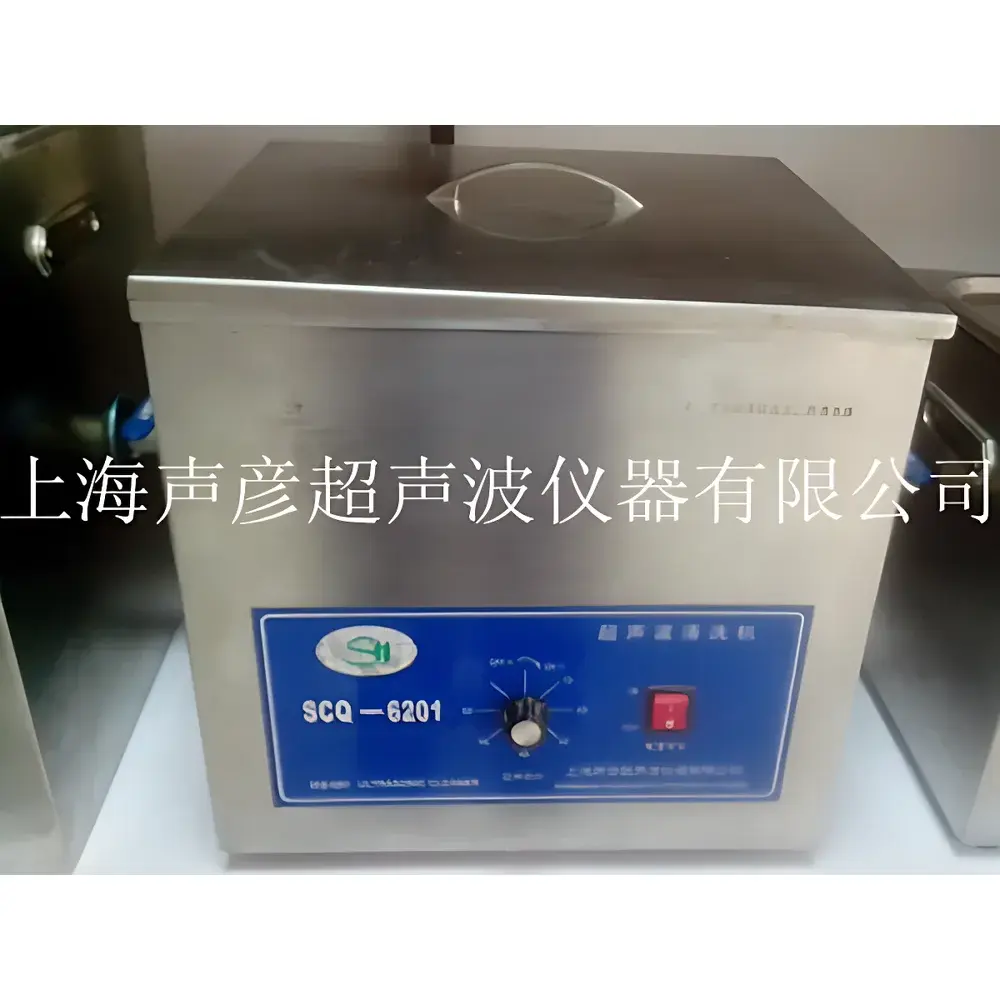
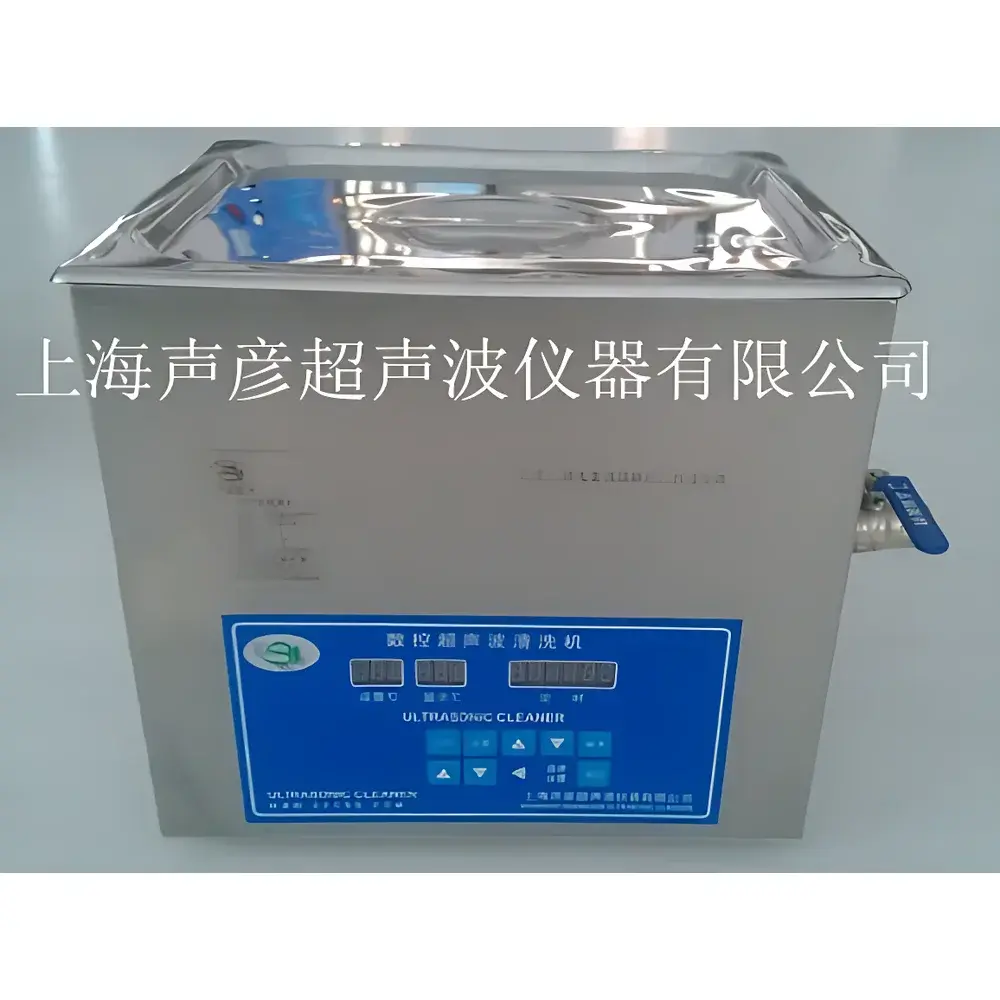
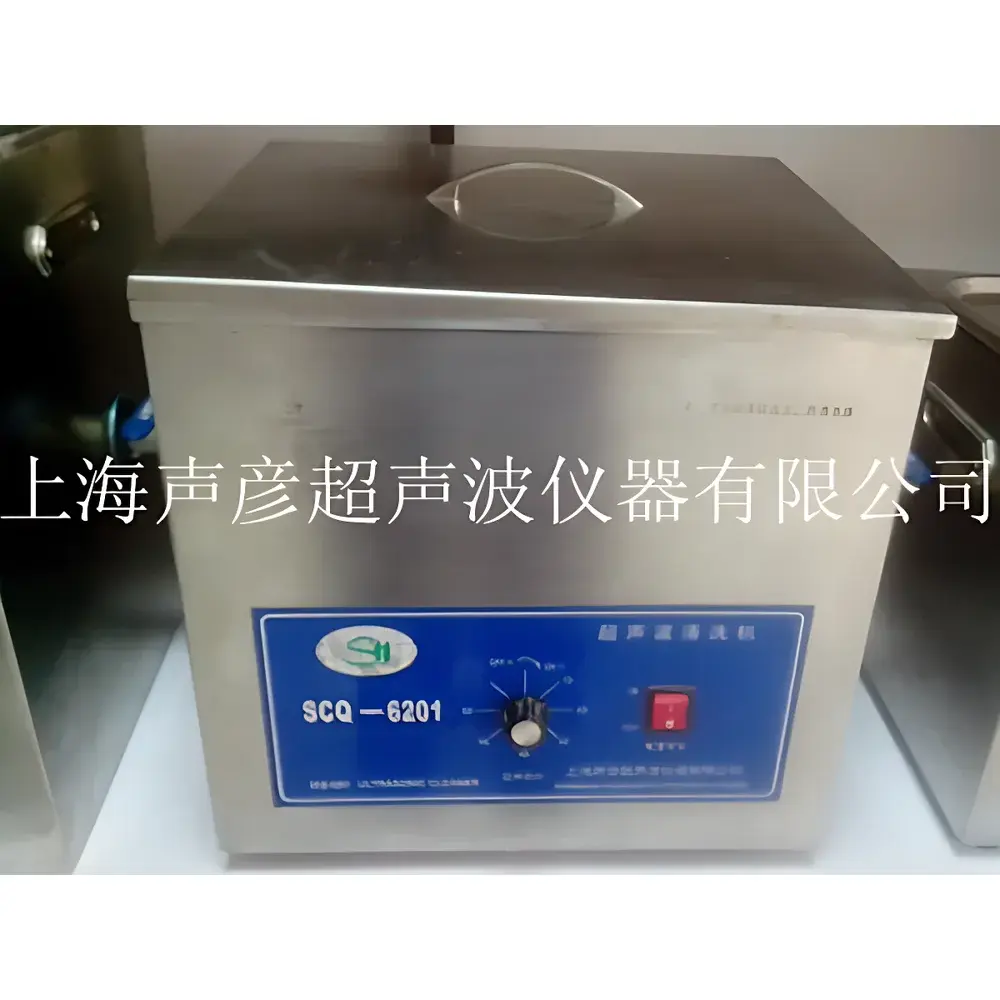
SYCS SCQ-131023 Five-Sided Vibration Dual-Frequency Ultrasonic Cleaner
| Brand | SYCS |
|---|---|
| Origin | Shanghai, China |
| Model | SCQ-131023 |
| Capacity | 6 L |
| Ultrasonic Frequency | 20 / 40 kHz (switchable) |
| Total Ultrasonic Power | 500 W (five-sided transducer array) |
| Heating Power | 300 W |
| Temperature Range | Ambient to 80 °C |
| Timer Range | 1–600 min (digital, 1-s resolution) |
| Tank Dimensions (L×W×H) | 300 × 150 × 150 mm |
| Tank Material | SUS304 stainless steel, 2.0 mm wall thickness |
| Lid | Sound-dampening cover included |
| Drain/Inlet | Manual valve control |
| Power Supply | AC 220 V, 50 Hz |
| Safety Protections | Overvoltage, overcurrent, and output short-circuit protection |
| Frequency Tracking | Automatic frequency tracking with fine-tuning capability |
| Power Adjustment | 10–100% continuous ultrasonic power regulation |
Overview
The SYCS SCQ-131023 is a high-performance dual-frequency ultrasonic cleaner engineered for laboratories and industrial quality control environments requiring reproducible, residue-free cleaning of precision components. It operates on the principle of cavitation-induced acoustic streaming—where alternating high- and low-pressure cycles generated by piezoelectric transducers at 20 kHz and 40 kHz induce microbubble formation and collapse in aqueous or solvent-based cleaning media. The five-sided vibration architecture—featuring transducers mounted on the bottom and all four vertical walls—ensures uniform energy distribution across the entire tank volume, eliminating dead zones and significantly enhancing cleaning efficacy for complex geometries, blind holes, and microstructured surfaces. Unlike conventional single-frequency units, the SCQ-131023 allows real-time switching between 20 kHz (optimized for heavy particulate removal and macro-contaminants) and 40 kHz (suited for delicate substrates and sub-micron particle detachment), enabling process optimization without hardware modification.
Key Features
- Five-sided transducer array delivering 500 W total ultrasonic output with spatially balanced energy coupling into the cleaning bath.
- Dual-frequency operation (20 kHz / 40 kHz) with manual switchable mode and automatic frequency tracking to maintain resonance under varying load and temperature conditions.
- SUS304 stainless steel tank and housing (2.0 mm wall thickness), fully compliant with ISO 15190:2020 laboratory equipment material requirements for corrosion resistance and cleanability.
- Digital timer with 1-second resolution (1–600 minutes), supporting extended batch processing and GLP-compliant documentation via external logging interfaces.
- Integrated heating system (300 W) with PID-controlled thermal regulation from ambient to 80 °C—compatible with aqueous alkaline, acidic, and enzymatic cleaning formulations.
- Sound-dampening lid meeting ISO 11201:2010 noise emission standards for laboratory environments (measured ≤ 68 dB(A) at 1 m).
- Modular design: Separated ultrasonic generator and tank assembly connected via shielded high-frequency cable—facilitating maintenance, calibration, and electromagnetic compatibility (EMC) compliance per IEC 61326-1.
Sample Compatibility & Compliance
The SCQ-131023 accommodates standard laboratory glassware (e.g., volumetric flasks, centrifuge tubes, Petri dishes), metallic calibration standards, optical lenses, semiconductor wafers (up to 6-inch diameter), and medical-grade stainless steel instruments. Its non-contact cleaning mechanism avoids mechanical abrasion and preserves surface integrity—including Ra < 0.2 µm finishes and thin-film coatings. The unit meets essential safety and performance benchmarks: CE marking (2014/30/EU EMC Directive and 2014/35/EU LVD Directive), RoHS 2011/65/EU, and conforms to ASTM D2603–21 for ultrasonic cleaning validation methodology. For regulated environments, optional audit-trail-capable firmware supports 21 CFR Part 11-compliant electronic records when integrated with validated LIMS platforms.
Software & Data Management
While the SCQ-131023 operates via an intuitive front-panel interface, its embedded controller supports RS-232 and optional USB-to-serial connectivity for remote parameter configuration and event logging. Time-stamped operational data—including actual temperature, elapsed cycle time, frequency mode, and power level—is exportable as CSV for traceability. Firmware updates are performed via secure signed binaries, and system diagnostics include transducer impedance monitoring and thermal derating alerts. When deployed in GMP or ISO/IEC 17025-accredited labs, the device supports IQ/OQ documentation packages aligned with USP Analytical Instrument Qualification guidelines.
Applications
This cleaner serves critical pre-analytical and post-processing functions across multiple sectors: removal of machining oils and oxides from metrology tools (ASTM E1157); decontamination of HPLC autosampler vials and GC injectors; cleaning of MEMS sensors prior to packaging; sterilization-prep of endoscopic components (EN ISO 15883-1); residue-free debonding of photomasks in lithography workflows; and consistent preparation of TEM grids for electron microscopy. In biopharmaceutical QC, it enables validated cleaning of stainless-steel sampling probes used in bioreactor effluent analysis—reducing carryover risk below 10 ppb for proteinaceous residues.
FAQ
Is the ultrasonic power adjustable during operation?
Yes—the unit features continuous 10–100% power regulation via front-panel potentiometer, allowing dynamic optimization for sensitive substrates or viscous cleaning solutions.
Can this unit be used with flammable solvents?
No—it is designed exclusively for aqueous and water-miscible solutions. Use with organic solvents requires explosion-proof certification not provided with this model.
Does the timer support repeat-cycle programming?
No—each run is single-sequence; however, the digital timer retains last-used settings for rapid reinitiation.
What is the maximum recommended fill level for optimal cavitation?
For consistent performance, maintain liquid level between 30 mm below the tank rim and 10 mm above the transducer mounting plane (i.e., 100–140 mm depth).
Is calibration documentation available?
Factory calibration certificates (temperature accuracy ±0.5 °C, timer deviation < ±0.1%) are supplied with each unit; field recalibration services are available through authorized SYCS service centers.



