
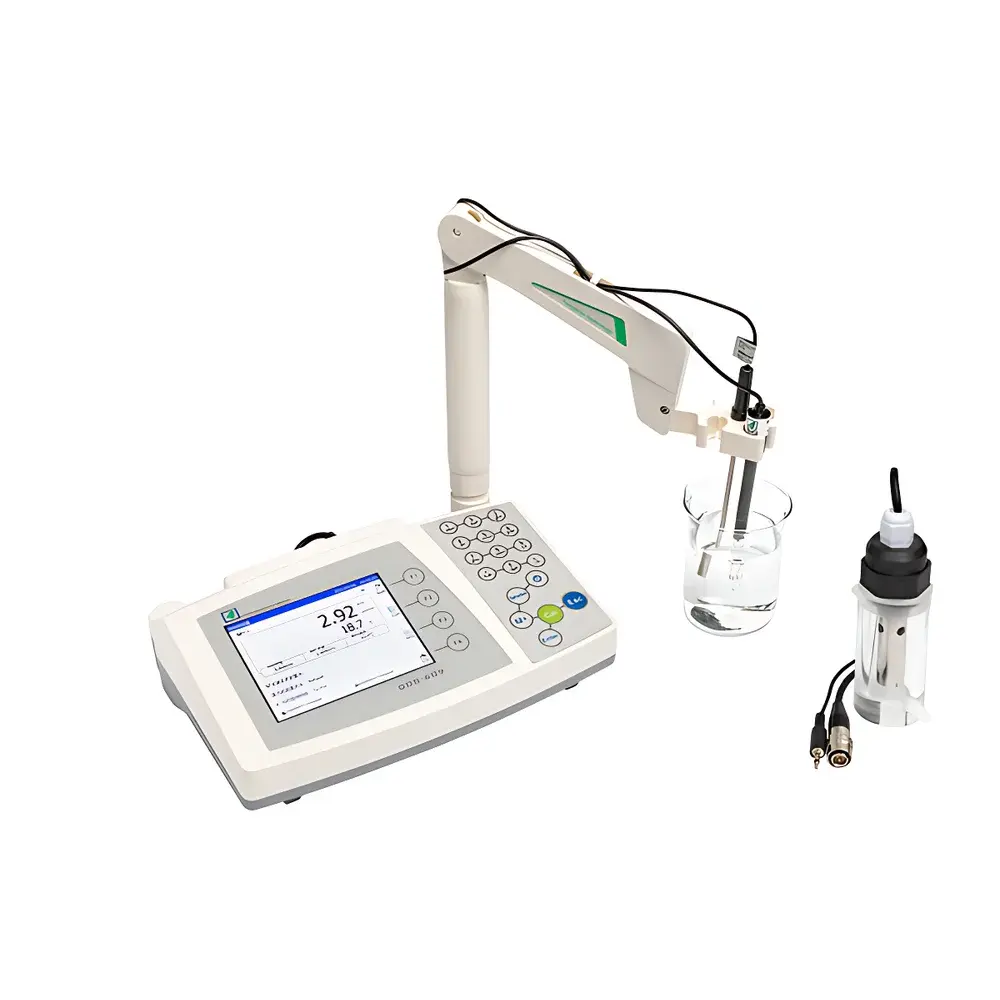
FangZhou DDS-609 Benchtop Conductivity Meter for Purified Drinking Water
| Brand | FangZhou |
|---|---|
| Origin | Sichuan, China |
| Manufacturer Type | Authorized Distributor |
| Product Category | Domestic |
| Model | DDS-609 Purified Water Conductivity Meter |
| Detection Parameters | Multi-parameter (Conductivity, Resistivity, TDS, Salinity, Conductive Ash, Temperature) |
| Portability | Benchtop |
| Application Environment | Laboratory |
| Conductivity Range | (0–2×10⁵) µS/cm |
| TDS Range | (0.00–300.0) g/L |
| Resistivity Range | (5.00–10⁸) Ω·cm |
| Salinity Range | (0.00–80.00) ppt |
| Temperature Range | (−25.0–135.0) °C |
| Accuracy | ±0.5% FS |
| Minimum Resolution | 0.0001 µS/cm |
Overview
The FangZhou DDS-609 is a high-precision benchtop conductivity meter engineered specifically for quality control and compliance verification of purified and ultrapure drinking water in regulated laboratory environments. It operates on the principle of two-electrode or four-electrode conductometric measurement, where electrical conductance across a defined cell geometry is converted into quantitative parameters—conductivity (µS/cm), resistivity (Ω·cm), total dissolved solids (TDS, g/L), salinity (ppt), conductive ash (%), and temperature (°C)—all traceable to NIST-traceable reference standards. Designed for ISO/IEC 17025-accredited labs and pharmaceutical QC facilities, the instrument meets core requirements for monitoring USP , ASTM D1125, ISO 7888, and GB/T 11017 (Chinese standard for drinking water purity). Its architecture supports rigorous metrological traceability, with built-in diagnostics, audit-ready data logging, and full GLP/GMP alignment—including user authentication, method versioning, electrode lifecycle tracking, and electronic signature readiness.
Key Features
- 8-range auto-ranging conductivity measurement with seamless switching between 0.0000–0.2000 µS/cm (DJS=0.01 cm⁻¹) and 200.0–2000 mS/cm (DJS=10 cm⁻¹), enabling accurate detection from ultrapure water (≥18.2 MΩ·cm) to concentrated brines;
- Multi-parameter simultaneous display: real-time conductivity, resistivity, TDS (with adjustable coefficient 0.2–1.00), salinity, conductive ash, and temperature—with selectable reference temperature (15.0–25.0 °C) and linear/non-linear temperature compensation;
- Comprehensive electrode management system: stores electrode ID, calibration history, DJS constant, last calibration timestamp, and status (e.g., “calibrated”, “expired”, “out-of-spec”); supports interchangeable electrodes with DJS = 0.01, 0.1, 1.0, or 10.0 cm⁻¹;
- Regulatory-grade software architecture: 1000-user role-based access control with password enforcement, 1000 customizable measurement methods, embedded 10 certified conductivity standards (including ASTM D1125, ISO 7888, and GB/T 6682), plus one user-defined standard;
- Full GLP-compliant data handling: time/date-stamped records with operator ID, sample ID, electrode ID, method ID, environmental conditions, and diagnostic flags; storage capacity ≥100,000 datasets (expandable to >1 million via internal flash memory);
- Dual communication interfaces: isolated RS-232 port for legacy lab network integration and USB-B interface for direct PC connection—enabling export to Excel, Word, or CSV in Simple, Standard, or full GLP report formats (including audit trail metadata).
Sample Compatibility & Compliance
The DDS-609 is validated for use with Type I–III laboratory water (per ISO 3696 and GB/T 6682), USP Purified Water and Water for Injection (WFI), and SEMI-standard electronic-grade water (EW-I to EW-III). Its non-linear temperature compensation algorithm accommodates the non-Arrhenius behavior of ultrapure water below 10 µS/cm, ensuring accuracy across −25.0 to 135.0 °C. The instrument complies with IEC 61010-1 (safety), EN 61326-1 (EMC), and supports 21 CFR Part 11 readiness through optional secure login, electronic signatures, and immutable audit logs. All calibration events are timestamped and linked to certified reference solutions, satisfying internal QA audits and external inspections by CNAS, FDA, or EMA.
Software & Data Management
Firmware v3.2+ includes an embedded database engine supporting hierarchical data organization by sample batch, operator, method, and date range. Data retrieval is enabled via on-device search (by sample name, ID, or timestamp), or remote pull via PC software with ODBC connectivity. Statistical functions include mean, SD, RSD, min/max, trend analysis, and pass/fail flagging against configurable limits. Exported reports embed full metrological context: calibration certificates, electrode drift history, environmental deviation alerts, and instrument self-diagnostics (e.g., open-circuit detection, temperature sensor validation). All stored data retain integrity during power loss via EEPROM-backed write protection.
Applications
- Pharmaceutical water system validation (PW, WFI, Pure Steam condensate);
- Monitoring reverse osmosis (RO), EDI, and polishing loop performance in biotech cleanrooms;
- QC release testing of bottled drinking water per GB 5749 and EU Directive 2020/2184;
- Electronics manufacturing: semiconductor rinse water purity verification (SEMI F57, F68);
- Environmental labs performing surface/groundwater baseline characterization under EPA Method 120.1;
- Academic research requiring trace-level ion quantification in low-conductivity matrices.
FAQ
Does the DDS-609 support non-linear temperature compensation for ultrapure water?
Yes—it implements the DIN 38404-4 and ISO 7888 polynomial algorithm for accurate resistivity correction below 10 µS/cm.
Can calibration data be exported with traceability to national standards?
Yes—each calibration record includes solution lot number, expiration date, certified value, uncertainty, and certifying body (e.g., NIM, NIST, or LGC).
Is the instrument compatible with LIMS integration?
Yes—RS-232 output supports ASTM E1384 and HL7-formatted ASCII streams for direct ingestion into major LIMS platforms.
What is the maximum allowable electrode cable length for stable readings?
For DJS=0.01 cm⁻¹ cells, maximum shielded cable length is 5 m; for DJS=1.0 cm⁻¹, up to 15 m with optional active shielding.
How does the system enforce data integrity during power interruption?
All measurements and calibrations are written to non-volatile flash memory with atomic write operations and cyclic redundancy checksums (CRC-32).






