
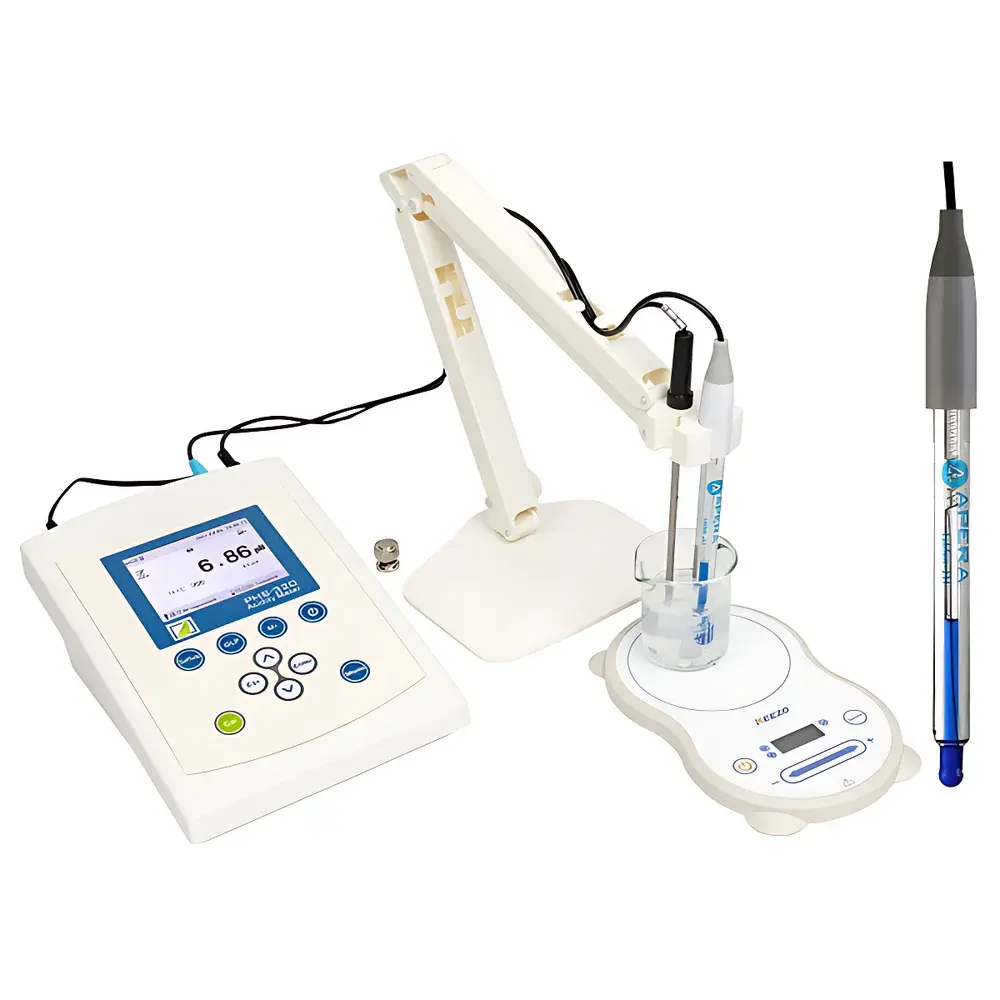
FangZhou PHS-320 Viscous Sample pH Meter
| Brand | FangZhou |
|---|---|
| Origin | Sichuan, China |
| Manufacturer Type | Authorized Distributor |
| Product Category | Domestic |
| Model | PHS-320 Viscous Sample pH Meter |
| Instrument Type | Multifunctional |
| Parameter Types | pH, mV, Rel.mV, ORP, ISE, Temperature |
| Measurement Accuracy | ±0.002 pH |
| pH Range | (−5.000 to 20.000) pH |
| Resolution | 0.001 / 0.01 / 0.1 pH (user-selectable) |
| Calibration Standards | NIST-traceable buffers |
| Input Impedance | ≥3 × 10¹² Ω |
| Temperature Compensation | Automatic (ATC) or Manual (−20.0 to 135.0 °C) |
| Data Storage | ≥100,000 entries |
| GLP Compliance | Full audit trail, sample/analyst ID, timestamping, calibration history |
| Connectivity | RS232 with printer export, PC data transfer (Excel/Word/Notepad), bidirectional control |
Overview
The FangZhou PHS-320 Viscous Sample pH Meter is a microprocessor-controlled, high-precision electrochemical analyzer engineered for rigorous laboratory and industrial quality control environments. It operates on the fundamental principle of potentiometric measurement: detecting the electromotive force (EMF) generated at the interface between a glass pH electrode and the test solution, referenced against a stable internal Ag/AgCl reference system. Designed specifically for challenging matrices—including viscous gels, emulsions, suspensions, and low-conductivity samples—the instrument integrates advanced electrode diagnostics, adaptive signal conditioning, and robust input impedance (>3 × 10¹² Ω) to minimize junction potential drift and ensure stable readings in high-resistance media. Its extended pH range (−5.000 to 20.000) supports measurements beyond conventional aqueous systems, such as strongly alkaline cleaning agents or acidic catalyst slurries. The PHS-320 meets the functional requirements of ISO/IEC 17025-accredited laboratories and aligns with key regulatory expectations for analytical instrumentation under GLP and GMP frameworks.
Key Features
- True-color TFT LCD display with graphical real-time trend visualization and intuitive menu navigation
- User-selectable resolution: 0.001 pH (high-precision mode), 0.01 pH (standard QC), or 0.1 pH (rapid screening)
- Five-point auto-identification calibration using up to 33 NIST-traceable or internationally recognized buffer standards (DIN, JIS, USP, Merck, Mettler Toledo)
- Comprehensive electrode health diagnostics: impedance monitoring, asymmetry potential assessment, and slope evaluation
- Configurable measurement modes: real-time, timed interval (0–6000 s), and adaptive speed (fast/medium/slow) optimized for sample viscosity and stability
- Isopotential adjustment (−20.000 to +20.000 mV) for zero-potential electrode compatibility and reference electrode offset compensation
- Integrated temperature sensor interface with automatic or manual compensation across −20.0 to 135.0 °C
- Full GLP functionality: dual ID management (10 sample IDs + 10 analyst IDs), full calibration log with timestamps, and electronic signature-ready audit trail
Sample Compatibility & Compliance
The PHS-320 is validated for use with specialized electrode configurations tailored to non-standard sample types. Optional probe variants include double-junction viscous-sample electrodes with ceramic junctions resistant to clogging, semi-micro and micro-volume electrodes (≥15 µL), flat-surface sensors for solid or semi-solid substrates, and HF-resistant electrodes for hydrofluoric acid applications. All configurations maintain compliance with ASTM D1293 (pH of water), ISO 7888 (water quality), and USP (pH measurement in pharmaceutical preparations). The instrument’s firmware implements data integrity safeguards per FDA 21 CFR Part 11 requirements—including immutable storage, user authentication, and electronic record retention—making it suitable for regulated environments requiring audit-ready documentation.
Software & Data Management
Data handling is implemented via native RS232 serial protocol supporting three interoperable operational modes: direct printing (GLP-compliant reports in customizable formats), PC-based data ingestion into Microsoft Excel, Word, or plain-text editors without proprietary software dependencies, and bidirectional command-and-control for automated workflows. Internal memory retains ≥100,000 measurement records with full metadata: date/time stamp, operator ID, sample ID, electrode serial number, calibration parameters, temperature, and raw mV values. Exported datasets include traceable calibration history and diagnostic flags—enabling retrospective validation and statistical process control (SPC) analysis per ISO 13485 or ICH Q2(R2) guidelines.
Applications
- Pharmaceutical manufacturing: pH monitoring of culture media, injectables, and lyophilized formulations
- Food & beverage QA/QC: viscosity-dependent pH of dairy products (yogurt, cheese), fruit gels, sauces, and emulsified dressings
- Environmental testing: soil leachates, wastewater sludge, and sediment pore water
- Chemical R&D: epoxy resin curing profiles, polymerization reaction endpoints, and catalyst bath monitoring
- Clinical and biotech labs: protein purification buffers (TRIS, PBS), cell lysates, and electrophoresis running buffers
- Power generation: boiler feedwater and condensate pH verification per ASTM D1066 and EPRI guidelines
FAQ
Does the PHS-320 support FDA 21 CFR Part 11 compliance?
Yes—through enforced user authentication, electronic audit trails, and immutable data logging with time-stamped calibration events and operator identifiers.
Can it measure ultra-low-volume samples?
Yes; with optional micro-volume electrodes (≥15 µL), validated for PCR tubes and microcentrifuge applications.
What temperature compensation methods are available?
Both automatic (via integrated ATC probe) and manual entry, with compensation applied across −20.0 to 135.0 °C.
Is NIST traceability built into the calibration routine?
Calibration buffers are selected from a preloaded library aligned with NIST SRM specifications; certificate numbers and lot traceability are recorded in each calibration log.
How is electrode performance monitored during operation?
Real-time diagnostics include junction resistance estimation, asymmetry potential deviation, and slope calculation—each displayed with pass/fail indicators and stored with measurement records.





