
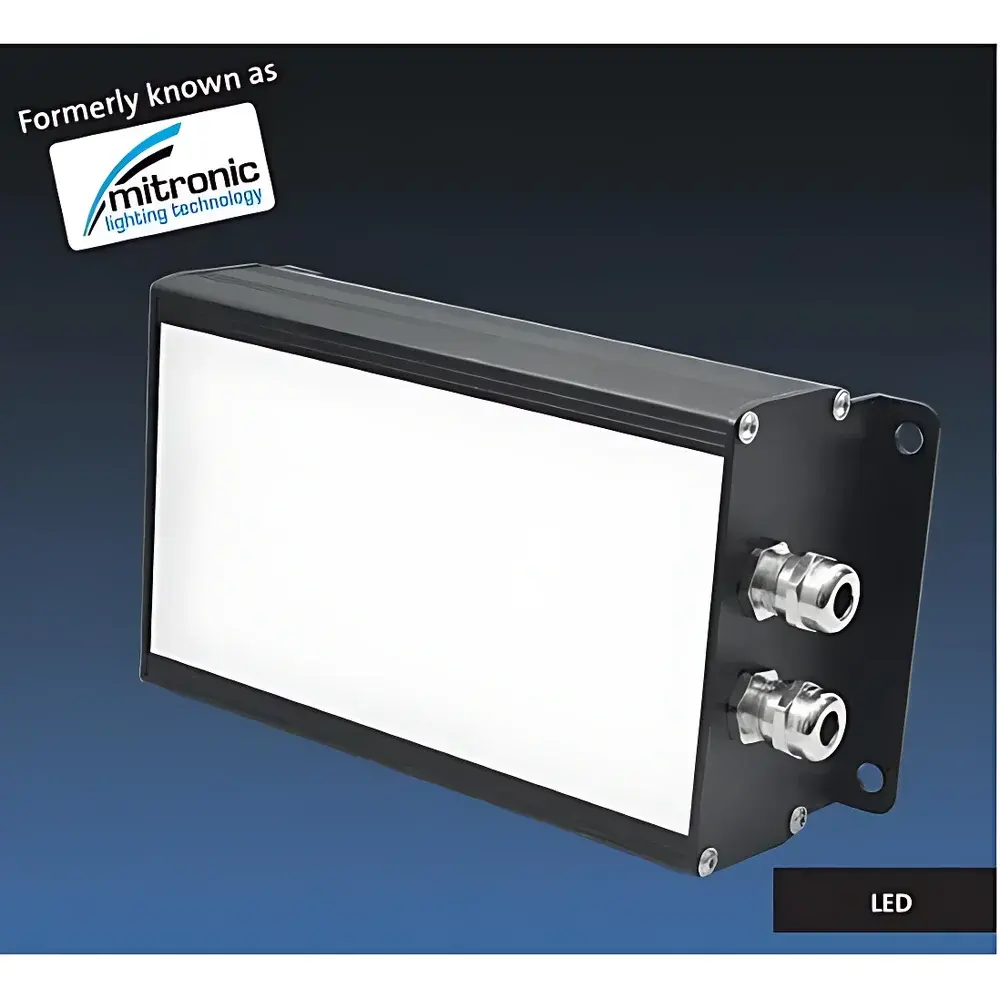
Hoenle LED-On-Board Lighting System OBL300
| Brand | Hoenle |
|---|---|
| Origin | Germany |
| Model | OBL300 |
| Power Rating | 300 W |
| Application | In-Vehicle Illumination for Crash Test Documentation |
| Light Source | High-Intensity LED Array |
| Mounting | Flexible, Low-Profile Vehicle Interior Fixturing |
| Compliance | CE, RoHS, ISO 16750-3 (Mechanical Environmental Testing for Automotive Electronics) |
Overview
The Hoenle LED-On-Board Lighting System OBL300 is an engineered illumination solution specifically developed for high-fidelity optical documentation during automotive crash testing and dynamic impact analysis. Unlike conventional halogen or xenon-based in-vehicle lighting, the OBL300 employs a thermally optimized, high-luminance LED array operating at a nominal 300 W DC input. Its design adheres to the fundamental photometric requirements of high-speed imaging systems used in SAE J211-compliant sled tests, full-scale frontal offset collisions (ECE R94), and side-impact simulations (ECE R95). The system delivers uniform, flicker-free, daylight-balanced illumination (CCT ≈ 5600 K) with minimal infrared emission—critical for avoiding thermal interference with pyroelectric sensors, accelerometers, and high-speed camera synchronization. Its compact form factor (L × W × H: 320 × 120 × 45 mm) and low mass (<2.1 kg) ensure minimal inertial loading on vehicle interior structures during acceleration phases up to 100 g, preserving test integrity per ISO 6487 and FMVSS 208 validation protocols.
Key Features
- Stable, continuous-output LED architecture with active thermal management—enabling sustained operation at rated power without luminous flux decay over ≥30 min exposure cycles.
- Integrated CAN bus interface (ISO 11898-2 compliant) for synchronized on/off control and intensity modulation via vehicle test bench master controllers.
- IP54-rated housing with vibration-dampened mounting brackets engineered for ISO 16750-3 Category 3 mechanical shock profiles (50 g, 11 ms half-sine pulse).
- Optical output calibrated to ±3% photometric accuracy traceable to PTB (Physikalisch-Technische Bundesanstalt) reference standards.
- No external ballast or high-voltage driver required—direct 24 V DC input (operating range: 18–32 V DC) with reverse polarity and overvoltage protection.
- EMC compliance per CISPR 25 Class 3 and ISO 11452-2 (bulk current injection), ensuring immunity in high-noise crash lab environments.
Sample Compatibility & Compliance
The OBL300 is designed for installation within occupant compartments of passenger vehicles, light trucks, and autonomous test platforms undergoing regulatory or internal safety validation. It accommodates standard OEM mounting points (e.g., A-pillar channels, roof rail slots, seat frame brackets) without structural modification. All materials comply with UL 94 V-0 flammability rating and automotive-grade outgassing limits (SAE J1757-1). The system conforms to EU Directive 2004/108/EC (EMC), Regulation (EU) No 2017/1354 (RoHS), and meets functional safety requirements aligned with ISO 26262 ASIL-A for non-safety-critical illumination functions. Documentation includes full Declaration of Conformity and test reports from TÜV Rheinland.
Software & Data Management
While the OBL300 operates as a deterministic hardware device without embedded firmware, its CAN interface supports integration into industry-standard test data acquisition ecosystems—including ETAS INCA, Vector CANoe, and dSPACE SCALEXIO platforms. Configuration logs, activation timestamps, and voltage monitoring data can be time-synchronized with accelerometer, video, and CAN bus streams using IEEE 1588 PTP v2. Audit trails generated during test execution satisfy GLP-aligned documentation requirements for NCAP submissions and internal R&D traceability. Calibration certificates include NIST-traceable spectral irradiance data (380–780 nm) and are archived in accordance with ISO/IEC 17025 clause 7.7.
Applications
- High-speed motion capture of dummy kinematics (Hybrid III, THOR, Q-Series) during FMVSS 208/214 and Euro NCAP frontal/side impact tests.
- Illumination support for stereo-DIC (Digital Image Correlation) systems measuring localized deformation on instrument panels and door trims.
- Backlighting for transparent airbag modules during deployment sequence analysis.
- Low-heat ambient lighting for thermal IR camera co-registration where blackbody radiation must remain uncompromised.
- Validation lighting in ADAS sensor obstruction testing (e.g., camera lens soiling under controlled illumination conditions).
FAQ
Is the OBL300 certified for use in UN/ECE type-approval testing?
Yes—the system holds TÜV-certified compliance with ECE R10 (EMC) and R128 (lighting equipment for special-purpose vehicles), and has been deployed in multiple WLTP and RDE test campaigns under accredited laboratories.
Can the OBL300 be operated continuously during a full 120 ms crash pulse?
Yes—thermal modeling and empirical validation confirm stable photometric output throughout the entire duration of standardized crash pulses per ISO 6487 Annex C.
Does Hoenle provide calibration services for field-installed units?
Yes—on-site photometric recalibration and mounting verification are available through authorized service partners in North America, EU, and APAC regions, with turnaround ≤10 business days.
What is the expected service life under cyclic crash test conditions?
Rated for ≥5,000 operational cycles (defined as one 60 s powered-on event per crash test), with LED L70 lifetime exceeding 15,000 hours under laboratory thermal cycling (−40 °C to +85 °C, 500 cycles).




