
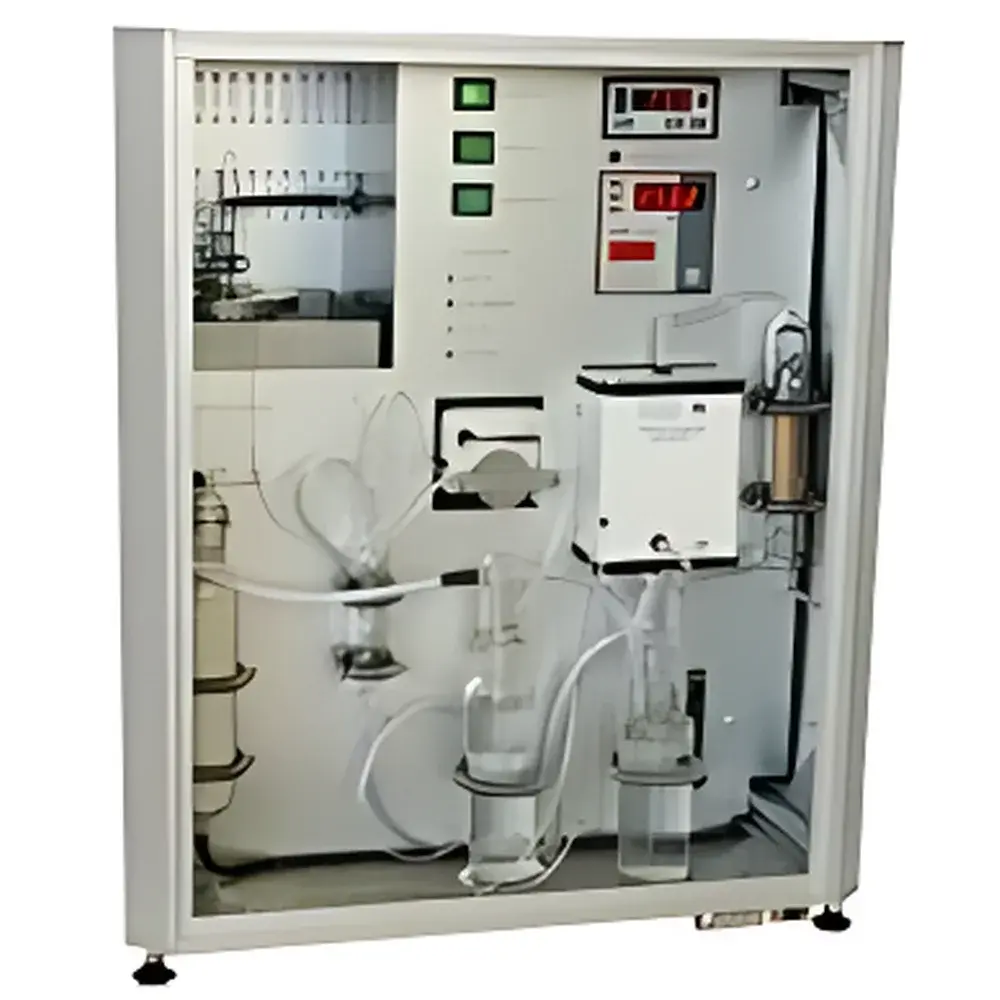
Groegero GO-TOC 1000 Online Total Organic Carbon Analyzer
| Brand | Groegero |
|---|---|
| Origin | Germany |
| Model | GO-TOC 1000 |
| Instrument Type | Online TOC Analyzer |
| Measurement Principle | Direct Conductivity (Post-Combustion NDIR) |
| Oxidation Method | High-Temperature Catalytic Combustion (850 °C) |
| Measurement Range | 0–300 mg/L as C |
| Accuracy | ±2% of span |
| Detection Limit | 0.1 mg/L as C |
| Resolution | Better than 2% of full scale |
| Repeatability | ±2% of span |
| Sample Flow Rate | 125 mL/h (inlet), 25 mL/h (analysis) |
| T90 Response Time | ~4 min |
| Inorganic Carbon Removal | Acidification with HCl + Sparging |
| Carrier Gas | Ambient air (filtered and dried) |
| Gas Cooler | Semiconductor-based (GO-EPK-1) |
| Operating Temperature | +5 °C to +30 °C |
| Power Supply | 230 V, 50 Hz |
| Enclosure | Painted aluminum housing with resin-glass front door |
| Dimensions (W×H×D) | 590 × 690 × 440 mm |
| Weight | ~40 kg |
| Output Signals | 0–20 mA / 4–20 mA analog + RS-232 serial interface |
| Software | GO-WinSoft for data logging and configuration |
| Optional | Integrated dilution module |
Overview
The Groegero GO-TOC 1000 is a robust, CE-marked online total organic carbon (TOC) analyzer engineered for continuous, unattended monitoring of ultrapure water, pharmaceutical process water, boiler feedwater, and municipal or industrial wastewater streams. It employs high-temperature catalytic combustion (850 °C) followed by non-dispersive infrared (NDIR) detection—a method compliant with ISO 8245, ASTM D5907, and USP for TOC quantification. Unlike UV-persulfate or electrochemical methods, this dual-stage thermal oxidation ensures complete conversion of refractory and non-volatile organic compounds—including humic substances, amino acids, and low-molecular-weight organics—into CO2. The evolved CO2 is carried by ambient air (pre-filtered and moisture-conditioned via integrated semiconductor cooling), dried in a thermoelectric gas dryer (GO-EPK-1), and quantified by a precision NDIR optical bank calibrated against certified CO2 standards. Results are reported in mg C/L, traceable to NIST-traceable reference materials.
Key Features
- High-temperature catalytic oxidation at 850 °C for >99% carbon recovery across diverse matrixes, including saline and high-TDS waters
- Automated inorganic carbon (TIC) removal via programmable acidification (HCl) and sparging—eliminating interference without manual intervention
- Integrated 4-channel peristaltic pump enabling precise reagent dosing, sample aspiration, acid addition, and carrier gas conditioning
- Real-time analog outputs (0–20 mA / 4–20 mA) plus RS-232 serial interface for PLC integration, SCADA systems, or central data acquisition
- Compact, panel-mountable enclosure (590 × 690 × 440 mm) with IP54-rated painted aluminum chassis and resin-glass front access—designed for cleanroom and utility corridor deployment
- Onboard 4½-digit display for local status verification, calibration checks, and alarm indication without external software dependency
- Configurable measurement cycle timing and auto-dilution capability (optional module) for extended dynamic range up to 3000 mg/L via internal 1:10 dilution
Sample Compatibility & Compliance
The GO-TOC 1000 accommodates aqueous samples with conductivity up to 5 mS/cm and suspended solids <5 ppm. It is validated for use in GMP-regulated environments: its firmware supports audit trail generation, user-level access control (admin/operator), and electronic signature readiness per FDA 21 CFR Part 11 when paired with GO-WinSoft v3.2+. All calibration and maintenance events—including zero/span checks, acid refill alerts, and oxidation furnace temperature logs—are timestamped and exportable. The analyzer meets IEC 61000-6-2 (EMC immunity) and IEC 61000-6-4 (EMC emission) standards. Its operation aligns with ISO/IEC 17025 requirements for testing laboratories performing TOC analysis under accredited quality management systems.
Software & Data Management
GO-WinSoft is a Windows-based configuration, calibration, and data logging application supporting multi-instrument fleet management. It enables method-defined sequence programming (e.g., daily zero check → acid purge → sample injection → TIC subtraction → TOC calculation), automated report generation (PDF/CSV), and configurable alarm thresholds with email/SNMP notification. Raw sensor outputs (NDIR voltage, temperature, pressure), calculated TOC values, and system diagnostics are stored with millisecond timestamps. Data files comply with ALCOA+ principles (Attributable, Legible, Contemporaneous, Original, Accurate, Complete, Consistent, Enduring, Available) and support 21 CFR Part 11-compliant electronic records when deployed on validated IT infrastructure.
Applications
- Pharmaceutical water systems: PW, WFI, and pure steam condensate monitoring per EU GMP Annex 1 and USP
- Power generation: Real-time TOC surveillance in condensate polishers and demineralizer effluents to prevent turbine deposit formation
- Microelectronics: Ultrapure water (UPW) TOC control in fab supply loops where sub-ppb carbon levels impact wafer yield
- Municipal drinking water treatment: Disinfection by-product precursor tracking pre- and post-ozonation/chloramination
- Environmental compliance: Continuous reporting for NPDES permits requiring TOC or DOC trending in effluent discharge streams
FAQ
Does the GO-TOC 1000 require carrier gas cylinders?
No—ambient air is used as the carrier gas after filtration and dew-point control via the integrated semiconductor cooler. No compressed gas supply or external drying units are needed.
How is inorganic carbon (TIC) removed during analysis?
Automated acidification with hydrochloric acid (HCl) lowers sample pH below 2, converting bicarbonate and carbonate species to CO2, which is then purged prior to combustion—ensuring TOC-specific measurement.
Can the instrument be integrated into a DCS or MES platform?
Yes—via standard 4–20 mA analog output or Modbus RTU over RS-232. GO-WinSoft also supports OPC UA connectivity through optional middleware configuration.
What maintenance intervals are recommended?
Quarterly oxidation furnace inspection, biannual NDIR optical path cleaning, and annual calibration verification using certified TOC standards (e.g., potassium hydrogen phthalate). Pump tubing replacement is scheduled every 6 months under continuous operation.
Is the GO-TOC 1000 suitable for seawater or brine applications?
It is not designed for direct seawater analysis due to chloride-induced corrosion risk and potential catalyst poisoning. For high-salinity matrices, offline dilution or pretreatment via ion exchange is required prior to inlet.







