
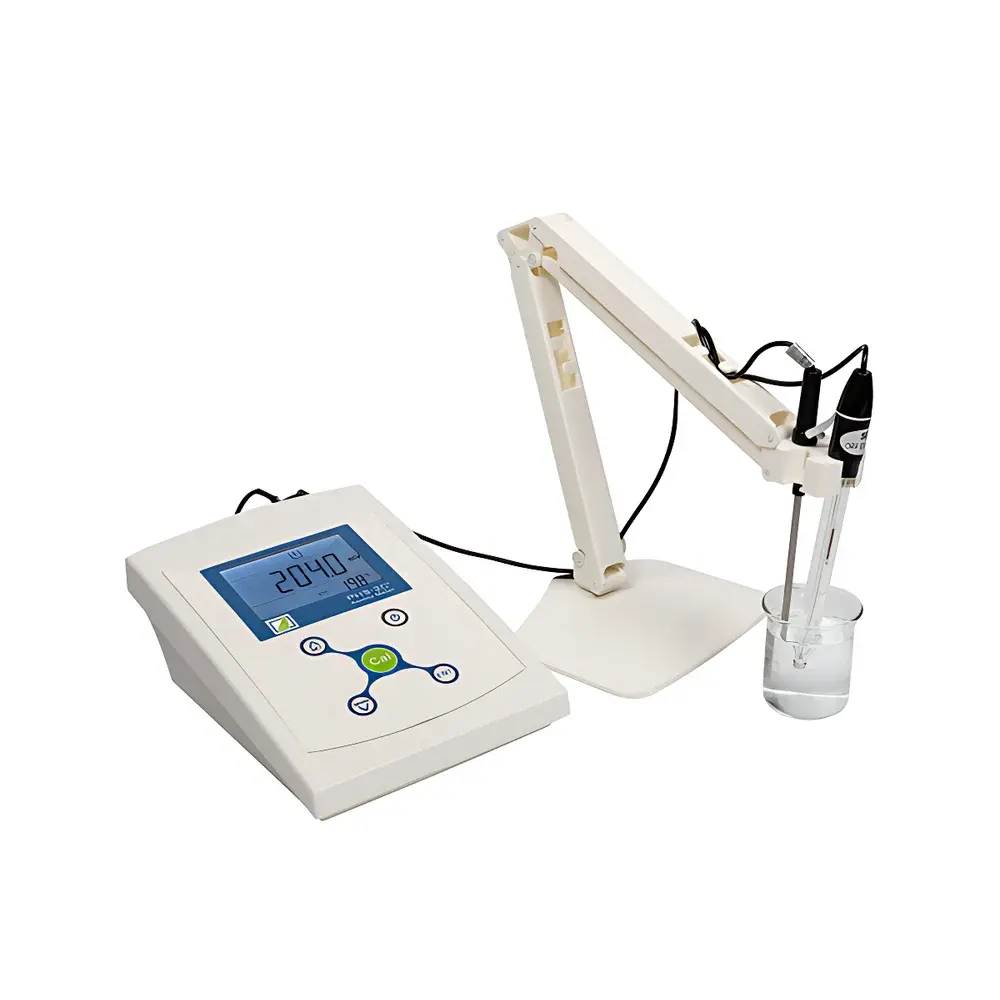
FangZhou PHS-3C+ Benchtop pH Meter
| Brand | FangZhou |
|---|---|
| Origin | Sichuan, China |
| Manufacturer Type | Authorized Distributor |
| Product Origin | Domestic (China) |
| Model | PHS-3C+ |
| Instrument Type | Benchtop |
| Parameter Types | Multi-parameter (pH, mV, ORP, Temperature) |
| Measurement Accuracy | ±0.01 pH |
| pH Range | −5.00 to 20.00 pH |
| Resolution | 0.01 pH / 0.1 mV |
| Calibration Standards | NIST-traceable buffers (USA) |
| Temperature Compensation | Automatic (ATC) and Manual |
| Input Impedance | ≥1 × 10¹² Ω |
| Interface | BNC electrode port, Pt1000/NTC temperature sensor port, RS232 serial output |
Overview
The FangZhou PHS-3C+ is a precision benchtop pH meter engineered for routine laboratory, quality control, and environmental testing applications requiring high reproducibility in electrochemical measurements. Based on potentiometric measurement principles, it determines hydrogen ion activity via a glass pH electrode and reference electrode pair, delivering stable, drift-compensated readings under variable thermal conditions. Its microprocessor-controlled architecture supports multi-parameter acquisition—simultaneously reporting pH, millivolt (mV), oxidation-reduction potential (ORP), and temperature—with built-in automatic temperature compensation (ATC) using either Pt1000 or NTC sensors. Designed to meet international calibration traceability requirements, the instrument accepts NIST-certified buffer solutions and supports up to five-point calibration across four predefined buffer groups (NIST, Merck, MT Europe, and Chinese national standards), ensuring compliance with ISO/IEC 17025–aligned laboratory practices.
Key Features
- High-resolution LCD display with adjustable backlight for low-light environments—enabling clear visualization of real-time pH, mV, ORP, temperature, electrode status, and calibration diagnostics
- 0.01 pH resolution and ±0.01 pH accuracy (±1 digit), meeting Class 0.01 specification per GB/T 11165–2022 and equivalent to ISO 7888:2019 performance thresholds for routine pH instrumentation
- Multi-point calibration capability: 1–5 point calibration with auto-buffer recognition; selectable from 12 standard solutions across 4 regional buffer sets
- Electrode health monitoring—including impedance estimation, response time evaluation, and equilibrium indication—to support preventive maintenance and GLP-compliant electrode validation
- Robust input impedance ≥1 × 10¹² Ω minimizes loading error during high-impedance electrode operation, critical for low-conductivity or organic-phase samples
- RS232 serial interface enables direct data logging to PCs or LIMS systems; compatible with standard terminal emulators and custom scripts for automated reporting
- Dual temperature compensation modes: automatic (via integrated sensor) or manual entry, covering −5.0 °C to 135.0 °C with ±0.3 °C accuracy
Sample Compatibility & Compliance
The PHS-3C+ accommodates standard BNC-compatible pH electrodes and interchangeable temperature probes, supporting aqueous, semi-aqueous, and buffered biological samples within typical industrial and academic use cases. It complies with national metrological verification regulations JJG 119–2018 (China) and aligns with functional safety expectations outlined in IEC 61010-1 for laboratory electrical equipment. While not certified for FDA 21 CFR Part 11 out-of-the-box, its RS232 output and deterministic calibration audit trail (including date/time-stamped calibration events and buffer IDs) facilitate integration into validated workflows under GMP/GLP frameworks when paired with compliant data capture software.
Software & Data Management
Data export is performed via ASCII-formatted RS232 transmission at configurable baud rates (up to 115200 bps), enabling seamless ingestion into spreadsheet tools, statistical process control (SPC) platforms, or laboratory information management systems (LIMS). The device stores no internal calibration history beyond the current session, emphasizing operator accountability—a design consistent with ISO/IEC 17025 clause 7.7 on result reporting integrity. For regulated environments, users are advised to implement external timestamped logging and maintain independent calibration records per ASTM E2041–22 guidelines.
Applications
- Environmental monitoring: pH profiling of surface water, wastewater effluents, and soil extracts per EPA Method 150.1 and ISO 10523
- Pharmaceutical QC: Dissolution media pH verification in accordance with USP and EP 2.2.3
- Food & beverage production: Batch consistency checks for dairy, brewing, and juice processing lines
- Academic teaching labs: Electrochemistry fundamentals instruction, including Nernst equation validation and buffer capacity analysis
- Research laboratories: Supporting long-term stability studies where repeatable endpoint detection is required
FAQ
Does the PHS-3C+ support GLP-compliant calibration documentation?
It provides on-screen calibration confirmation with buffer ID and date/time stamp, but full GLP audit trails require external recording of calibration parameters and electrode metadata.
Can it measure non-aqueous samples?
Yes—when used with appropriate low-water-content electrodes and standardized procedures (e.g., ISO 12076), though accuracy may vary depending on solvent dielectric constant and junction potential effects.
Is firmware upgrade available?
Firmware updates are distributed exclusively through authorized FangZhou service centers and require dedicated programming hardware; no field-upgradable bootloader is provided.
What is the warranty coverage?
The instrument carries a three-year limited warranty on the main unit and six months for replacement of defective components due to manufacturing defects, subject to registration and proof of purchase.
How is temperature compensation applied during pH measurement?
ATC uses real-time sensor input to adjust the Nernst slope dynamically (−0.1984 mV/pH/°C at 25 °C), while manual mode allows fixed-temperature correction when sensor integration is impractical.






