
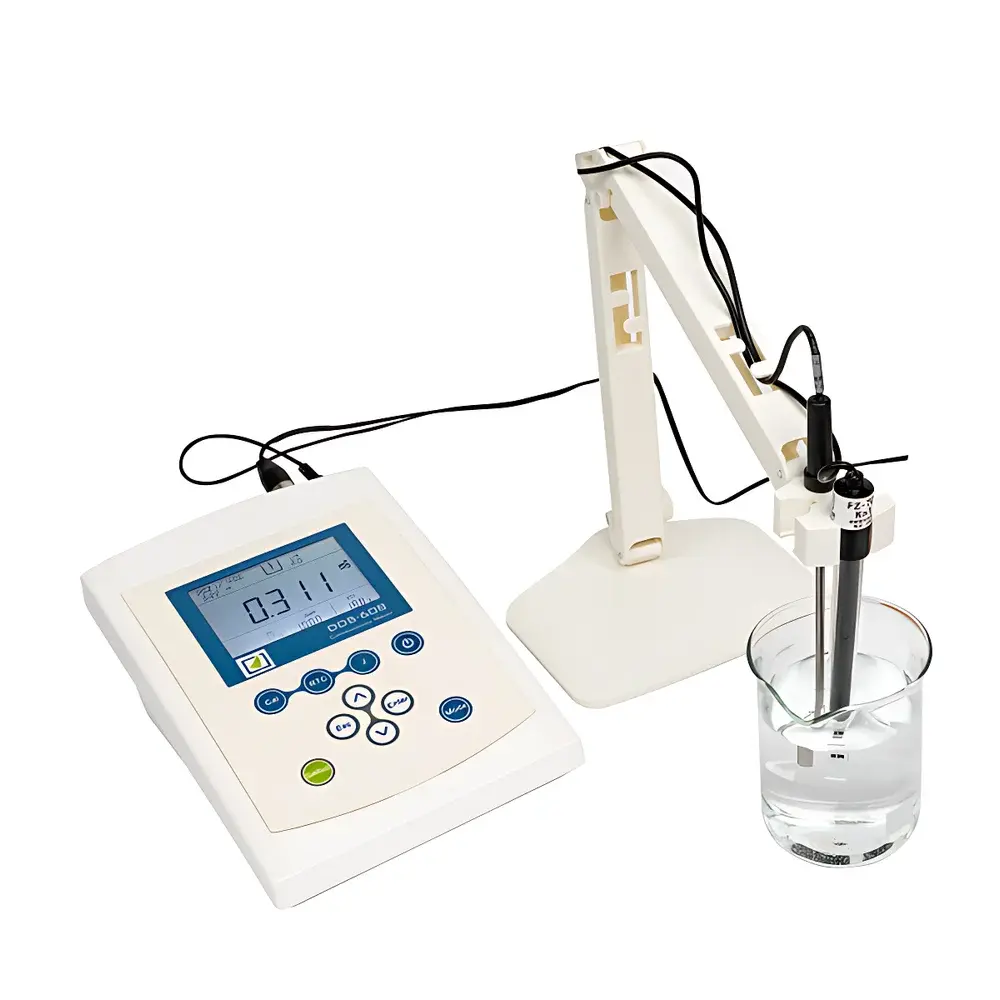
FangZhou DDS-608 Titanium Dioxide (TiO₂) Conductivity Meter
| Brand | FangZhou |
|---|---|
| Origin | Sichuan, China |
| Model | DDS-608 TiO₂ Conductivity Meter |
| Form Factor | Benchtop |
| Application Environment | Laboratory |
| Conductivity Range | 0–2×10⁵ µS/cm |
| TDS Range | 0.00–200.0 g/L (TDS factor = 1) |
| Resistivity Range | 5.00–10⁸ Ω·cm |
| Salinity Range | 0.00–80.00 ppt |
| Temperature Range | −9.9 to 135.0 °C |
| Accuracy | ±0.5% FS (conductivity, resistivity, TDS), ±0.3 °C (temperature), ±1.0 ppt (salinity) |
| Minimum Resolution | 0.001 µS/cm |
| Temperature Compensation | Automatic (ATC) and Manual (MTC) |
| Calibration | Built-in 4 standard points + 1 user-defined point |
| Data Storage | 4096 GLP-compliant records with timestamp |
| Interface | RS232 serial output, 0–20 mV analog output |
| Adjustable Parameters | Reference temperature, temperature coefficient (0.0–10.0 %/°C), TDS factor (0.2–1.00), cell constant (DJS = 0.01, 0.1, 1, 10 cm⁻¹) |
Overview
The FangZhou DDS-608 Titanium Dioxide (TiO₂) Conductivity Meter is a benchtop electrochemical analyzer engineered for precise, multi-parameter measurement of aqueous suspensions and process solutions in pigment, coating, and quality control laboratories. Designed specifically for the titanium dioxide industry, it employs two-electrode AC conductivity measurement at a fixed frequency (typically 1 kHz) to minimize polarization errors and electrode fouling—critical when analyzing highly dispersed, non-ionic TiO₂ slurries where conventional pH or ion-selective methods are unsuitable. Its robust architecture supports full-range conductivity quantification from ultra-pure water (down to 0.000 µS/cm) to concentrated electrolyte solutions (up to 200 mS/cm), enabling consistent batch-to-batch verification of surface treatment efficacy, dispersion stability, and residual electrolyte content in dry and slurry-phase TiO₂ products per ASTM D3451 and ISO 8781-3.
Key Features
- 7 auto-ranging conductivity scales with dedicated calibration points per range—ensuring linear response across five decades (0.000 µS/cm to 200.00 mS/cm)
- Simultaneous real-time display of conductivity, resistivity, TDS, salinity, and temperature—with independent resolution settings per parameter (e.g., 0.001 µS/cm, 0.01 ppt, 0.1 °C)
- Configurable temperature compensation using either automatic (ATC) Pt1000 probe input or manual (MTC) entry, with adjustable temperature coefficient (0.0–10.0 %/°C) and reference temperature (15–25 °C)
- Integrated GLP-compliant data management: 4096 timestamped records stored with operator ID, calibration history, and measurement conditions
- Dual-output interface: RS232 serial port for direct PC connection and 0–20 mV analog output for PLC or SCADA integration
- Four selectable cell constants (DJS = 0.01, 0.1, 1.0, 10.0 cm⁻¹) compatible with standardized TiO₂ electrode geometries per ISO 7888
- Onboard calibration wizard supporting four preloaded standards (84 µS/cm, 1413 µS/cm, 12.88 mS/cm, 111.8 mS/cm) plus one user-defined point for custom matrix matching
Sample Compatibility & Compliance
The DDS-608 is validated for use with TiO₂ aqueous dispersions (1–30 wt%), chloride-containing wash liquors, and post-surface-treatment rinse waters. Its sealed, corrosion-resistant housing (IP54-rated) and platinum-black-coated electrodes withstand abrasive particulates and mild oxidants common in pigment manufacturing. All measurement algorithms comply with IEC 60746-3 for conductivity instrumentation and support traceable calibration per ISO/IEC 17025 requirements. Data storage includes mandatory GLP fields—date/time stamp, operator ID, electrode serial number, and calibration verification status—enabling audit readiness for FDA 21 CFR Part 11–aligned environments when paired with FangZhou EC-Link software.
Software & Data Management
FangZhou EC-Link PC software (optional) provides secure, encrypted data transfer via RS232, enabling automated report generation in PDF/CSV formats compliant with laboratory information management systems (LIMS). The software enforces electronic signatures, audit trails, and role-based access control—fulfilling ALCOA+ principles (Attributable, Legible, Contemporaneous, Original, Accurate). Raw conductivity traces, calibration logs, and drift diagnostics are exportable for statistical process control (SPC) analysis. Firmware updates preserve all stored calibration coefficients and user configurations without data loss.
Applications
- Quantifying residual sodium sulfate or ammonium sulfate in TiO₂ filter cakes post-washing
- Monitoring conductivity drift during hydrothermal surface modification processes
- Verifying deionized water rinse efficiency in chloride removal validation protocols
- Batch release testing of rutile/anatase slurries per customer technical specifications (e.g., ≤50 µS/cm at 25 °C)
- Supporting ISO 9001 internal audits through documented measurement uncertainty budgets and calibration certificates
- Process troubleshooting in wet-grind circuits by correlating conductivity trends with particle size distribution (PSD) shifts
FAQ
What electrode configurations are supported for TiO₂ slurry measurements?
The DDS-608 accepts standard DIN/ISO-compliant two-electrode cells with DJS = 0.01 cm⁻¹ (for low-conductivity wash water) and DJS = 1.0 cm⁻¹ (for high-solids slurries); optional flow-through cells are available for inline monitoring.
Does the instrument meet regulatory requirements for pharmaceutical-grade water testing?
While optimized for TiO₂ applications, its 0.5-class accuracy, GLP data logging, and traceable calibration satisfy USP conductivity criteria for Purified Water and Water for Injection when operated within specified temperature and range limits.
How is temperature compensation applied during high-temperature TiO₂ drying validation?
The ATC mode uses a Pt1000 sensor embedded in the sample cup; compensation follows the linear equation σT = σref × [1 + α(T − Tref)], where α is user-adjustable up to 10.0 %/°C to match non-aqueous solvent behavior.
Can historical calibration data be exported for third-party audit review?
Yes—EC-Link software exports full calibration event logs including date/time, standard used, measured value, deviation, and operator signature in tamper-evident XML format.
Is firmware upgrade capability included in the base configuration?
Yes—firmware updates are delivered via USB-to-RS232 adapter and preserve all user settings, calibration coefficients, and stored data without reset.
Related Products





