
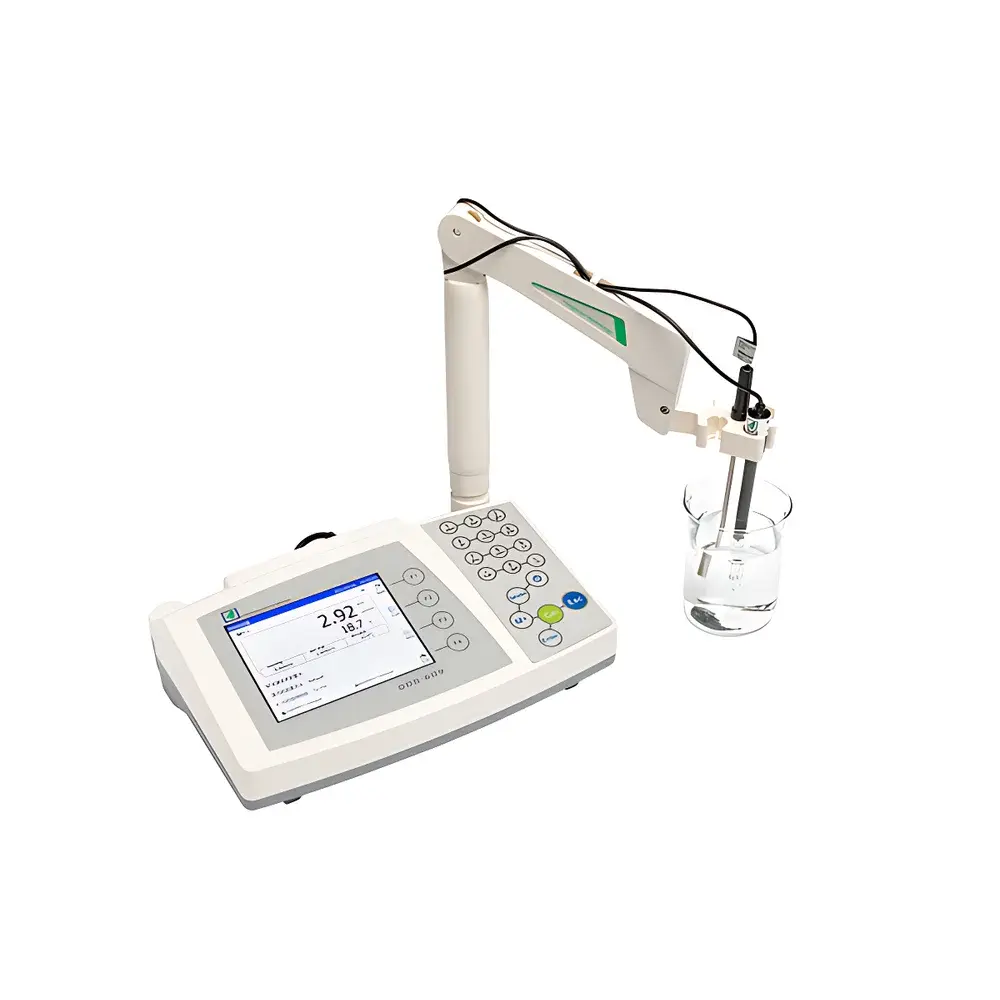
FangZhou DDS-609 Laboratory-Grade Conductivity Meter
| Brand | FangZhou |
|---|---|
| Origin | Sichuan, China |
| Model | DDS-609 |
| Form Factor | Benchtop |
| Application | Laboratory Water Quality Analysis |
| Conductivity Range | (0–2×10⁵) µS/cm |
| TDS Range | (0.00–300.0) g/L |
| Resistivity Range | (5.00–10⁸) Ω·cm |
| Salinity Range | (0.00–80.00) ppt |
| Temperature Range | (−25.0–135.0) °C |
| Accuracy | ±0.5% FS |
| Minimum Conductivity Resolution | 0.0001 µS/cm |
| Calibration Points | 4 Chinese Standard, 6 US/EU Standard, 1 Custom Solution |
| GLP Compliance | Yes |
| Data Storage Capacity | ≥100,000 measurement records |
| Interface | RS-232 & USB |
| Output Formats | Simple / Standard / GLP-compliant reports |
Overview
The FangZhou DDS-609 Laboratory-Grade Conductivity Meter is a high-precision, multi-parameter benchtop instrument engineered for rigorous water quality assessment in regulated laboratory environments. It operates on the principle of two-electrode or four-electrode conductometric measurement—applying an alternating current across a conductivity cell to determine solution conductance, which is then converted into conductivity (µS/cm), resistivity (Ω·cm), total dissolved solids (TDS, g/L), salinity (ppt), and conductivity ash (%). Designed specifically for ultrapure and pharmaceutical-grade water monitoring—including ASTM D1125, ISO 7888, USP , and EP 2.2.38 compliant applications—the DDS-609 supports trace-level detection down to 0.0001 µS/cm with automatic range switching across eight decades (0.0000–2000 mS/cm). Its temperature-compensated measurements incorporate linear, non-linear, and reference-temperature-based algorithms—critical for accurate interpretation of Type I/II/III laboratory water, WFI (Water for Injection), Purified Water (PW), and electronic-grade water (EW-I to EW-III) per SEMI F63 standards.
Key Features
- 8-range auto-scaling conductivity measurement with dynamic resolution (0.0001–1 µS/cm, auto-variable)
- Integrated multi-parameter calculation: conductivity, resistivity, TDS (with adjustable coefficient 0.2–1.00), salinity, conductivity ash, and temperature
- Comprehensive temperature compensation: ATC (automatic, −25.0–135.0 °C) and MTC (manual), with user-selectable reference temperature (15.0–25.0 °C)
- Dedicated water grade modes: Lab Grade I/II/III, USP Purified Water, USP WFI, and SEMI EW-I/EW-II/EW-III—with configurable alarm thresholds and real-time compliance status display
- Advanced electrode management system: stores electrode ID, calibration history, K-factor, and last calibration timestamp
- Full GLP/GMP support: audit-trail enabled user authentication (1000+ accounts), method versioning, electronic signatures, and tamper-evident data logging
- High-resolution color LCD with adjustable backlight and intuitive menu navigation via alphanumeric keypad
- Onboard storage capacity ≥100,000 measurement records with time/date stamp, operator ID, sample ID, electrode metadata, and diagnostic flags
Sample Compatibility & Compliance
The DDS-609 is validated for use with deionized water, distilled water, reverse osmosis (RO) permeate, ultrapure water (UPW), pharmaceutical process water, and low-conductivity industrial rinse solutions. Its measurement architecture meets the metrological requirements of ISO/IEC 17025-accredited laboratories and aligns with regulatory expectations under FDA 21 CFR Part 11 (when paired with validated software), EU Annex 11, and WHO TRS 992 Annex 4. The instrument supports dual-standard calibration protocols—four certified Chinese national standard solutions (GB/T 6682) and six internationally recognized reference materials (e.g., NIST SRM 3198, Mettler Toledo CertiPUR®), plus one user-defined solution. All calibration events are timestamped, attributed, and retained within the internal database for full traceability.
Software & Data Management
Data export is supported via RS-232 serial and USB interfaces, enabling direct transfer to Windows-based systems without proprietary drivers. Measurement records can be exported in three structured formats: Simple (tab-delimited), Standard (CSV with metadata headers), and GLP-compliant (XML or PDF with embedded digital signature, calibration logs, and environmental conditions). The built-in software protocol allows seamless import into Microsoft Excel, Word, and Office 365 for statistical analysis, trend reporting, and audit preparation. Up to 1000 custom methods—including electrode configuration, temperature compensation model, TDS factor, and alarm thresholds—can be stored, duplicated, and assigned to specific users or workflows. All data modifications trigger immutable audit entries, satisfying ALCOA+ principles (Attributable, Legible, Contemporaneous, Original, Accurate, Complete, Consistent, Enduring, Available).
Applications
- Monitoring resistivity/conductivity of ultrapure water in semiconductor fab UPW loops (SEMI F63)
- USP and Ph. Eur. 2.2.38 validation of purified water and water-for-injection systems
- Quality control of dialysis fluid, parenteral formulation water, and clean-in-place (CIP) rinse endpoints
- Environmental lab analysis of low-TDS surface waters and groundwater per ISO 7888
- Educational and research labs requiring trace-level conductivity measurement with full parameter flexibility
- Pharmaceutical manufacturing QA/QC for Stage 1–3 water system qualification (IQ/OQ/PQ)
FAQ
Does the DDS-609 comply with FDA 21 CFR Part 11 for electronic records?
Yes—when operated with validated firmware and paired with appropriate access controls and audit-trail review procedures, it satisfies core Part 11 requirements for record integrity and user accountability.
Can the instrument store calibration data for multiple electrodes?
Yes—each electrode is assigned a unique ID; its K-factor, calibration date, standard used, and deviation from nominal value are persistently logged.
What temperature compensation models are available?
Three options: no compensation, linear (with adjustable β coefficient), and non-linear (based on polynomial fit for high-accuracy ultrapure water applications).
Is external software required for data export or report generation?
No—native export to Excel-ready CSV and GLP-formatted reports is fully integrated; no third-party software is needed for basic archiving or regulatory submission.
How does the DDS-609 handle low-conductivity measurements below 1 µS/cm?
It employs guarded-cell design principles, low-noise AC excitation, and adaptive gain control to minimize polarization effects and stray capacitance errors—ensuring stability and repeatability at sub-µS/cm levels.
Related Products




