
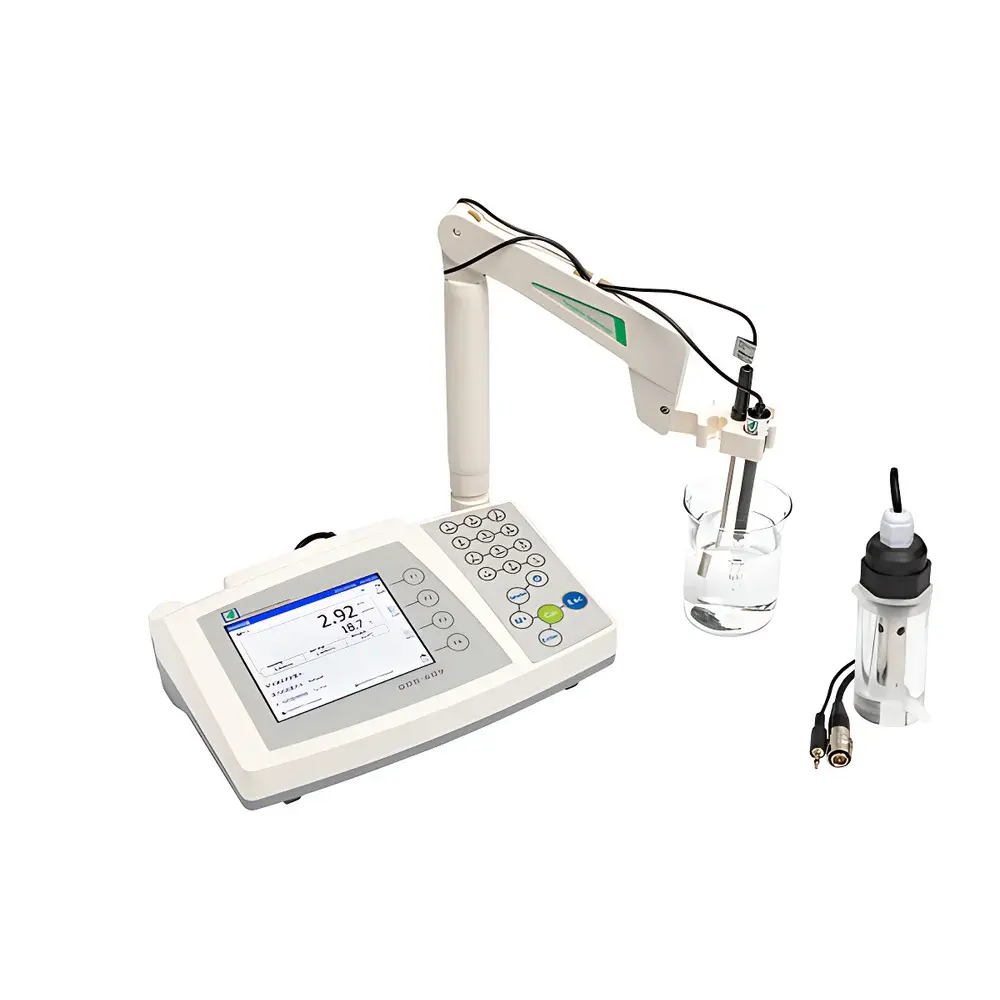
FangZhou DDS-609 Sodium Hydroxide-Compatible Conductivity Meter
| Brand | FangZhou |
|---|---|
| Origin | Sichuan, China |
| Manufacturer Type | Authorized Distributor |
| Product Category | Domestic |
| Model | DDS-609 NaOH-Compatible Conductivity Meter |
| Price Range | USD 700–1,400 (FOB) |
| Measurement Parameters | Conductivity, Resistivity, TDS, Salinity, Conductive Ash, Temperature |
| Portability | Benchtop |
| Application Environment | Laboratory |
| Conductivity Range | (0–2×10⁵) µS/cm |
| TDS Range | (0.00–300.0) g/L (TDS factor = 1.0) |
| Resistivity Range | (5.00–10⁸) Ω·cm |
| Salinity Range | (0.00–80.00) ppt |
| Temperature Range | (−25.0–135.0) °C |
| Accuracy | ±0.5% FS |
| Minimum Conductivity Resolution | 0.0001 µS/cm |
| Calibration Points | 4 Chinese standard, 6 international (ASTM/ISO/USP), 1 custom solution |
| Temperature Compensation | Automatic (ATC) or Manual (MTC), nonlinear mode supported |
| GLP Compliance | Full audit trail, user authentication, method versioning, timestamped data logging |
| Data Storage | ≥100,000 measurement records |
| Interface | RS-232, USB, analog 0–20 mV output |
| Electrode Constant Adjustment | 0.01, 0.1, 1.0, 10.0 cm⁻¹ selectable |
Overview
The FangZhou DDS-609 Sodium Hydroxide-Compatible Conductivity Meter is a high-precision benchtop instrument engineered for reliable, traceable electrochemical measurement in demanding laboratory environments—particularly where concentrated alkaline solutions such as sodium hydroxide (NaOH) are routinely analyzed. Unlike general-purpose conductivity meters, the DDS-609 incorporates chemically resistant electrode interface design, temperature-stable analog front-end circuitry, and programmable non-linear temperature compensation algorithms optimized for high-pH, high-conductivity media. It operates on the principle of two-electrode or four-electrode AC conductance measurement at fixed frequency (1 kHz nominal), minimizing polarization error and electrode fouling during extended exposure to caustic electrolytes. The instrument meets ISO/IEC 17025 technical competence requirements for calibration laboratories and supports full compliance with pharmacopeial standards including USP , EP 2.2.38, and ChP 0681 for purified water and water-for-injection (WFI) testing.
Key Features
- 8-range auto-ranging conductivity measurement with dynamic resolution scaling—from 0.0001 µS/cm (DJS-0.01 cell) to 2000 mS/cm (DJS-10.0 cell)—ensuring optimal signal-to-noise ratio across ultra-pure to highly concentrated NaOH solutions.
- Dual-mode temperature compensation: linear (α = 0.000–0.025 °C⁻¹ adjustable) and non-linear (polynomial-based), with configurable reference temperature (15.0–25.0 °C) and automatic sensor detection for Pt1000 or NTC thermistors.
- Comprehensive parameter calculation engine supporting conductivity, resistivity, TDS (with user-defined factor 0.2–1.0), salinity (PSS-78 algorithm), and conductive ash (per ASTM D1127) in real time.
- GLP-compliant data architecture featuring role-based user authentication (1000+ accounts), method version control (1000 stored methods), electrode lifecycle tracking (ID, K-value history, calibration timestamps), and tamper-evident audit logs.
- High-resolution color LCD with adjustable backlight, intuitive icon-driven navigation, and multi-layer status display showing sample ID, operator ID, electrode status, diagnostic flags, and active measurement method.
- Built-in calibration library with preloaded 4 Chinese national standard solutions (GB/T 6682), 6 international references (including ASTM D1125 KCl series and ISO 7888), plus 1 customizable solution slot for in-house standards.
Sample Compatibility & Compliance
The DDS-609 is specifically validated for use with sodium hydroxide solutions up to 50% w/w, leveraging corrosion-resistant electrode materials (platinum-black coated or titanium-coated electrodes optional) and sealed input circuitry rated to IP54. It complies with IEC 61000-4 electromagnetic immunity standards and conforms to safety requirements per GB 4793.1 (equivalent to IEC 61010-1). For regulated environments, the instrument supports 21 CFR Part 11-compliant electronic signatures when paired with validated PC software, and all stored data include mandatory metadata: date/time stamp, operator ID, method ID, electrode serial number, calibration verification status, and environmental temperature/humidity (when external sensors connected). It satisfies GMP Annex 11 and EU GMP Chapter 4 data integrity expectations through immutable record generation and export controls.
Software & Data Management
- Onboard storage capacity exceeds 100,000 measurement groups, each containing full parameter set, raw sensor values, compensation parameters, and operator context.
- Data export via RS-232 or USB supports three report formats: Simple (CSV tabular), Standard (PDF with header/footer), and GLP (PDF with digital signature, calibration certificate linkage, and audit trail appendix).
- Direct integration with Microsoft Excel and Word via OLE automation enables automated report generation; no proprietary viewer required.
- PC software (optional) provides advanced statistical tools—including batch trend analysis, outlier detection per ISO 5725, and comparative validation against reference instruments—fully traceable to ISO/IEC 17025 clause 7.7.
- All data transfers enforce encryption-at-rest and access-controlled write permissions, preventing unauthorized modification post-acquisition.
Applications
The DDS-609 serves critical quality control and R&D functions across multiple sectors: monitoring NaOH concentration in caustic scrubber solutions (power generation, semiconductor wet processing); verifying conductivity specifications of pharmaceutical-grade purified water (PW), water-for-injection (WFI), and clean steam condensate per USP/EP/JP monographs; validating rinse water purity in biopharmaceutical manufacturing (clean-in-place cycle verification); assessing TDS and salinity in food-grade brines and dairy processing effluents; and performing routine calibration of inline conductivity sensors used in continuous process streams. Its laboratory-grade stability and reproducibility (RSD < 0.3% at 1000 µS/cm, n=10) make it suitable for method transfer between QC labs and third-party contract testing facilities.
FAQ
Does the DDS-609 support direct measurement of 50% sodium hydroxide solutions without electrode degradation?
Yes—the instrument’s input stage and optional electrode configurations are rated for sustained operation in pH >14 environments. Use of DJS-10.0 or titanium-coated cells is recommended for long-term stability.
Can calibration data be exported in a format compliant with FDA 21 CFR Part 11?
When used with validated PC software and configured user roles, calibration events generate digitally signed PDF reports with embedded audit trails, meeting Part 11 requirements for electronic records.
Is nonlinear temperature compensation applicable to NaOH solutions?
Yes—the built-in polynomial algorithm (based on empirical NaOH conductivity vs. temperature curves from NIST SRM data) is activated automatically above 25°C and >10 mS/cm.
How does the instrument handle electrode constant drift during repeated NaOH exposure?
The electrode management module logs K-value changes over time, triggers recalibration alerts at user-defined thresholds, and archives historical calibration certificates for trending and root-cause analysis.
What validation documentation is provided for GMP-regulated use?
FangZhou supplies IQ/OQ protocols, factory calibration certificates traceable to NIM (China National Institute of Metrology), and a complete Design Qualification (DQ) summary aligned with ISO 13485 and ICH Q9 principles.





