
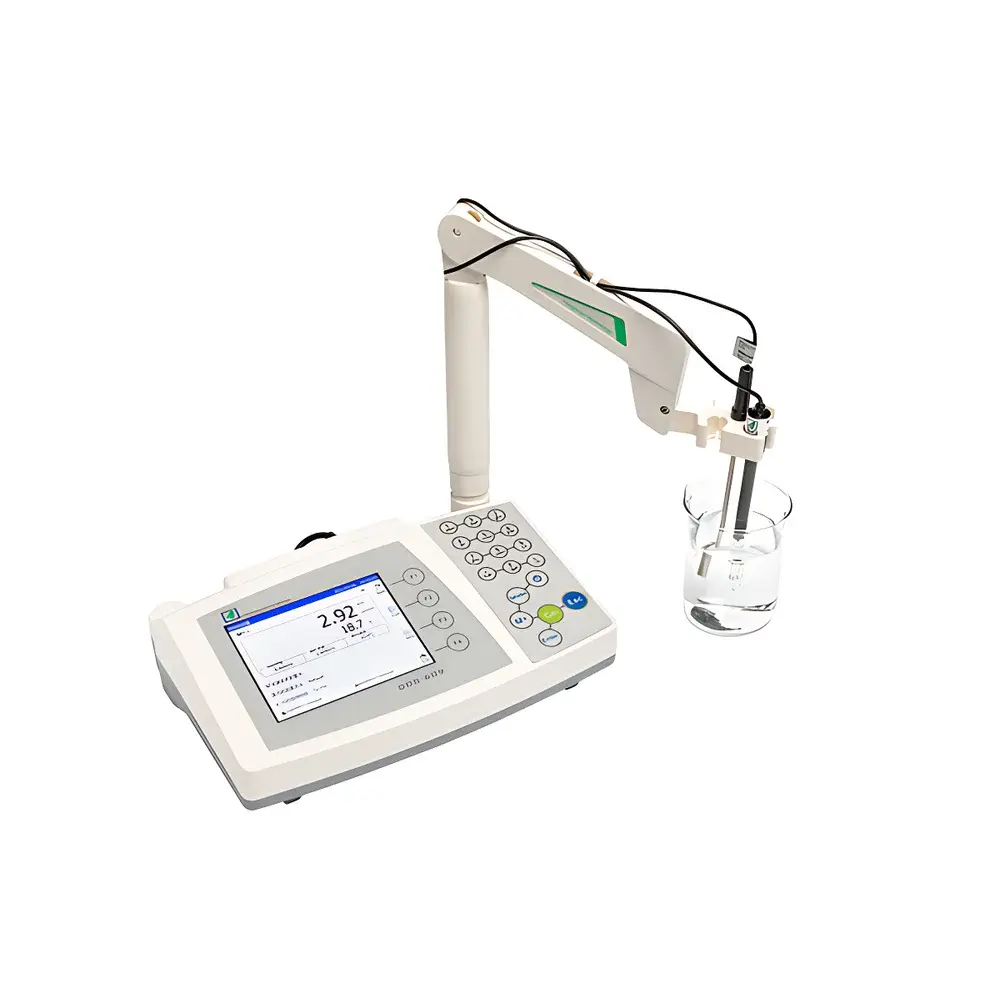
FangZhou DDS-609 Benchtop Conductivity Meter for Acid and Alkaline Samples
| Brand | FangZhou |
|---|---|
| Origin | Sichuan, China |
| Manufacturer Type | Authorized Distributor |
| Product Category | Domestic |
| Model | DDS-609 Acid/Alkali Conductivity Meter |
| Detection Parameters | Conductivity, Resistivity, TDS, Salinity, Conductive Ash, Temperature |
| Portability | Benchtop |
| Application Environment | Laboratory |
| Conductivity Range | (0–2×10⁵) µS/cm |
| TDS Range | (0.00–300.0) g/L |
| Resistivity Range | (5.00–10⁸) Ω·cm |
| Salinity Range | (0.00–80.00) ppt |
| Temperature Range | (−25.0–135.0) °C |
| Accuracy | ±0.5% FS |
| Minimum Conductivity Resolution | 0.0001 µS/cm |
Overview
The FangZhou DDS-609 is a high-precision benchtop conductivity meter engineered for rigorous laboratory analysis of acidic and alkaline aqueous solutions. It operates on the principle of two-electrode or four-electrode conductometric measurement—applying an alternating current across a defined electrode cell geometry to determine solution conductivity without polarization effects. The instrument complies with international electrochemical measurement standards including ISO 7888 (water quality — determination of electrical conductivity), ASTM D1125 (standard test methods for electrical conductivity of water), and supports traceable calibration protocols required under GLP and GMP environments. Designed specifically for aggressive media—including strong acids (e.g., HCl, H₂SO₄) and caustic alkalis (e.g., NaOH, KOH)—the DDS-609 integrates chemically resistant electrode interfaces, temperature-compensated measurement algorithms, and configurable cell constants (DJS = 0.01, 0.1, 1.0, or 10.0 cm⁻¹) to ensure metrological integrity across wide dynamic ranges.
Key Features
- 8-range auto-ranging conductivity measurement with seamless switching between µS/cm and mS/cm scales, supporting full-scale coverage from 0.0000 µS/cm to 2000 mS/cm
- Multi-parameter simultaneous readout: conductivity, resistivity, TDS (with adjustable coefficient 0.2–1.0), salinity (ppt), conductive ash (%), and temperature
- High-resolution 7-inch color TFT display with adjustable backlight, intuitive icon-based navigation, and dual-language UI (English preloaded)
- Comprehensive electrode management system: stores electrode ID, calibration history, cell constant, last calibration date, and status flags (e.g., “calibrated”, “expired”, “out-of-spec”)
- GLP-compliant data architecture: embedded real-time clock, user authentication (1000+ accounts with role-based permissions), method versioning, and audit-trail-enabled operations
- Dual temperature compensation modes: linear (α = 0.000–0.030 °C⁻¹, adjustable) and non-linear (for ultra-pure water and pharmaceutical-grade applications)
- Specialized water-grade modes: Lab Grade I/II/III, USP Purified Water, USP Water for Injection (WFI), and SEMI-International Electronic Grade (EW-I/EW-II/EW-III) with configurable alarm thresholds
Sample Compatibility & Compliance
The DDS-609 is validated for direct measurement of corrosive electrolytes commonly encountered in chemical synthesis, electroplating bath monitoring, boiler water treatment, and pharmaceutical process water qualification. Its electrode interface accommodates standard DIN/ISO-compatible conductivity cells with platinum black or stainless-steel electrodes rated for pH 0–14 and temperatures up to 135 °C. All firmware and calibration logic adhere to ISO/IEC 17025:2017 requirements for testing and calibration laboratories. Instrument-level compliance includes CE marking (EMC Directive 2014/30/EU and LVD Directive 2014/35/EU), RoHS 2011/65/EU, and conformity to Chinese Metrology Law JJG 376–2007 for conductivity meters. Calibration traceability is supported via NIST-traceable reference solutions (KCl 0.01 mol/kg, 0.1 mol/kg, 1.0 mol/kg) and optional certified CRM kits aligned with USP and EP 2.2.38.
Software & Data Management
Data handling conforms to FDA 21 CFR Part 11 requirements for electronic records and signatures when paired with optional FangZhou LabLink Pro software. The instrument features dual communication interfaces: isolated RS-232 (with hardware handshaking) and USB 2.0 (CDC class), enabling direct export to Excel, Word, or CSV without proprietary drivers. Stored datasets (≥100,000 entries) retain full contextual metadata: timestamp, operator ID, method name, electrode serial number, ambient temperature, calibration certificate ID, and diagnostic flags. Report generation supports three formats: Simple (minimal fields), Standard (full parameter set), and GLP (including digital signature, audit trail summary, and calibration verification logs). All internal memory is non-volatile and retains data during power loss; automatic backup occurs at every measurement cycle.
Applications
- Quality control of acid/alkali stock solutions in fine chemical manufacturing
- In-process monitoring of neutralization reactions and titration endpoints
- Validation of purification systems (RO, EDI, distillation) in biopharmaceutical facilities
- Conductivity profiling of cooling tower and steam condensate loops per ASME PTC 19.11
- Environmental lab analysis of industrial effluents per EPA Method 120.1
- Educational use in university analytical chemistry labs for fundamental electrochemistry experiments
FAQ
What electrode constants are supported, and how are they selected?
The DDS-609 accepts cell constants of 0.01, 0.1, 1.0, and 10.0 cm⁻¹. Selection is performed via the Settings > Electrode > Cell Constant menu; the instrument automatically adjusts scaling and resolution accordingly.
Does the instrument support non-linear temperature compensation for ultrapure water?
Yes—select “Non-Linear Compensation” under Temp Mode to activate the IAPWS-95 based algorithm compliant with ASTM D5391 and USP , optimized for resistivity measurements below 1 µS/cm.
How many calibration points can be stored, and what standards are included?
Up to 11 calibration points: 4 Chinese national standards (GB/T 6682), 6 international standards (ASTM, ISO, USP), and 1 user-defined point. All calibrations are time-stamped and linked to electrode ID.
Is remote firmware update possible?
Firmware updates are performed via USB drive using signed .bin files; no network connectivity or cloud dependency is required, ensuring air-gapped security for regulated environments.
Can measurement methods be exported and shared across instruments?
Yes—methods (including parameters, alarms, compensation settings, and report templates) are saved as encrypted .fzm files and can be loaded onto other DDS-609 units via USB, enabling standardized SOP deployment across multi-site labs.
Related Products






