
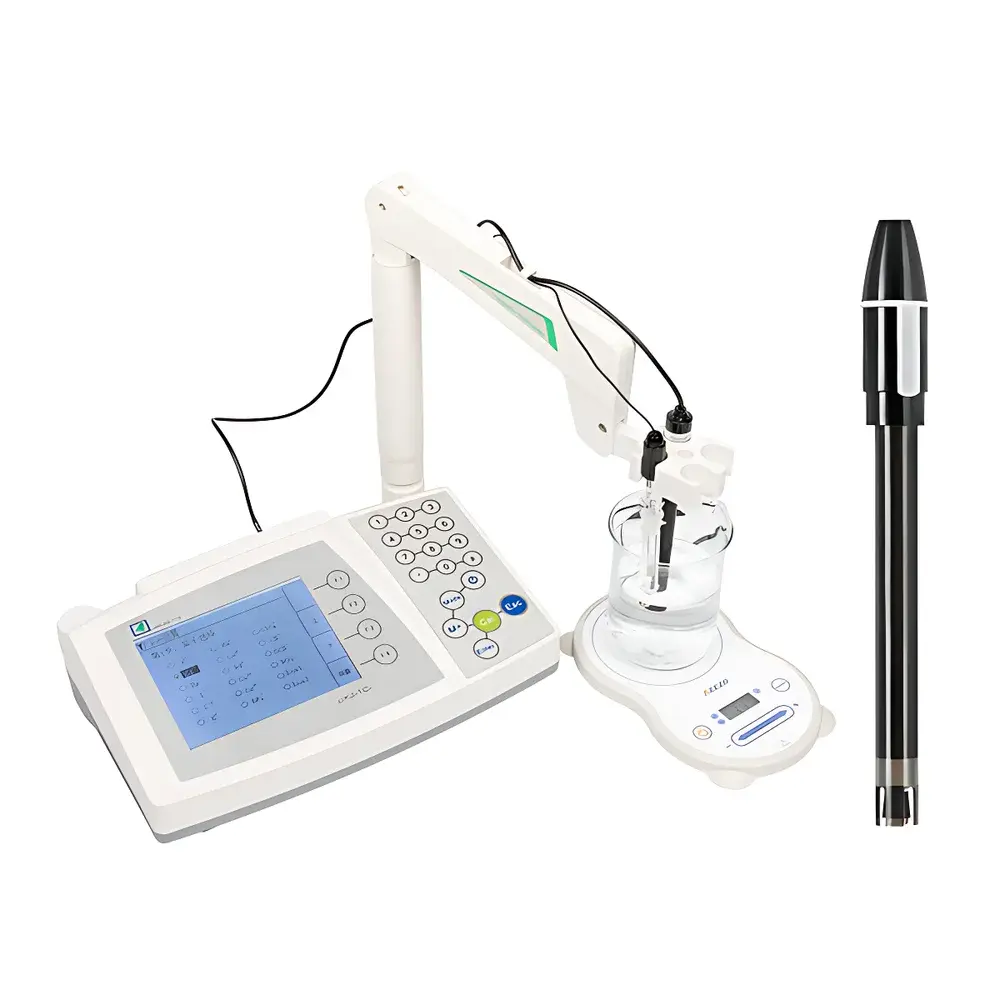
FangZhou PXJ-1C+ Potassium Ion Analyzer
| Brand | FangZhou |
|---|---|
| Origin | Sichuan, China |
| Manufacturer Type | Authorized Distributor |
| Product Category | Domestic |
| Model | PXJ-1C+ |
| Instrument Type | Benchtop |
| Ion Measurement Range | 0–99999 ppm |
| Detection Limit | 9999 ppm |
| Response Time | 3 s |
| Measurement Accuracy | ±0.5% FS ±1 digit |
| Temperature Range | −20.0 to 135.0 °C |
| Temperature Resolution | 0.1 °C |
| Temperature Accuracy | ±0.2 °C ±1 digit |
| Input Impedance | ≥3 × 10¹² Ω |
| Data Storage Capacity | 4096 sets |
| GLP Compliance | Yes |
| Calibration Points | 2–9 points (ion), up to 5 points (pH) |
| Supported Units | pX, ppm, ppb, ppt, mol/L, mmol/L, µmol/L, nmol/L, %, µg/L, mg/L, g/L, ng/L |
| pH Range | −10.000 to 20.000 |
| pH Resolution | 0.001/0.01/0.1 (selectable) |
| pH Accuracy | ±0.002 pH ±1 digit |
| mV Range | −2000.00 to 2000.00 mV |
| mV Resolution | 0.01/0.1/1 mV (selectable) |
| mV Accuracy | ±0.02% FS ±1 digit |
| Interface | BNC electrode port, Pt1000 temperature input, USB, RS232, 0–20 mV analog output |
Overview
The FangZhou PXJ-1C+ Potassium Ion Analyzer is a high-precision benchtop ion concentration meter engineered for rigorous water quality analysis in environmental monitoring laboratories, municipal water treatment facilities, and industrial process control environments. It operates on the principle of potentiometric measurement using selective ion electrodes—specifically optimized for potassium (K⁺) detection—combined with thermistor-based temperature compensation and advanced analog-to-digital signal conditioning. The instrument integrates pH, redox potential (ORP/mV), and multi-ion quantification into a single platform, enabling simultaneous evaluation of critical water quality parameters without requiring separate instrumentation. Its design adheres to fundamental electrochemical measurement standards, including Nernst equation-based response modeling and logarithmic ion activity conversion, ensuring traceable and reproducible results across variable matrix conditions. With a wide operational temperature range (−20.0 to 135.0 °C) and high-input-impedance circuitry (≥3 × 10¹² Ω), the PXJ-1C+ maintains signal integrity even with low-conductivity or high-resistance reference electrodes—essential for accurate K⁺ determination in ultrapure water, soil leachates, and wastewater effluents.
Key Features
- Benchtop architecture with integrated LCD display featuring backlighting and intuitive menu navigation for field-deployable usability in controlled lab settings
- Multi-parameter capability: simultaneous measurement of K⁺ concentration (pX/ppm), pH (−10.000 to 20.000), ORP/mV (−2000.00 to 2000.00 mV), and temperature (−20.0 to 135.0 °C)
- High-resolution readout: 0.001 pH, 0.01 mV, and selectable 1–3-digit resolution for ion concentration (e.g., ppm or pX)
- Advanced calibration flexibility: 2–9-point ion calibration with automatic standard curve generation; up to 5-point pH calibration with auto-recognition of 18 certified buffer solutions
- Comprehensive unit conversion: 13 concentration units supported—including ppm, ppb, mol/L, mmol/L, µmol/L, mg/L, and %—with real-time interconversion during measurement
- GLP-compliant data management: timestamped storage of 4096 measurement records with audit-ready metadata (date, time, electrode ID, calibration status, temperature)
- Dual temperature compensation: ATC (Automatic Temperature Compensation) via Pt1000 sensor or manual entry; compensation range matches full operational temperature span
- Expandable ion support: pre-configured calibration profiles for F⁻, Cl⁻, Br⁻, NH₄⁺, NO₃⁻, Na⁺, and 11 additional ions; two user-definable ion parameters for custom electrode integration
Sample Compatibility & Compliance
The PXJ-1C+ is validated for use with standard liquid-phase aqueous samples, including drinking water, surface water, groundwater, wastewater, agricultural runoff, and industrial process streams. It supports direct measurement using commercially available solid-state or liquid-membrane potassium-selective electrodes (e.g., PVC-based valinomycin membranes). The instrument complies with core regulatory frameworks governing environmental testing, including ASTM D1293 (pH of water), ISO 7888 (electrical conductivity), and US EPA Method 300.0 (ion chromatography reference correlation). While not FDA 21 CFR Part 11-certified out-of-the-box, its GLP-aligned data structure—including immutable timestamps, operator ID fields (via software), and full calibration history logging—facilitates validation for ISO/IEC 17025-accredited laboratories. All firmware and calibration routines are traceable to NIST-traceable reference standards.
Software & Data Management
The PXJ-1C+ interfaces seamlessly with FangZhou’s proprietary “pH-Link” PC software via USB or RS232 connection. This application enables secure data export in CSV and Excel-compatible formats, graphical trend analysis of time-series ion concentration profiles, comparative calibration verification, and batch report generation compliant with internal QA protocols. The software enforces structured data entry, supports electronic signature fields for analyst approval, and maintains full revision history of method configurations. Raw analog outputs (0–20 mV) allow integration into SCADA or PLC-based continuous monitoring systems where real-time K⁺ feedback is required for dosing control loops. Internal memory retains all calibration coefficients and electrode-specific slope/offset values—even after power cycling—ensuring continuity across shifts and operators.
Applications
- Environmental compliance monitoring: Quantification of potassium in riverine and estuarine systems as an indicator of agricultural fertilizer runoff or wastewater discharge
- Drinking water safety assessment: Verification of K⁺ levels in desalinated or softened water where elevated concentrations may affect taste or corrosion behavior
- Soil and sediment leaching studies: Extraction solution analysis per ISO 11268-1 protocols to assess cation exchange capacity and nutrient mobility
- Pharmaceutical manufacturing: Monitoring potassium content in purified water (PW) and water-for-injection (WFI) systems per USP
- Food and beverage QC: Verification of potassium fortification in dairy alternatives, sports drinks, and infant formula against Codex Alimentarius limits
- Academic research: Teaching potentiometric principles in analytical chemistry labs and supporting ion-selective electrode characterization studies
FAQ
What electrode types are compatible with the PXJ-1C+ for potassium measurement?
The analyzer accepts standard BNC-output potassium-selective electrodes with integrated or separate reference junctions. Recommended models include valinomycin-based PVC membrane electrodes with Ag/AgCl reference systems.
Does the PXJ-1C+ support automatic electrode diagnostics?
Yes—it performs real-time impedance monitoring and displays electrode slope, offset, and response stability indicators during calibration and measurement cycles.
Can calibration data be exported for audit purposes?
All calibration events—including date/time stamp, standard concentrations used, measured mV values, calculated slope/intercept, and pass/fail status—are stored internally and exportable via pH-Link software.
Is temperature compensation mandatory for ion measurements?
While manual temperature entry is permitted, ATC is strongly recommended: the Nernstian response of ion-selective electrodes exhibits inherent thermal dependence, and uncoupled temperature readings introduce systematic error exceeding ±2% per 10 °C deviation.
How is measurement uncertainty estimated for potassium results?
Total uncertainty derives from electrode slope error (±1–2 mV), temperature measurement tolerance (±0.2 °C), standard solution purity (typically ±0.5%), and instrument resolution—combined per GUM (ISO/IEC Guide 98-3) methodology in validated lab SOPs.
Related Products







