
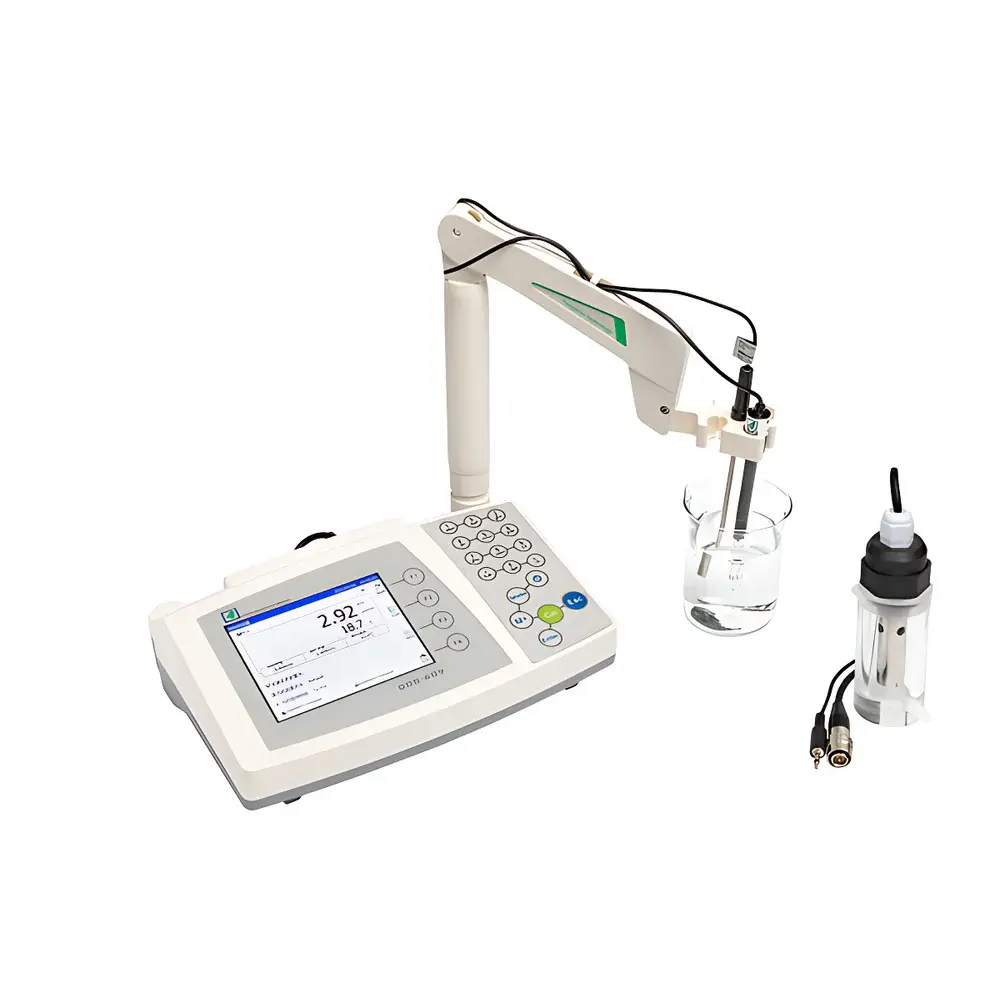
FangZhou DDS-609 Power Plant Water Conductivity Analyzer
| Brand | FangZhou |
|---|---|
| Origin | Sichuan, China |
| Manufacturer Type | Authorized Distributor |
| Product Category | Domestic |
| Model | DDS-609 Power Plant Water Conductivity Analyzer |
| Detection Parameters | Conductivity, Resistivity, TDS, Salinity, Conductivity Ash, Temperature |
| Portability | Benchtop |
| Application Environment | Laboratory |
| Conductivity Range | (0–2×10⁵) µS/cm |
| TDS Range | (0.00–300.0) g/L |
| Resistivity Range | (5.00–10⁸) Ω·cm |
| Salinity Range | (0.00–80.00) ppt |
| Temperature Range | (−25.0–135.0) °C |
| Accuracy | ±0.5% FS |
| Minimum Resolution | 0.0001 µS/cm |
Overview
The FangZhou DDS-609 Power Plant Water Conductivity Analyzer is a high-precision benchtop electrochemical instrument engineered for continuous, trace-level monitoring and quality control of ultrapure and process water in thermal power generation, nuclear power, and related industrial water treatment systems. It operates on the principle of two-electrode or four-electrode AC conductivity measurement, applying a low-frequency sinusoidal excitation voltage to minimize polarization effects and electrode fouling—critical for long-term stability in low-conductivity boiler feedwater and condensate applications. The analyzer supports dual-mode temperature compensation (linear and non-linear), configurable reference temperatures (15.0–25.0 °C), and user-definable TDS conversion factors (0.20–1.00), enabling compliance with multiple international water purity standards including ASTM D1125, ISO 7888, IEC 60454-2, and GB/T 6908–2018 for power plant water specifications.
Key Features
- 8-range auto-ranging conductivity measurement with dynamic resolution adjustment from 0.0001 µS/cm (at lowest range) to 1 mS/cm (at highest range), ensuring optimal signal-to-noise ratio across ultra-pure water (≤0.1 µS/cm) and high-salinity cooling water (up to 200 mS/cm)
- Integrated multi-parameter capability: simultaneous real-time display and logging of conductivity, resistivity, TDS, salinity, conductivity ash, and temperature—with independent calibration and compensation per parameter
- Intelligent electrode management system supporting DJS-0.01, 0.1, 1.0, and 10.0 cm⁻¹ cell constants; automatic electrode ID recognition, calibration history tracking, and validity timestamping
- Comprehensive GLP-compliant data governance: audit-trail-enabled user authentication (1000+ accounts), method versioning (1000 stored methods), sample ID tagging, and electronic signature support
- Triple-compensation architecture: selectable non-linear temperature compensation curves optimized for deionized water, boiler feedwater, and seawater matrices—aligned with IAPWS formulations for enhanced accuracy below 1 µS/cm
- Industrial-grade benchtop enclosure with IP54-rated front panel, wide-temperature LCD (−25–135 °C operating range), adjustable backlight, and tactile membrane keypad for glove-compatible operation in control rooms or QC labs
Sample Compatibility & Compliance
The DDS-609 is validated for use with Type I–III laboratory water (per ISO 3696 and ASTM D1193), pharmaceutical purified water and water for injection (WFI) per USP , and electronic-grade water (EW-I/II/III per SEMI F63), with built-in alarm thresholds for each grade. It meets the electrical safety requirements of IEC 61010-1 and electromagnetic compatibility per IEC 61326-1. All calibration protocols adhere to ISO/IEC 17025 traceability principles, supporting metrological verification against NIST-traceable KCl standard solutions (0.01 mol/kg to 1.0 mol/kg). Data integrity complies with FDA 21 CFR Part 11 requirements via secure user roles, immutable audit logs, and electronic record export in GLP-formatted CSV or Excel-ready reports.
Software & Data Management
Data acquisition and reporting are governed by embedded firmware compliant with GLP documentation standards. The instrument stores ≥100,000 measurement records with full metadata: timestamp (date/time), operator ID, method name, electrode serial number, calibration status, ambient temperature, and diagnostic flags. Data export occurs via RS-232 or USB interface in three formats: Simple (raw values only), Standard (with method and electrode metadata), and GLP (including audit trail, calibration certificates, and electronic signatures). Integrated PC software enables direct import into Microsoft Excel, Word, or LIMS platforms using standardized .csv or .xlsx templates—eliminating manual transcription errors. All stored methods support version control, duplication, and role-based editing permissions.
Applications
- Real-time monitoring of demineralized water in high-pressure boiler feed circuits and steam condensate return lines
- Validation of reverse osmosis (RO) and electrodeionization (EDI) system performance in power plant make-up water treatment trains
- QC testing of ultrapure water used in turbine lube oil conditioning and hydrogen-cooled generator cooling loops
- Compliance verification for nuclear power plant secondary coolant chemistry per EPRI TR-102323 and IEEE 383
- Pharmaceutical facility water system qualification (IQ/OQ/PQ) under Annex 1 and EU GMP guidelines
- Research-grade characterization of ionic impurity profiles in semiconductor fabrication rinse water
FAQ
Does the DDS-609 support non-linear temperature compensation for ultrapure water?
Yes—it implements a piecewise polynomial algorithm aligned with the International Association for the Properties of Water and Steam (IAPWS) conductivity-temperature model, specifically optimized for resistivity measurements below 1 µS/cm.
Can calibration data be traced to national metrology institutes?
Calibration is performed using certified KCl reference solutions traceable to NIST SRM 3880 or equivalent national standards; calibration certificates include uncertainty budgets per ISO/IEC 17025.
Is user permission management compatible with FDA 21 CFR Part 11?
Yes—role-based access control (RBAC), electronic signatures, and immutable audit trails meet Part 11 requirements for electronic records and signatures in regulated environments.
What electrode constants are supported, and how is cell constant verification performed?
Four fixed cell constants are supported (0.01, 0.1, 1.0, 10.0 cm⁻¹); cell constant is verified during calibration using at least four certified standard solutions spanning the operational range.
How does the instrument handle electrode drift in long-term unattended operation?
It performs automated self-diagnostic checks before each measurement cycle—including open-circuit detection, short-circuit validation, and impedance monitoring—and triggers visual/audible alerts when electrode performance deviates beyond ±2% of nominal constant.



