
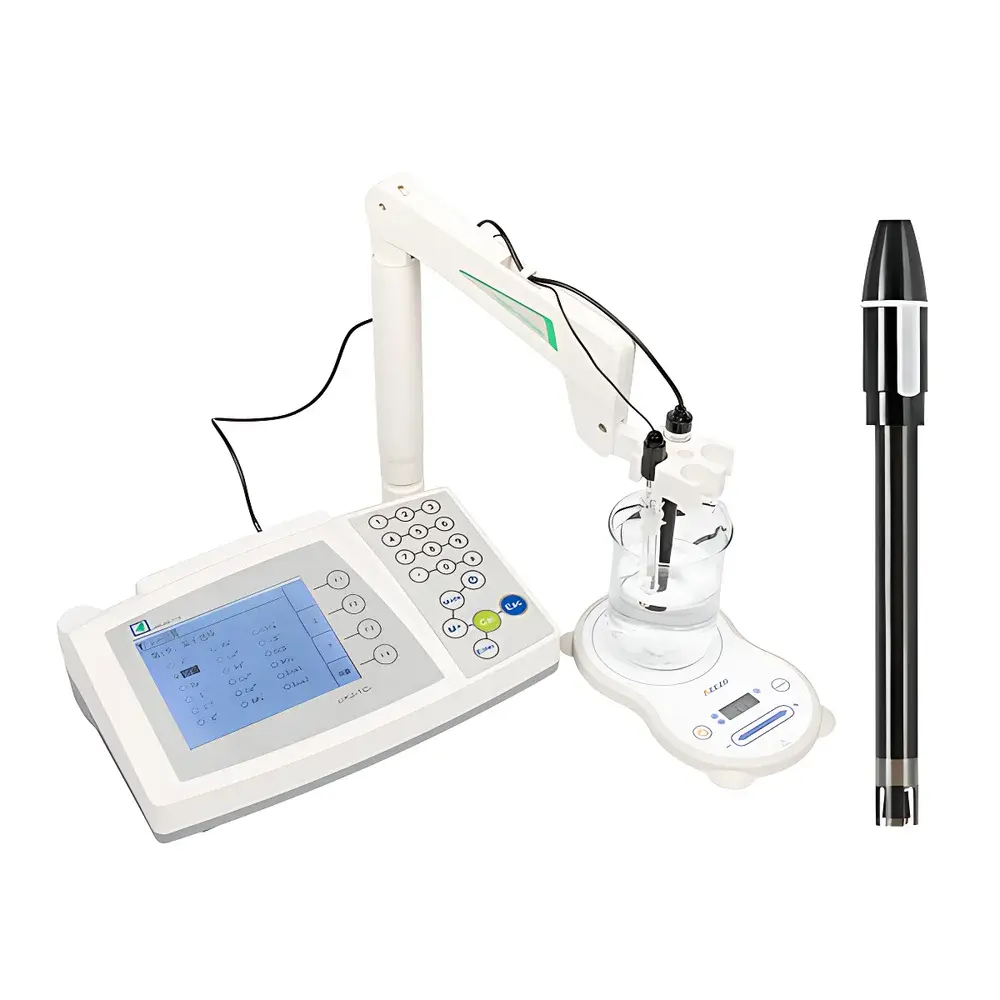
FangZhou PXJ-1C+ Chloride Ion Analyzer
| Brand | FangZhou |
|---|---|
| Origin | Sichuan, China |
| Manufacturer Type | Authorized Distributor |
| Product Category | Domestic |
| Model | PXJ-1C+ Chloride Ion Analyzer |
| Instrument Type | Benchtop |
| Ion Measurement Range | 0–99999 ppm |
| Detection Limit | 9999 ppm |
| Response Time | 3 s |
| Measurement Accuracy | ±0.5% FS ±1 digit |
| Temperature Range | −20.0–135.0 °C |
| Resolution | 0.001 pH / 0.01 mV / 0.1 °C |
| Data Storage Capacity | 4096 records |
| Calibration Points | 2–9 points (ion), up to 5 points (pH) |
| Compliance | GLP-compliant |
| Interface | USB, RS-232, 0–20 mV analog output |
| Input Impedance | ≥3×10¹² Ω |
Overview
The FangZhou PXJ-1C+ Chloride Ion Analyzer is a high-precision benchtop ion concentration meter engineered for rigorous water quality analysis in environmental monitoring, municipal water treatment, industrial process control, and laboratory research settings. Based on potentiometric measurement using selective ion electrodes (e.g., chloride-selective electrode with Ag/AgCl sensing element), the instrument quantifies chloride activity in aqueous solutions via Nernst equation-derived calibration. Its architecture supports multi-parameter measurement—including pH, mV, ORP, and temperature—within a single platform, eliminating the need for separate instruments during routine compliance testing. Designed to meet international methodological expectations for ion analysis, it delivers trace-level resolution and robust reproducibility across wide dynamic ranges, making it suitable for applications ranging from drinking water compliance (per ISO 10523, ASTM D4192) to wastewater effluent monitoring under regulatory frameworks such as EPA Method 300.1 and EU Directive 2020/2184.
Key Features
- Benchtop design with large backlit LCD display and intuitive menu-driven navigation for operation in low-light field or lab environments
- GLP-compliant data management: timestamped storage of 4096 measurement records with automatic date/time stamping (real-time clock integrated)
- Multi-ion capability: pre-programmed calibration parameters for 16 standard ions (Cl⁻, F⁻, Br⁻, NH₄⁺, NO₃⁻, Na⁺, etc.) plus two user-definable ions
- Flexible concentration unit conversion: 13 selectable units including ppm, ppb, mol/L, mmol/L, μmol/L, ng/L, mg/L, g/L, %, and pX scale
- Advanced calibration architecture: 2–9 point ion calibration with automatic standard curve generation; up to 5-point pH calibration with auto-recognition of 4 preloaded buffer sets (including DIN, NIST, and USP standards)
- Temperature compensation: ATC (Automatic Temperature Compensation) and manual modes supported over −20.0–135.0 °C range; accuracy ±0.2 °C ±1 digit
- High-input-impedance circuitry (≥3×10¹² Ω) ensures minimal loading error when paired with high-impedance ion-selective electrodes
- Dual-mode measurement: real-time continuous monitoring, timed interval acquisition, and triggered auto-measurement
Sample Compatibility & Compliance
The PXJ-1C+ is optimized for aqueous samples with total dissolved solids (TDS) ≤ 10,000 ppm and conductivity < 20 mS/cm. It accommodates standard chloride-selective electrodes (e.g., Ag/AgCl solid-state or liquid-membrane types) via universal electrode interface and optional adapter modules. The system meets fundamental requirements for regulatory data integrity per GLP (Good Laboratory Practice) guidelines, including audit-trail-ready data logging, operator ID tagging (via software), and immutable record timestamps. While not inherently 21 CFR Part 11 compliant out-of-the-box, its data export architecture (CSV, TXT) and “FangZhou pH-Link” software enable integration into validated LIMS environments where electronic signatures and access controls are externally managed. It conforms to ISO 7888 (electrochemical methods for water analysis) and supports validation against ISO/IEC 17025 accredited test procedures.
Software & Data Management
The included FangZhou pH-Link PC software provides secure bidirectional communication via USB or RS-232. Users can download full datasets, generate calibration reports, perform statistical analysis (mean, SD, RSD), and export formatted reports compatible with Microsoft Excel and PDF printers. All exported files retain embedded metadata: measurement ID, electrode serial number (if entered), calibration history, ambient temperature, and operator notes. Raw data files include header information required for traceability in QA/QC documentation. The software supports batch export for multi-sample workflows and allows custom report templates aligned with internal SOPs or regional regulatory submission formats (e.g., EPA Form 3320-1).
Applications
- Drinking water quality verification: chloride monitoring per WHO Guidelines for Drinking-water Quality (limit: 250 mg/L) and national standards (e.g., GB 5749–2022)
- Wastewater discharge compliance: effluent chloride tracking prior to release into receiving waters (EPA NPDES permits)
- Industrial cooling water systems: corrosion risk assessment via chloride-to-sulfate ratio analysis
- Food and beverage processing: brine concentration control in pickling, curing, and dairy sanitation protocols
- Soil leachate and groundwater studies: anion migration modeling in environmental impact assessments
- Pharmaceutical water systems: purified water and WFI (Water for Injection) monitoring per USP and EP 2.2.38
FAQ
What electrode types are compatible with the PXJ-1C+ for chloride measurement?
The analyzer supports standard BNC-interface chloride-selective electrodes, including solid-contact Ag/AgCl sensors and liquid-membrane electrodes. An optional electrode converter module enables use of DIN, T-type, or mini-pin connectors.
Does the instrument support automatic electrode diagnostics?
Yes—built-in self-diagnostic routines evaluate electrode slope, asymmetry potential, and reference junction stability during calibration and measurement cycles.
Can calibration curves be exported for external validation?
Calibration parameters (slope, intercept, R²) and raw standard readings are exportable via pH-Link software in CSV format, enabling third-party verification and uncertainty budgeting per ISO/IEC 17025 Annex A.
Is temperature compensation mandatory for chloride measurements?
While manual compensation is permitted, ATC is strongly recommended—especially outside 15–25 °C—as Nernstian response exhibits measurable thermal dependence; the instrument applies the theoretical temperature coefficient (−0.198 mV/°C per decade for Cl⁻ at 25 °C) in real time.
How is data security ensured during transfer to a networked LIMS?
Data export is file-based (no direct database injection); users implement encryption, access controls, and audit logging at the host system level—consistent with ALCOA+ principles for raw data integrity.







