
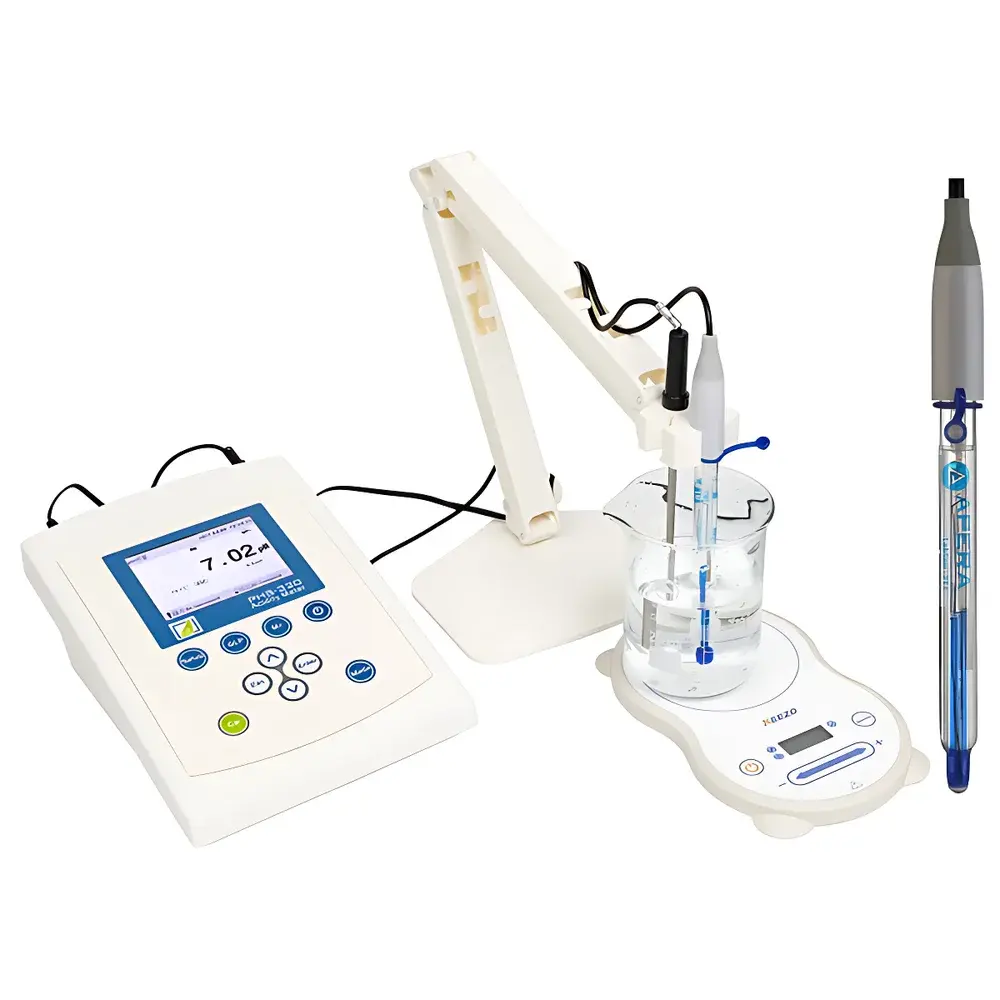
FangZhou PHS-320 Protein-Sample pH Meter
| Brand | FangZhou |
|---|---|
| Origin | Sichuan, China |
| Manufacturer Type | Authorized Distributor |
| Instrument Type | Multiparameter Benchtop pH Meter |
| Measurement Accuracy | ±0.002 pH |
| pH Range | −5.000 to 20.000 pH |
| Resolution | 0.001 / 0.01 / 0.1 pH (user-selectable) |
| mV Range | −2000.00 to +2000.00 mV |
| mV Resolution | 0.01 / 0.1 / 1 mV (user-selectable) |
| Temperature Range | −20.0 to 135.0 °C |
| Temp. Resolution | 0.1 °C |
| Temp. Accuracy | ±0.2 °C ±1 digit |
| Input Impedance | ≥3 × 10¹² Ω |
| Calibration | Up to 5-point auto-recognized NIST-traceable buffer sets (33 buffers across 7 international standards including NIST, DIN, JIS, USP, and ISO) |
| GLP Compliance | Full audit trail, user ID (10), sample ID (10), timestamped data logging (≥100,000 entries), RS232 interface with printer/PC export (Excel, Word, plain text), 24-hr clock & date stamp |
| Electrode Compatibility | Dedicated protein-, low-ionic-strength-, viscous-, micro-volume-, surface-, and extreme-pH electrodes (HF-resistant, alkaline-resistant, planar, semi-micro, and ultra-micro configurations) |
Overview
The FangZhou PHS-320 Protein-Sample pH Meter is a high-precision, microprocessor-controlled benchtop electrochemical analyzer engineered for rigorous laboratory environments where measurement integrity, reproducibility, and regulatory traceability are critical. Designed specifically for challenging biological and industrial matrices—including protein-rich solutions (e.g., cell lysates, fermentation broths, antibody formulations), low-conductivity samples (ultrapure water, dialysates), viscous media (gels, emulsions), and heterogeneous suspensions (soil extracts, wastewater)—the PHS-320 employs a dual-junction reference system architecture and high-input-impedance analog front-end (>3 × 10¹² Ω) to minimize liquid junction potential drift and electrode polarization errors. Its core measurement principle adheres to the Nernst equation, with real-time temperature compensation (ATC or manual) applied via integrated Pt1000 or thermistor inputs. The instrument meets the metrological requirements of Class 0.001 pH meters per JJG 119–2018 (China), while its calibration logic supports full compliance with international reference material frameworks—NIST SRM, DIN 19266/19267, JIS Z 8802, and USP . It is not a general-purpose handheld device but a GLP- and GMP-aligned analytical platform intended for QC labs in biopharmaceutical manufacturing, food safety testing, environmental monitoring, and academic research.
Key Features
- True-color 4.3-inch TFT LCD with graphical real-time trend display, intuitive menu navigation, and multi-language UI support (English, Spanish, German, Chinese)
- User-configurable resolution modes: 0.001 pH / 0.01 mV (high-precision mode) or adaptive coarser resolution for noisy environments
- Comprehensive electrode diagnostics: impedance monitoring, asymmetry potential check, slope validation, and junction status reporting
- Seven preloaded buffer groups (33 total standards) with automatic recognition during calibration—supports single-, two-, three-, four-, or five-point protocols
- Five measurement modes: Real-time (continuous), Timed (user-defined interval), Auto-Fast (≤1 sec response), Auto-Medium (2–5 sec), Auto-Slow (≥10 sec) — optimized for unstable or slow-equilibrating samples
- Dedicated isopotential adjustment (−20.000 to +20.000 mV offset) to accommodate non-zero-reference electrodes (e.g., Ag/AgCl with KCl-saturated fill solution)
- Integrated temperature sensor input with automatic or manual compensation; compatible with external Pt1000, NTC, or built-in probe
- Internal clock and calendar (RTC) synchronized to all stored measurements—enabling full 21 CFR Part 11–compliant audit trails when paired with validated software
Sample Compatibility & Compliance
The PHS-320 is explicitly engineered for physicochemically demanding samples that compromise conventional pH meters. Its modular electrode ecosystem includes FDA-compliant food-grade stainless-steel puncture probes for cheese and fruit, double-junction low-flow-rate electrodes for protein adsorption resistance, open-junction ceramic sleeves for suspended solids, and specialized micro-volume electrodes (≥15 µL minimum volume) for PCR tubes and microcentrifuge applications. All configurations maintain stable liquid junction potentials in high-protein, high-fat, or low-ionic-strength environments. The instrument conforms to GLP principles as defined in OECD Series on Principles of Good Laboratory Practice and aligns with ISO/IEC 17025:2017 clause 7.7 (uncertainty of measurement) through documented calibration records, user authentication, and tamper-evident data storage. While not certified to IEC 61010-1 for hazardous locations, it complies with CE electromagnetic compatibility (EMC) directives and RoHS 2.0 material restrictions.
Software & Data Management
Data integrity is enforced via a secure RS232 serial interface supporting three operational modes: (1) Direct printing to ESC/POS-compatible thermal printers in GLP-formatted reports (including operator ID, sample ID, timestamp, calibration history, and electrode metadata); (2) Bidirectional PC communication using ASCII-based protocol—data exports natively into Microsoft Excel (.csv), Word (.txt), or Notepad without proprietary drivers; (3) Remote instrument control (start/stop measurement, recall calibration, initiate diagnostics) via terminal emulation. Internal memory retains ≥100,000 timestamped entries with full GLP fields: date/time, pH/mV/T values, electrode serial number (if encoded), calibration buffer IDs, slope (%), offset (mV), and user-assigned identifiers. Exported files include SHA-256 checksums for data authenticity verification—essential for FDA audit readiness and internal QA documentation.
Applications
- Biopharmaceutical process development: monitoring pH stability of monoclonal antibody formulations, cell culture media, and purification buffers containing bovine serum albumin (BSA) or casein
- Food & beverage QC: measuring pH of dairy products (yogurt, whey, cheese), fermented foods (kimchi, soy sauce), and protein-fortified beverages without electrode fouling
- Environmental analysis: determining acidity in soil leachates, anaerobic digestate, and wastewater with suspended solids or sulfide interference
- Clinical & diagnostic research: quantifying pH shifts in protein electrophoresis gels, ELISA wash buffers, and nucleic acid extraction eluents
- Materials science: evaluating hydrolysis kinetics of biodegradable polymers and epoxy resins under controlled pH conditions
FAQ
Does the PHS-320 support ISO/IEC 17025-compliant uncertainty estimation?
Yes—the instrument’s documented accuracy (±0.002 pH), repeatability (0.001 pH), temperature compensation error (±0.2 °C), and calibration uncertainty (based on NIST-traceable buffers) provide foundational inputs for laboratory-specific uncertainty budgets per ISO/IEC Guide 98-3.
Can the PHS-320 be validated for 21 CFR Part 11 compliance?
The hardware supports key technical controls (audit trail, electronic signatures, role-based access). Full Part 11 compliance requires implementation of validated third-party software for user management, digital signature enforcement, and electronic record archiving.
What electrode types are recommended for measuring pH in undiluted milk or serum?
Use the optional FZ-600T protein-resistant electrode with open ceramic junction and low-fouling glass membrane—specifically designed for high-fat, high-protein matrices without requiring dilution or frequent cleaning.
Is automatic temperature compensation (ATC) mandatory for accurate pH readings?
No—ATC is optional. Manual temperature entry is supported; however, ATC is strongly recommended for samples exhibiting significant thermal drift during measurement, especially in kinetic studies or uncontrolled ambient environments.
How does the PHS-320 handle calibration when using non-standard buffers (e.g., TRIS or phosphate-based)?
It supports user-defined buffer tables: up to 10 custom buffers can be entered with assigned nominal pH values at specified temperatures, enabling traceable calibration against lab-prepared standards used in specialized assays.
Related Products



