
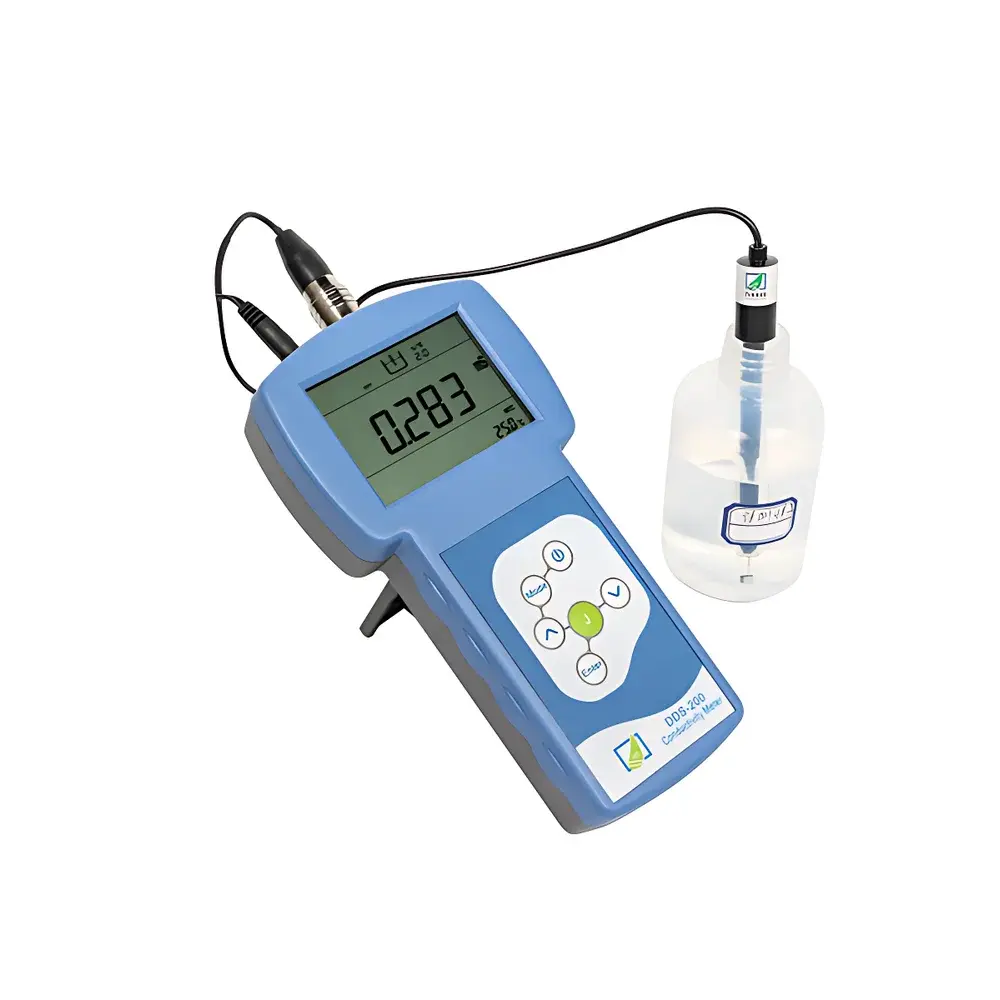
FangZhou DDS-200 Portable Wastewater Conductivity Meter
| Brand | FangZhou |
|---|---|
| Origin | Sichuan, China |
| Model | DDS-200 Portable Wastewater Conductivity Meter |
| Portability | Handheld |
| Application Environment | Laboratory & Field |
| Conductivity Range | 0–1×10⁵ µS/cm |
| TDS Range (at coefficient = 1) | 0.00–200.0 g/L |
| Resistivity Range | 5.00–10⁸ Ω·cm |
| Salinity Range | 0.00–80.00 ppt |
| Temperature Range | −15.0–125.0 °C |
| Accuracy | ±1.0% FS |
| Minimum Resolution | 0.001 µS/cm |
| IP Rating | IP65 |
| Data Storage | 200 measurement sets |
| Auto-Temperature Compensation (ATC) | Yes |
| Electrode Compatibility | DJS-0.01 / 0.1 / 1.0 / 10.0 cells |
| Power Supply | AC/DC dual-mode |
| Default Auto-Off | 10 min (user-adjustable) |
Overview
The FangZhou DDS-200 Portable Wastewater Conductivity Meter is a microprocessor-controlled electrochemical instrument engineered for precise, field-deployable measurement of electrical conductivity, total dissolved solids (TDS), resistivity, salinity, and temperature in aqueous samples—particularly wastewater, surface water, effluent, and process streams. It operates on the principle of two-electrode or four-electrode conductometric measurement, where conductivity is determined by applying an alternating current across a known cell geometry and calculating conductance (G) from the measured voltage and current. The instrument automatically selects one of seven measurement ranges (from 0.000 to 200.0 mS/cm) based on sample conductivity, eliminating manual range switching and minimizing user error. Its robust architecture, combined with low-voltage frequency-modulated excitation and high-resolution 24-bit A/D conversion, ensures stable readings under variable environmental conditions—including fluctuating ambient temperatures and electromagnetic interference common in industrial or outdoor settings.
Key Features
- IP65-rated enclosure for dust-tight and water-jet resistant operation—validated for use in humid laboratories, wastewater treatment plants, and field sampling sites.
- Multi-parameter capability: simultaneous real-time display of conductivity, TDS (with adjustable coefficient 0.00–1.00), resistivity, salinity (in ppt), and temperature (°C).
- Intelligent auto-ranging across seven decades (0.000 µS/cm to 200.0 mS/cm), optimized for wastewater matrices ranging from ultrapure influent to highly saline discharge.
- Automatic temperature compensation (ATC) with NTC thermistor-based sensing and selectable linear temperature coefficient (default 2.0%/°C per ISO 7888); manual compensation also supported.
- Dual power mode: rechargeable Li-ion battery (≥12 h continuous operation) and universal AC adapter (100–240 V, 50/60 Hz), enabling uninterrupted deployment during extended monitoring campaigns.
- Non-volatile memory storing up to 200 timestamped datasets, including calibration history, electrode constants, and measurement metadata—retained after power loss.
- Ergonomic handheld design with tactile silicone keypad and backlit LCD (128 × 64 pixels), readable under direct sunlight and low-light conditions.
Sample Compatibility & Compliance
The DDS-200 is validated for use with standard conductivity cells conforming to DIN EN 27888 and ASTM D1125 test methods. It supports interchangeable electrodes with cell constants of 0.01, 0.1, 1.0, and 10.0 cm⁻¹—enabling accurate measurements across diverse sample types: low-conductivity source waters (e.g., reverse osmosis permeate), mid-range municipal wastewater (1–20 mS/cm), and high-salinity industrial discharges (>50 mS/cm). The instrument meets IEC 61000-4 electromagnetic compatibility standards and complies with ISO 9001:2015 quality management system requirements. While not certified for GLP/GMP-regulated environments out-of-the-box, its audit-ready data logging, calibration traceability (stored electrode constant and date/time stamps), and configurable auto-off timer support alignment with internal QA/QC protocols required by environmental testing labs operating under EPA Method 120.1 or ISO 7888.
Software & Data Management
Data export is performed via USB-C interface to Windows-based PCs using FangZhou’s proprietary PC-Link software (v3.2+), which provides CSV export, calibration report generation, and trend visualization. Each stored record includes measurement value, unit, temperature, date/time stamp, electrode ID (if entered), and calibration status flag. The software enforces user-defined password protection for calibration parameter modification and supports electronic signature logging for audit trails—facilitating partial compliance with FDA 21 CFR Part 11 when deployed within controlled laboratory information management systems (LIMS). No cloud connectivity or remote firmware updates are implemented; all configuration changes occur locally to ensure data sovereignty and cybersecurity integrity.
Applications
- Wastewater treatment plant (WWTP) process control: monitoring influent conductivity for load estimation, activated sludge tank profiling, and final effluent compliance verification against local discharge permits (e.g., China’s GB 8978–1996 or EU Urban Wastewater Treatment Directive).
- Environmental field surveys: rapid assessment of river, lake, and groundwater contamination gradients—especially chloride intrusion, agricultural runoff, or industrial leachate plumes.
- Pharmaceutical water system validation: preliminary checks of purified water (PW) and water-for-injection (WFI) conductivity per USP , though final release testing requires dedicated online sensors meeting stricter accuracy criteria.
- Food & beverage QC: incoming raw water screening, brine concentration verification, and CIP rinse water conductivity monitoring.
- Educational laboratories: hands-on instruction in solution chemistry, ionic strength theory, and sensor calibration principles—supported by programmable TDS coefficients and manual temperature compensation modes.
FAQ
What electrode constants are supported?
The DDS-200 accepts standard conductivity cells with cell constants of 0.01, 0.1, 1.0, and 10.0 cm⁻¹. The instrument automatically recognizes the selected constant if encoded in the electrode connector; otherwise, it must be manually entered during calibration.
Does the meter support GLP-compliant calibration records?
It stores full calibration history (date, time, standard used, slope, offset, electrode constant) in non-volatile memory and exports it via PC-Link software. While not inherently 21 CFR Part 11 compliant, the data structure supports integration into validated LIMS environments with supplementary procedural controls.
Can the device measure seawater salinity accurately?
Yes—it measures salinity in ppt over 0.00–80.00 ppt with ±2.0 ppt ±1 digit accuracy, suitable for estuarine and coastal monitoring. For oceanographic-grade precision (±0.01 ppt), a dedicated CTD probe is recommended.
Is temperature compensation mandatory?
No—both automatic (ATC) and manual temperature compensation modes are available. Manual mode allows fixed-temperature correction when measuring at non-ambient reference points (e.g., 25.0 °C standardized reporting).
How is data integrity maintained during power interruption?
All calibration parameters, electrode constants, and logged measurements are stored in EEPROM. Power loss does not erase stored data or reset instrument configuration.





