
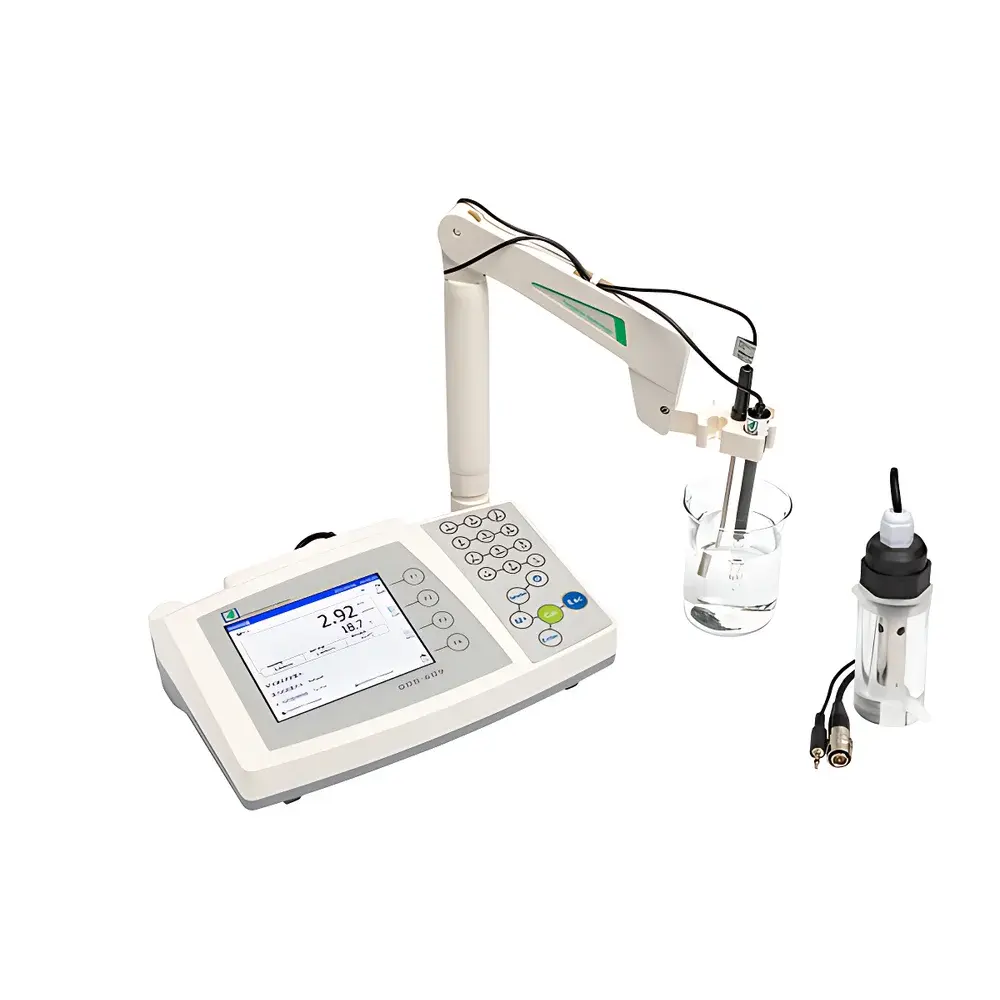
FangZhou DDS-609 Sugar-Specific Conductivity Analyzer
| Brand | FangZhou |
|---|---|
| Origin | Sichuan, China |
| Manufacturer Type | Authorized Distributor |
| Product Category | Domestic |
| Model | DDS-609 Sugar-Specific Conductivity Analyzer |
| Conductivity Range | (0–2×10⁵) µS/cm |
| TDS Range | (0.00–300.0) g/L |
| Resistivity Range | (5.00–10⁸) Ω·cm |
| Salinity Range | (0.00–80.00) ppt |
| Temperature Range | (−25.0–135.0) °C |
| Accuracy | ±0.5% FS |
| Minimum Resolution | 0.0001 µS/cm |
| Compliance | ISO 9001 certified |
| GLP Support | Full audit trail, user authentication, method versioning, electronic signature-ready data export (GLP, Standard, Simplified formats) |
Overview
The FangZhou DDS-609 Sugar-Specific Conductivity Analyzer is a high-precision, laboratory-grade electrochemical instrument engineered for accurate and traceable measurement of electrical conductivity in sugar-rich aqueous matrices—including sucrose solutions, molasses, syrups, beet and cane juice, and refined sugar process streams. Unlike general-purpose conductivity meters, the DDS-609 integrates sugar-specific compensation algorithms and multi-point calibration protocols aligned with ISO 21527, ICUMSA Method GS4/3-12, and national standard GB/T 10498–2022 for sugar industry applications. It operates on the principle of two-electrode or four-electrode AC conductometry (1 kHz excitation frequency), minimizing polarization errors and electrode fouling common in high-viscosity, high-solids-content sugar solutions. The instrument supports dual-mode temperature compensation—linear and non-linear (polynomial)—with configurable reference temperatures (15.0–25.0 °C) and adjustable temperature coefficients (0.00–4.00 %/°C), enabling rigorous compliance with pharmacopeial and food-grade water specifications (e.g., USP , EP 2.2.38, and Chinese Pharmacopoeia ChP IV).
Key Features
- 8-range auto-scaling conductivity measurement with dynamic resolution from 0.0001 µS/cm to 2000 mS/cm, optimized for low-conductivity pure water and high-conductivity industrial sugar liquors
- Dual-mode temperature compensation: automatic (ATC) via integrated Pt1000 sensor or manual (MTC) input; non-linear compensation enabled for precision in concentrated sucrose solutions where conductivity vs. temperature deviates from linearity
- Sugar-specific operational modes: Laboratory Grade I/II/III Water, Pharmaceutical Purified Water (PW), Water for Injection (WFI), and Electronic Grade Water (EW-I/EW-II/EW-III), each with configurable alarm thresholds and pass/fail logic
- Comprehensive electrode management: DJS constant programmability (0.01, 0.1, 1.0, 10.0 cm⁻¹), electrode ID registration, calibration history logging (date/time, operator, standard used), and validity status flagging
- Full GLP-compliant data architecture: 1000-user authentication with role-based permissions (Admin, Operator, Reviewer), 1000 customizable methods with version control, and timestamped audit trails for all calibrations, measurements, and configuration changes
- Triple-format data export (GLP, Standard, Simplified) via RS-232 and USB interfaces; native compatibility with Microsoft Excel™ and Word™ for direct report generation without proprietary software
Sample Compatibility & Compliance
The DDS-609 is validated for use with aqueous sugar solutions up to 85 Brix, including raw juice, diffusion juice, thin and thick liquor, and finished syrup. Its corrosion-resistant electrode interface and wide temperature range (−25.0 to 135.0 °C) accommodate both cold storage analysis and hot-process stream monitoring. The instrument meets ISO/IEC 17025 preconditions for laboratory accreditation when operated under documented SOPs. Calibration traceability is supported by built-in selection of 6 NIST-traceable European and American conductivity standards (e.g., KCl 0.01 mol/kg, 0.1 mol/kg) plus 4 Chinese national standards (GBW(E)130001–GBW(E)130004) and one user-defined solution. All calibration events are digitally signed and stored with full metadata—electrode ID, ambient conditions, operator credentials, and uncertainty estimates per ISO/IEC 17025 Clause 7.7.
Software & Data Management
The embedded firmware implements a secure, hierarchical data model compliant with FDA 21 CFR Part 11 requirements for electronic records and signatures. Each measurement record includes: sample ID, method name/version, electrode serial number and calibration date, environmental temperature and pressure (if external sensors connected), operator ID, timestamp (RTC with battery backup), and diagnostic flags (e.g., “electrode resistance out of range”, “temperature sensor drift detected”). Data storage capacity exceeds 1,000,000 measurement groups with cyclic overwrite protection for critical batches. Export files include digital hash signatures and embedded XML metadata for integrity verification. The system supports method cloning, parameter locking, and electronic approval workflows—enabling seamless integration into LIMS and QMS platforms.
Applications
- Quality control of sucrose concentration and purity in sugar refineries and ethanol biorefineries
- Monitoring conductivity drift in ion exchange resin regeneration cycles used in decolorization processes
- Verification of rinse water quality during CIP validation in pharmaceutical syrup manufacturing
- Resistivity testing of purified water systems supplying crystallization vessels
- Non-destructive estimation of ash content (conductivity-based “electrolytic ash”) per ICUMSA Method GS4/3-12
- Validation of conductivity sensors in continuous inline sugar process analyzers
FAQ
Does the DDS-609 support four-electrode conductivity measurement?
Yes—it accepts both two-electrode and four-electrode conductivity cells via standardized BNC and mini-DIN interfaces, with automatic detection and configuration.
Can the instrument store calibration curves for multiple electrode constants?
Yes—up to 100 electrode-specific calibration profiles can be saved, each associated with unique DJS values, temperature coefficients, and application modes.
Is TDS calculation compliant with ASTM D1125 and ISO 7888?
Yes—the TDS algorithm applies user-configurable conversion factors (0.20–1.00) and defaults to 0.50 per ISO 7888 for natural waters; alternative factors may be assigned per matrix-specific validation studies.
How does the system enforce data integrity during power interruption?
All active measurements and calibration events are written to non-volatile FRAM memory with atomic commit; no partial writes or corrupted records occur—even during sudden power loss.
Is remote firmware update supported?
Firmware updates are performed via USB flash drive using cryptographically signed .bin files; update logs are appended to the audit trail with SHA-256 hash verification.
Related Products







