
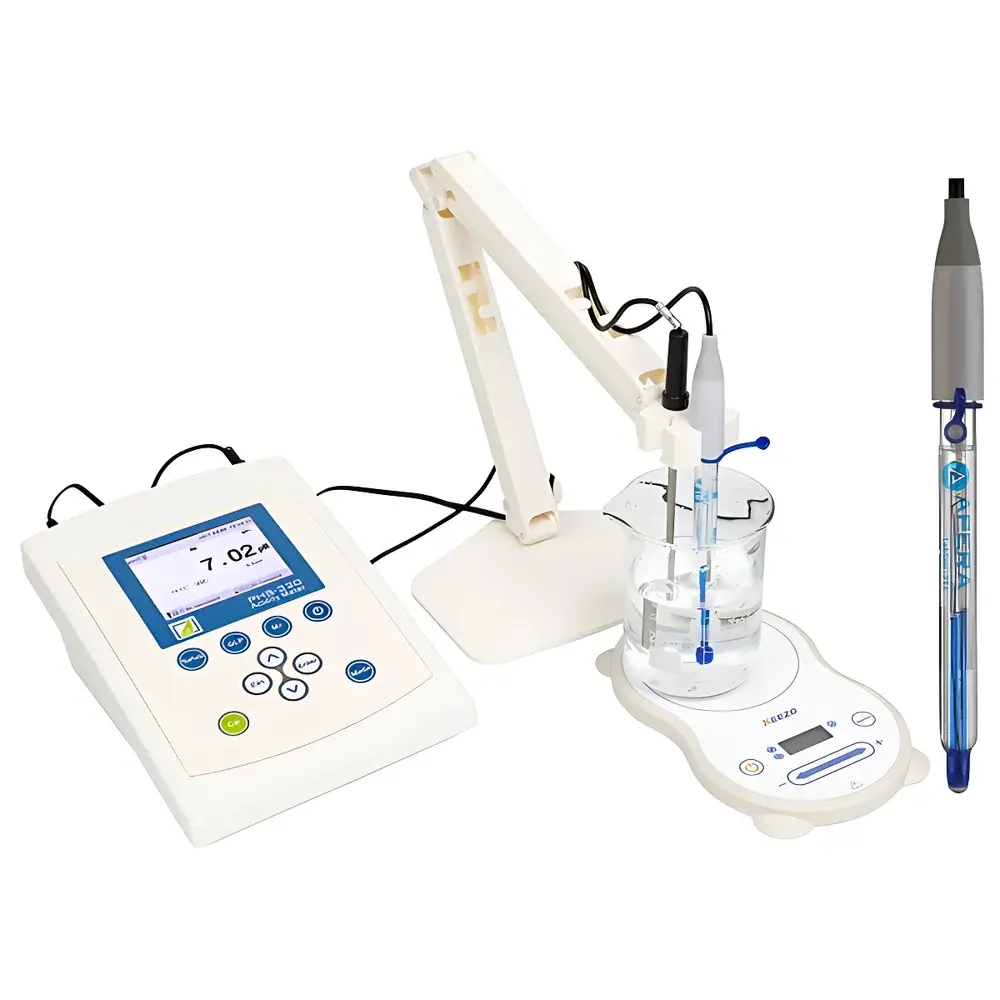
FangZhou PHS-320 Multi-Parameter pH Meter for Gypsum Powder and Industrial Applications
| Brand | FangZhou |
|---|---|
| Origin | Sichuan, China |
| Model | PHS-320 |
| pH Range | (−5.000 to 20.000) pH |
| Resolution | 0.001 / 0.01 / 0.1 pH (adjustable) |
| Accuracy | ±0.002 pH ±1 digit |
| Repeatability | 0.001 pH |
| mV Range | (−2000.00 to 2000.00) mV |
| mV Resolution | 0.01 / 0.1 / 1 mV (adjustable) |
| Temperature Range | (−20.0 to 135.0) °C |
| Temp. Resolution | 0.1 °C |
| Temp. Accuracy | ±0.2 °C ±1 digit |
| Input Impedance | ≥3×10¹² Ω |
| Calibration Points | 1–5 points |
| Buffer Standards | NIST, DIN 19266/19267, JIS Z8802, ASTM D1293, USP <791>, ISO 3696 |
| GLP Compliance | Full audit trail, sample/analyst ID, timestamped data logging |
| Data Storage | ≥100,000 records |
| Interface | RS232 with printer/PC bidirectional protocol |
| Power | DC 9 V, 500 mA (center-positive) |
Overview
The FangZhou PHS-320 is a high-precision, microprocessor-controlled multi-parameter benchtop pH meter engineered for rigorous industrial and laboratory applications—including gypsum powder quality control, pharmaceutical excipient testing, food matrix analysis, and environmental water characterization. It operates on the fundamental principle of potentiometric measurement: detecting the electromotive force (EMF) generated across a glass pH electrode and reference electrode pair immersed in an aqueous sample, then converting that voltage into a pH value using the Nernst equation (−59.16 mV/pH unit at 25 °C). Its extended pH range (−5.000 to 20.000) enables reliable measurement in highly acidic or alkaline process streams—such as gypsum slurry digestates, caustic cleaning solutions, or phosphate-buffered biological media—where conventional meters fail due to junction potential drift or electrode poisoning. The instrument meets ISO/IEC 17025 technical competence requirements for pH measurement and is designed to support regulatory compliance in GMP, GLP, and FDA 21 CFR Part 11 environments through traceable calibration, secure user authentication, and immutable data logging.
Key Features
- True-color TFT LCD display with graphical curve visualization for real-time titration monitoring and calibration diagnostics
- Adjustable resolution modes: 0.001 pH (for ultra-high-precision QC), 0.01 pH (routine lab use), and 0.1 pH (field screening)
- Seven pre-programmed buffer groups (33 total standards) covering NIST, DIN, JIS, ASTM, and USP specifications—with automatic buffer recognition during calibration
- Five adaptive measurement modes: Real-time, Timed (0–6000 s interval), Auto-Fast, Auto-Medium, and Auto-Slow—optimized for viscous, low-conductivity, or unstable samples
- Integrated ATC (Automatic Temperature Compensation) with dual-sensor input; supports both Pt1000 and thermistor probes (−20.0 to 135.0 °C)
- Electrode diagnostic function: continuously monitors slope (%), offset (mV), and impedance to flag aging, clogging, or dehydration
- Isopotential adjustment (−20.000 to +20.000 pH) for zero-potential calibration of specialty electrodes (e.g., antimony, solid-state, or polymer membrane sensors)
- RS232 interface supporting three operational protocols: direct thermal printing (GLP-compliant reports), PC data export to Excel/Word/Notepad via native ASCII protocol, and bidirectional command control
Sample Compatibility & Compliance
The PHS-320 accommodates diverse sample matrices through application-specific electrode configurations—including FZ-600T general-purpose combination electrodes, low-ionic-strength pure-water electrodes (for USP Purified Water and WFI), suspended-solid-tolerant double-junction probes, food-grade stainless-steel penetration electrodes, and HF-resistant sensors for hydrofluoric acid systems. All configurations maintain ≥3×10¹² Ω input impedance to minimize loading error in high-resistivity samples (e.g., deionized water, ethanol-water mixtures, or organic solvents). The system fully complies with GLP documentation standards: each stored measurement includes timestamp, analyst ID (10 configurable users), sample ID (10 configurable IDs), electrode serial number, calibration history, temperature reading, and environmental metadata. Data integrity is enforced via non-volatile memory with write-protection and sequential record numbering—supporting audit readiness per ISO 17025 Clause 7.7 and FDA 21 CFR Part 11 electronic record requirements.
Software & Data Management
Data acquisition and reporting are governed by embedded firmware compliant with ISO/IEC 17025 Clause 7.5.2 (control of records). The instrument stores ≥100,000 measurements with full GLP metadata: date/time stamp (RTC-driven), operator ID, sample ID, electrode model/serial, calibration status, ambient temperature, and raw mV output. Exported datasets include CSV-formatted headers compatible with LIMS integration and statistical software (Minitab, JMP, R). RS232 transmission uses ASCII-based command-response architecture—no proprietary drivers required. Print outputs offer four formats: Simple (pH/mV only), Standard (with calibration details), GLP (full audit trail), and Custom (user-defined fields). All stored data can be queried, filtered by date/operator/sample, exported, or selectively erased—without compromising historical calibration logs or system configuration.
Applications
- Gypsum powder hydration control: Monitoring pH shifts during slurry setting to optimize hemihydrate conversion kinetics and compressive strength development
- Pharmaceutical manufacturing: Measuring pH of buffer solutions, cell culture media, and injectables per USP and EP 2.2.3
- FDA-regulated food processing: Validating acidification of dairy products, fermented meats, and canned vegetables per 21 CFR 114
- Environmental wastewater treatment: Tracking alkalinity depletion in lime softening units and neutralization efficiency in acid mine drainage remediation
- Power plant chemistry: Monitoring condensate pH in steam cycles per ASTM D1293 and IAPWS guidelines to prevent flow-accelerated corrosion
- Research laboratories: Supporting electrochemical method development, enzyme kinetics studies, and ion-selective electrode validation
FAQ
Does the PHS-320 support calibration verification against NIST-traceable standards?
Yes—it recognizes NIST SRM 186, 469, and 1841 buffers automatically and stores calibration certificates with uncertainty budgets per ISO/IEC 17025.
Can it measure pH in non-aqueous or mixed-solvent systems?
It supports pH measurement in water-miscible solvents (e.g., ethanol/water, methanol/water) when used with appropriate electrodes and liquid-junction compensation; however, absolute pH values require matrix-matched calibration.
Is the RS232 interface compatible with modern Windows/macOS systems?
Yes—via standard USB-to-RS232 adapters; data streams directly into Excel using built-in carriage-return line-feed termination without third-party software.
How does the instrument handle low-conductivity samples like ultrapure water?
By combining high-input-impedance circuitry (>3×10¹² Ω), shielded cable routing, and optional low-noise pure-water electrodes with ceramic junctions to minimize ground-loop interference and diffusion potential errors.
What GLP features are implemented in firmware?
Full electronic signature capability (operator login), time-stamped audit trail, immutable calibration history, sample/analyst ID tagging, and exportable CSV logs with cryptographic checksums for data integrity verification.






