
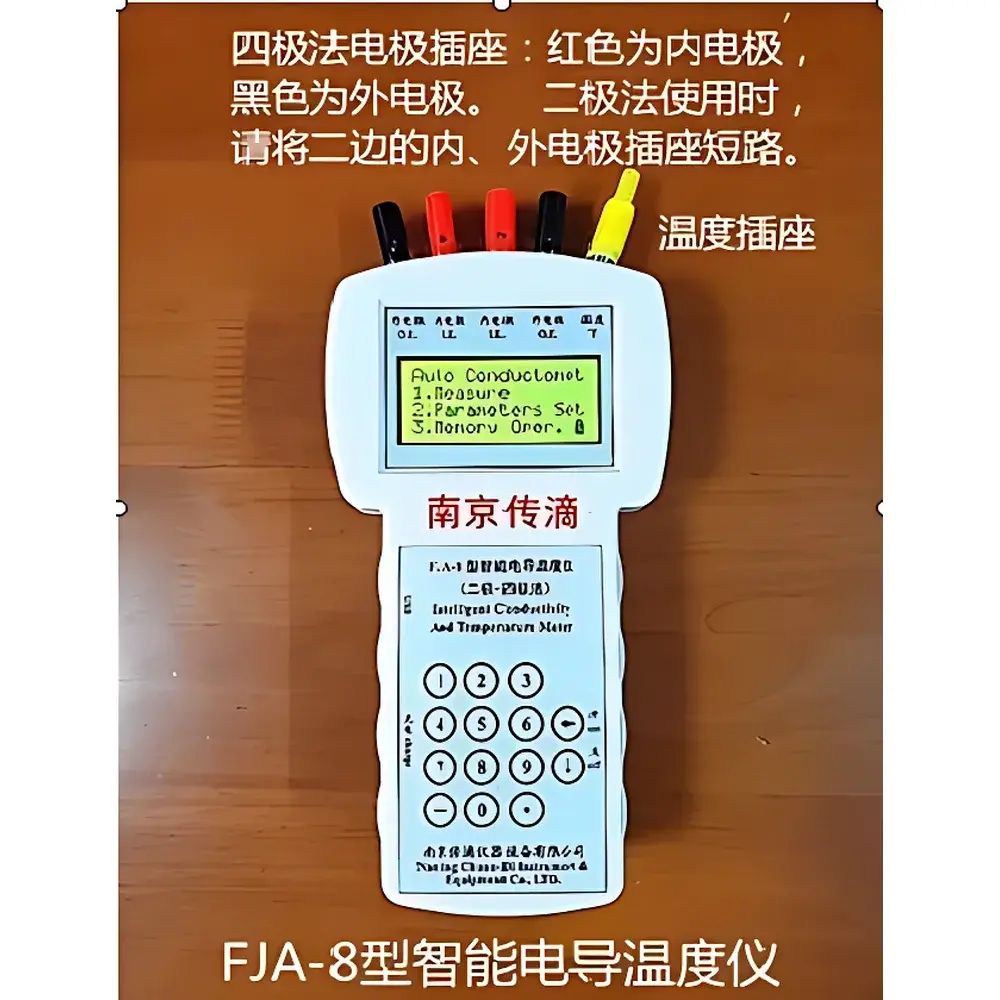
FJA-8 Intelligent Conductivity & Temperature Meter (2-Electrode / 4-Electrode Method)
| Origin | Jiangsu, China |
|---|---|
| Manufacturer Type | Distributor |
| Origin Category | Domestic |
| Model | FJA-8 |
| Price Range | USD 430–710 (FOB) |
| Measured Parameters | Conductivity, TDS, Resistivity, Salinity, Temperature |
| Portability | Handheld |
| Application Environment | Field, Laboratory, Soil Monitoring |
| Conductivity Range | 1 µS/cm – 10 mS/cm (5 auto-ranging decades) |
| TDS Range | 0–100 g/L |
| Resistivity Range | 0–10 MΩ·cm |
| Salinity Range | 0–0.3 mol/L |
| Temperature Range | 0–60 °C |
| Accuracy | ±2% of reading ± 0.01 µS/cm |
| Minimum Resolution | 0.001 µS/cm |
| Data Storage | 200 readings |
| Power Supply | Rechargeable 8.4 V Li-ion battery |
| Dimensions | 183 × 130 × 60 mm |
| Weight | < 0.5 kg |
| Operating Temp. | 0–45 °C |
| Relative Humidity | ≤85% RH |
| Interface | USB for PC data export |
| Software Support | FJA-6 Series PC Application Suite (data logging, calibration history, CSV export) |
Overview
The FJA-8 Intelligent Conductivity & Temperature Meter is a dual-mode, handheld electrochemical analyzer engineered for high-reliability field and laboratory measurement of aqueous conductivity, temperature, total dissolved solids (TDS), resistivity, and salinity. It implements both two-electrode and four-electrode (tetrapolar) measurement configurations—enabling accurate assessment across a wide dynamic range while minimizing polarization errors and electrode fouling effects. The instrument operates on the fundamental principle that solution conductivity (κ) is directly proportional to measured conductance (G) and inversely related to the cell’s geometric electrode constant (K): κ = K × G. Integrated Pt1000-grade temperature sensing enables real-time thermal compensation, automatically reporting all conductivity values referenced to the standard 25 °C condition per ISO 7888 and ASTM D1125. Its robust architecture supports rapid deployment in environmental monitoring, agricultural soil salinity profiling, water quality surveillance, and process validation where AC mains power is unavailable.
Key Features
- Dual measurement modes: switchable 2-electrode (for low-resistivity solutions) and 4-electrode (for high-resistivity or fouling-prone samples) operation with automatic electrode configuration recognition
- Five-decade auto-ranging conductivity measurement (1 µS/cm to 10 mS/cm), eliminating manual range selection and reducing operator error
- Integrated temperature compensation using high-stability digital thermistor (±0.2 °C accuracy), compliant with IEC 60746-3 for conductivity reference temperature correction
- Rechargeable 8.4 V lithium-ion battery (≥8 hours continuous operation), with low-battery indicator and intelligent charge protection circuitry to prevent overcharge per UL 1642
- Backlit graphical LCD display (128 × 64 pixels) showing simultaneous conductivity, temperature, and unit status; intuitive menu navigation via tactile keypad
- Onboard memory stores up to 200 timestamped measurements with automatic logging of date, time, temperature, and sensor ID (if configured)
- USB 2.0 interface (Type-B) for secure data transfer to Windows-based PCs; compatible with FJA-6 Series PC software supporting GLP-compliant audit trails, calibration certificate generation, and CSV/Excel export
Sample Compatibility & Compliance
The FJA-8 accommodates standard DIN/ISO-conforming conductivity cells (e.g., K = 0.01, 0.1, 1.0, and 10 cm⁻¹) as well as dedicated soil salinity probes (e.g., FJA-10 series). Its tetrapolar mode eliminates contact resistance artifacts, making it suitable for turbid waters, slurries, and saturated soil extracts per ASTM D512 and ISO 11265. For regulatory traceability, the device supports user-defined calibration protocols aligned with USP , EP 2.2.38, and CLSI C30-A3 guidelines. All stored data retain immutable timestamps and operator identifiers—enabling partial compliance with FDA 21 CFR Part 11 requirements when used within validated workflows and documented SOPs.
Software & Data Management
The optional FJA-6 Series PC application provides full data lifecycle management: import/export of measurement logs, calibration curve fitting (linear, polynomial), batch report generation, and trend visualization. Software enforces electronic signature capture for calibration events and maintains version-controlled firmware update history. Audit logs record all parameter changes, data deletions, and user login/logout events—supporting laboratory accreditation under ISO/IEC 17025:2017 clause 7.7. Data files are saved in encrypted binary format with SHA-256 checksum integrity verification, ensuring long-term archival reliability.
Applications
- Environmental field surveys: river, lake, and groundwater conductivity mapping with temperature normalization
- Agricultural soil health assessment: direct in-situ or extract-based salinity quantification (dS/m → EC₂₅ conversion per FAO 1985)
- Purified water system validation: monitoring feedwater, RO permeate, and ultrapure water loops per pharmacopeial standards
- Wastewater treatment plant QC: effluent conductivity trending for chloride/breakthrough detection
- Educational laboratories: hands-on instruction in electrochemical principles, electrode kinetics, and temperature-dependent ion mobility
- Industrial process control: boiler feedwater conditioning, desalination pre-treatment, and electroplating bath monitoring
FAQ
What electrode constants are supported?
The FJA-8 accepts user-input electrode constants from 0.005 to 10.0 cm⁻¹, enabling compatibility with microelectrodes, immersion cells, and custom soil probes.
Does the instrument support GLP-compliant calibration documentation?
Yes—when used with the FJA-6 PC software, calibration events generate PDF certificates including date, operator ID, standard used, deviation values, and pass/fail status per ISO/IEC 17025.
Can the device measure conductivity in non-aqueous solvents?
No—the FJA-8 is calibrated and validated exclusively for aqueous electrolyte systems; organic solvents require specialized impedance analyzers.
Is the battery replaceable by the end user?
The 8.4 V Li-ion pack is field-replaceable using standard Torx T5 tools; replacement batteries meet UN 38.3 transport safety requirements.
How is temperature compensation implemented?
A second-order polynomial algorithm (α + β·T + γ·T²) corrects raw conductance based on real-time Pt1000 sensor output, conforming to the default NaCl-based temperature coefficient model specified in IEC 60746-3.





