
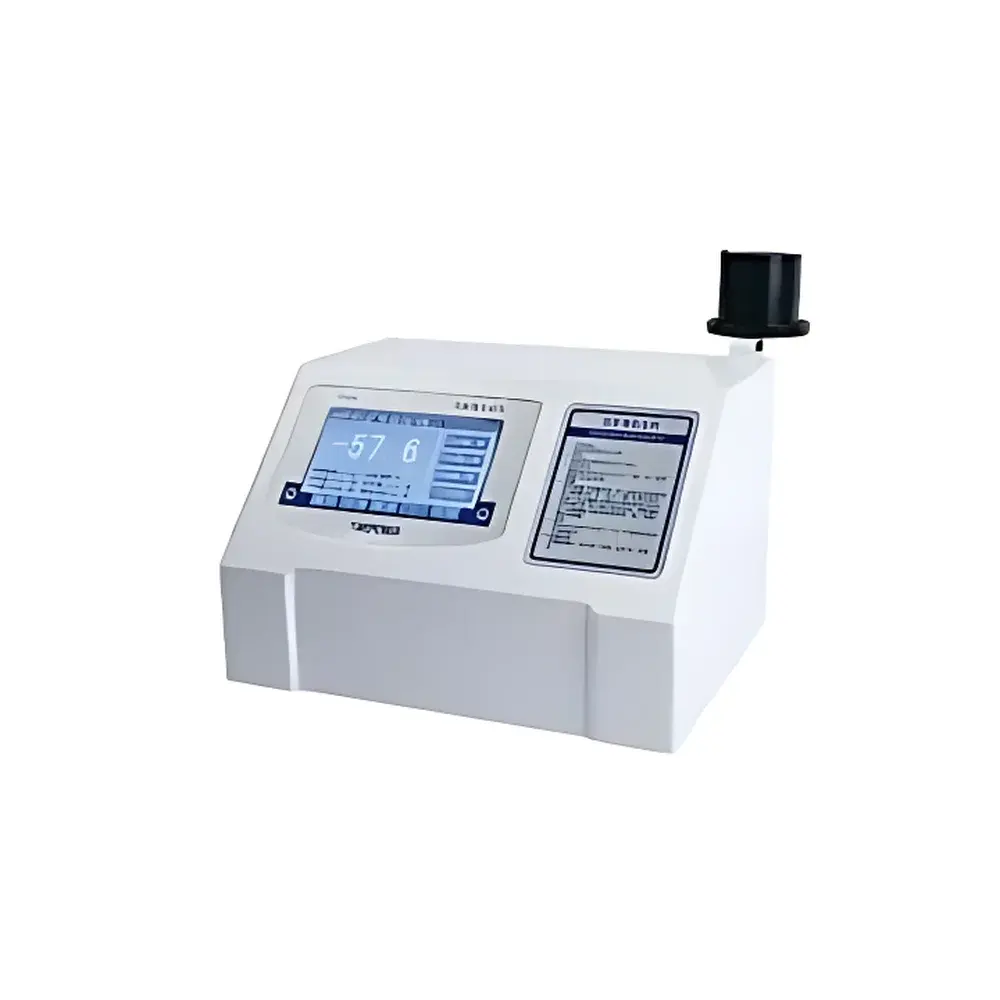
Timepower TP306 Laboratory Silica Photometer
| Brand | Timepower |
|---|---|
| Origin | Beijing, China |
| Manufacturer Type | Direct Manufacturer |
| Country of Origin | China |
| Model | TP306 |
| Pricing | Available Upon Request |
| Display | 5.0-inch capacitive touchscreen color LCD (Chinese UI) |
| Power Supply | AC 85–265 V, 45–65 Hz |
| Power Consumption | ≤30 W |
| Dimensions | 260 × 200 × 180 mm |
| Weight | 3.2 kg |
| Measurement Range | 0–200 μg/L and 0–2000 μg/L (dual-range selectable) |
| Accuracy | ±2% FS |
| Resolution | 0.1 μg/L |
| Repeatability | ≤1% |
| Stability | ±1% FS / 4 h |
| Operating Temperature | 5–45 °C |
| Relative Humidity | ≤90% RH (non-condensing) |
| Optical System | Imported monochromatic cold light source |
| Method Compliance | Chinese National Standard for Molybdenum Blue Spectrophotometric Determination of Soluble Silica |
| Sample Volume | Standard cuvette-based (10–25 mL) |
| Data Storage | Cyclic memory for up to 256 measurements |
| Calibration | Blank calibration + optional multi-point curve calibration |
| Key Functions | Built-in timer alert, baseline compensation, auto-zero drift correction, integrated PCB architecture with SMT process |
Overview
The Timepower TP306 Laboratory Silica Photometer is a dedicated benchtop spectrophotometric analyzer engineered for the precise quantification of soluble silica (as SiO₂) and silicate species in ultrapure water matrices. It operates on the internationally recognized molybdenum blue method—first establishing a yellow heteropoly acid complex between silicic acid and ammonium molybdate under controlled acidic conditions (pH 1.1–1.3), then selectively reducing the complex to an intensely colored silicon-molybdenum blue chromophore using 1-amino-2-naphthol-4-sulfonic acid (1-2-4 acid). The instrument measures absorbance at the characteristic peak wavelength (typically ~630–650 nm) and calculates silica concentration via the Lambert-Beer law: A = ε·c·l, where A is absorbance, ε is the molar absorptivity, c is concentration, and l is optical path length. Designed specifically for high-stakes water quality control environments—including power plant demineralized water, steam condensate, boiler feedwater, and ultrapure process water in semiconductor, pharmaceutical, and fine chemical manufacturing—the TP306 delivers trace-level sensitivity (down to 0.1 μg/L) with metrological rigor suitable for routine QC and regulatory documentation.
Key Features
- High-stability monochromatic cold light source ensures low thermal drift, consistent signal output, and extended service life (>10,000 hours).
- Dual-range measurement capability (0–200 μg/L and 0–2000 μg/L) enables seamless transition between ultra-trace and mid-range silica analysis without hardware modification.
- Integrated baseline compensation algorithm actively corrects for background interference from reagent blanks, particulate scatter, or minor cell imperfections—critical for sub-5 μg/L measurements.
- Onboard real-time timer function provides audible/visual alerts during color development (e.g., 10-min reduction step), eliminating manual stopwatch dependency and improving inter-operator reproducibility.
- Full blank calibration routine compensates for both electronic zero drift and optical baseline shift, enhancing long-term accuracy and reducing recalibration frequency.
- Compact, ruggedized chassis built with surface-mount technology (SMT) and single-board microcontroller architecture ensures electromagnetic compatibility, thermal resilience, and mechanical durability in laboratory and plant-floor settings.
- 5.0-inch capacitive touchscreen with intuitive Chinese-language GUI simplifies method selection, calibration execution, data review, and parameter configuration—no external PC required.
Sample Compatibility & Compliance
The TP306 is validated for aqueous samples meeting ASTM D859 (Standard Test Method for Silica in Water) and aligned with GB/T 12149–2017 (Chinese National Standard for Silica Determination in Industrial Boiler Water and Steam Condensate). It accepts standard 10-mm or 20-mm rectangular quartz or high-transmission optical glass cuvettes. Sample matrix requirements include pH adjustment to 1.1–1.3 prior to analysis; recommended pretreatment includes filtration through 0.45-μm membrane filters for turbid or particulate-laden streams. The method is inherently selective for monomeric orthosilicic acid [Si(OH)₄] and hydrolyzable silicates; polymeric silica requires acid digestion (e.g., HF-assisted hydrolysis) prior to analysis. All reagents—including ammonium molybdate, 1-2-4 acid, and sulfuric acid—must be analytical grade or higher and stored in certified polyethylene containers to prevent leaching or adsorption. The system supports GLP-compliant operation when paired with external audit logs and controlled access protocols.
Software & Data Management
Data acquisition and storage are handled internally via non-volatile flash memory supporting cyclic storage of up to 256 measurement records—including sample ID, date/time stamp, measured absorbance, calculated concentration, calibration status, and operator ID (if manually entered). Overflow management automatically overwrites oldest entries upon capacity exhaustion. While the TP306 does not feature USB or Ethernet connectivity, measurement exports can be documented via screen capture or manual transcription into LIMS or Excel-based QA/QC spreadsheets. For regulated environments requiring electronic record integrity, users may implement procedural controls such as daily calibration logs, signature-verified calibration reports, and periodic verification against NIST-traceable silica standards (e.g., AccuStandard SRM-101 or equivalent). Firmware updates are performed via secure SD card interface (optional accessory).
Applications
- Monitoring silica breakthrough in mixed-bed ion exchange resins and EDI units within power generation demineralization trains.
- Verification of silica removal efficiency in reverse osmosis pre-treatment systems serving semiconductor fab UPW loops.
- Boiler water chemistry control to prevent silica deposition on turbine blades and superheater tubes (per ASME PTC 19.11 and EPRI guidelines).
- Final rinse water testing in pharmaceutical sterile manufacturing (compliant with USP and EU Annex 1 water quality expectations).
- Process water qualification in synthetic fiber production, where silica-induced catalyst poisoning affects polymerization kinetics.
FAQ
What is the recommended frequency for blank calibration?
Blank calibration should be performed daily before the first sample analysis to compensate for reagent batch variability and optical baseline shifts.
Can the TP306 measure total silica, including colloidal or particulate forms?
No—the method is specific to dissolved, filterable silica. Total silica requires acid digestion (e.g., 10% v/v HCl reflux or HF fusion) prior to analysis.
Is the instrument compliant with FDA 21 CFR Part 11 requirements?
The TP306 does not natively support electronic signatures or audit trails; however, it can be operated within a Part 11-compliant workflow when integrated with validated procedural controls and external documentation systems.
What type of cuvettes are compatible?
Standard 10-mm or 20-mm pathlength quartz or optical-grade glass cuvettes with polished faces and matched tolerance (±0.01 mm) are recommended for optimal photometric accuracy.
How often should multi-point calibration curves be verified?
A full 3–5 point calibration curve should be verified every two weeks—or immediately following reagent lot changes, lamp replacement, or observed signal instability—to maintain traceability to reference standards.





