
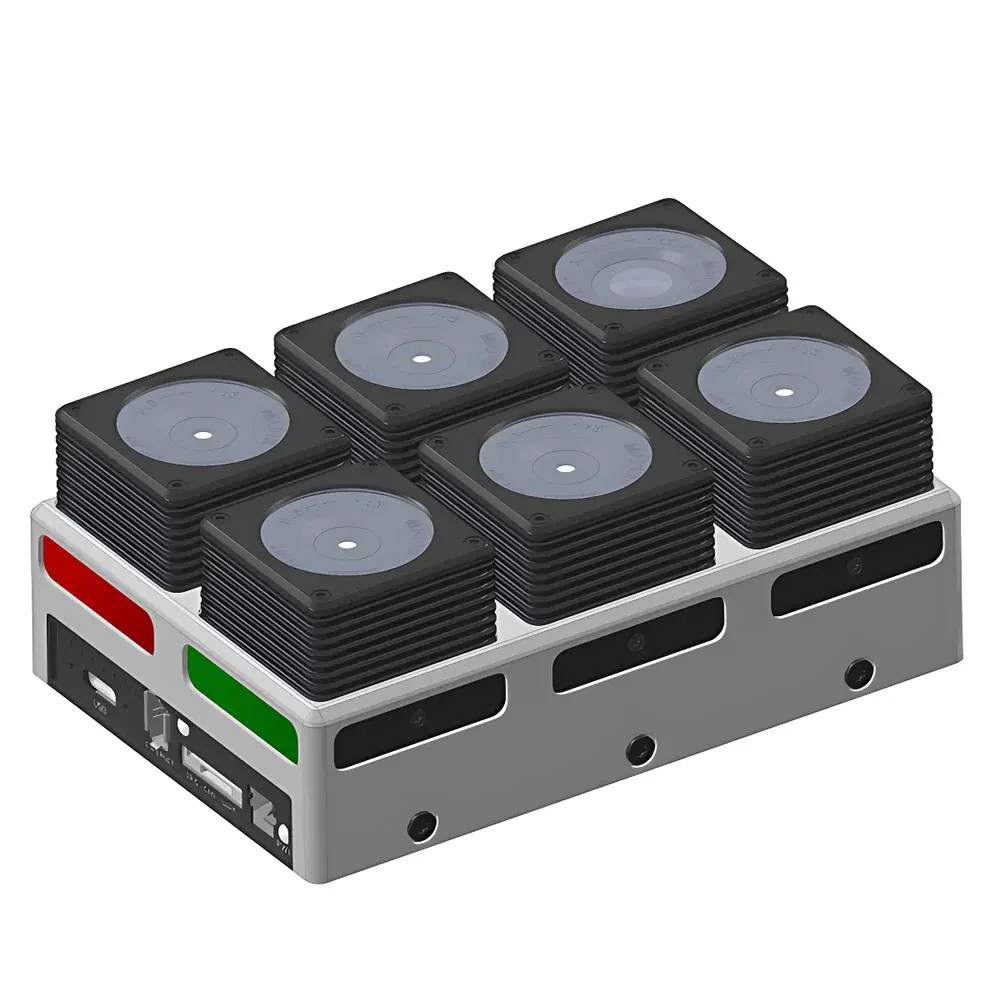
MapIR K6 / K12 Airborne Research-Grade Multispectral Imaging System
| Brand | MapIR |
|---|---|
| Origin | USA |
| Manufacturer Type | Authorized Distributor |
| Import Status | Imported |
| Model | K6 |
| Operating Principle | Filter-Wheel–Free Filter Array (Filter-Based) |
| Imaging Method | Simultaneous Multi-Channel Filter Array |
| Platform Integration | UAV-Mounted (Fixed-Wing & Multirotor Compatible) |
| Total Field of View (TFOV) | 87° or 41° HFOV |
| Processor | Freescale i.MX6 Dual-Core ARM Cortex-A9 @ 1.2 GHz |
| Sensor 1 (Mono) | 3.2 MP Global Shutter, 3.45 × 3.45 µm pixel size |
| Sensor 2 (RGB) | 14.4 MP Bayer, 1.4 × 1.4 µm pixel size |
| Spectral Options | 26 discrete monochrome filters (250–1000 nm) |
| Trigger Modes | PWM, Relay (voltage pulse), UAVCAN-synced autonomous capture |
| Output Format | 12-bit RAW per channel, 16-bit TIFF (per channel) |
| Frame Rate | 2 fps @ 3.2 MP RAW |
| Storage | Removable microSDXC (up to 128 GB) |
| Power | 5.0 VDC, 4.0 W per module |
| Lens FOV Options | 87° HFOV (wide) or 41° HFOV (narrow) |
| GSD | 4.3 cm/px (3.2 MP, 120 m AGL) |
| Interfaces | USB 2.0, UART, UAVCAN, PWM I/O, I²C, Ethernet, GPIO, HDMI, SD Video |
Overview
The MapIR K6 and K12 are modular, airborne research-grade multispectral imaging systems engineered for high-fidelity spectral data acquisition from unmanned aerial platforms. Unlike scanning or push-broom hyperspectral systems, the K6/K12 employs a filter-based, simultaneous multi-channel architecture—each optical module integrates a dedicated sensor, interference filter, lens, and on-board Linux computing core. This distributed design eliminates mechanical moving parts (e.g., filter wheels or tunable elements), ensuring robustness under vibration, thermal cycling, and rapid UAV maneuvers. The system operates on the principle of spatially registered, time-synchronized band capture: up to 12 independent spectral bands (K12) or 6 bands (K6) are acquired in parallel within a single exposure, enabling precise radiometric co-registration without motion-induced misalignment. Designed for scientific reproducibility, it supports traceable calibration workflows—including factory-measured spectral response functions (SRFs) for each filter–sensor–lens combination—and is routinely deployed in peer-reviewed remote sensing studies addressing vegetation biophysics, soil moisture mapping, precision agriculture validation, and environmental change monitoring.
Key Features
- Modular architecture: Each camera module houses an independent ARM Cortex-A9 processor, global-shutter mono or Bayer RGB sensor, calibrated interference filter, and 128 GB microSDXC storage—enabling firmware-level control and real-time metadata embedding.
- Configurable spectral payload: Select from 26 discrete narrowband filters (250–1000 nm) for mono modules; or deploy pre-optimized 3- or 4-band RGB+multispectral combinations (e.g., 550+660+850 nm) for RGB modules—no proprietary lock-in.
- UAVCAN-native synchronization: Direct integration with Pixhawk- and Cube-series autopilots via UAVCAN bus allows GPS-timestamped, georeferenced image capture synchronized to flight control events (e.g., waypoint triggers, altitude thresholds).
- Dual-sensor flexibility: Combine 3.2 MP global-shutter mono sensors (3.45 µm pixels) for high dynamic range and low noise in narrowband applications, or 14.4 MP Bayer sensors (1.4 µm pixels) for higher spatial resolution in broadband + multispectral fusion tasks.
- Field-serviceable hardware: All optical components—including lenses, filters, and sensors—are user-replaceable without recalibration tools. Firmware updates and spectral configuration are managed via standard Linux CLI or web-based UI over Ethernet or USB.
- Deterministic timing: Hardware-level PWM input/output and relay-trigger support ensure sub-millisecond shutter latency—critical for high-speed fixed-wing surveys and cross-platform sensor fusion (e.g., LiDAR + multispectral).
Sample Compatibility & Compliance
The K6/K12 is not a laboratory benchtop instrument but a field-deployable remote sensing platform optimized for outdoor, non-contact surface reflectance measurement. It complies with ISO 17123-8 (field performance testing of optical remote sensors) and supports NIST-traceable reflectance calibration via onboard white reference panels and optional irradiance sensors. While not certified for medical or aerospace safety-critical use, its design adheres to DO-160 Section 21 (vibration) and MIL-STD-810G (shock and thermal shock) environmental test profiles. Data provenance meets GLP-aligned requirements: every image embeds EXIF-compliant metadata including GPS position (WGS84), IMU attitude (pitch/roll/yaw), UTC timestamp (GPS-synchronized), sensor temperature, exposure settings, and full spectral configuration hash. Raw output formats (12-bit linear RAW, 16-bit TIFF per band) preserve bit-depth integrity for downstream atmospheric correction (e.g., QUAC, FLAASH) and spectral unmixing algorithms.
Software & Data Management
MapIR provides open-source Python toolchains (mapir-sdk) for batch processing, radiometric calibration, and orthomosaic generation via OpenDroneMap or Agisoft Metashape APIs. All modules run Debian-based Linux with SSH access, enabling custom scripting for on-device preprocessing (e.g., NDVI computation, cloud masking). Metadata conforms to XMP and GeoTIFF standards, supporting ingestion into ENVI, QGIS, Google Earth Engine, and ESA SNAP. For regulated environments, audit trails—including firmware version history, user login logs, and image write timestamps—are retained on-device and exportable as CSV. While not FDA 21 CFR Part 11–certified (as it is not a diagnostic device), its immutable logging and cryptographic hash verification of raw files satisfy many academic and governmental data integrity policies (e.g., NASA’s DAAC submission guidelines, USDA ARS data curation standards).
Applications
- Agricultural phenotyping: Quantify chlorophyll content (NDVI, REIP), water stress (NDWI), and nitrogen status (R750/R705) across breeding trials at plot scale.
- Ecological monitoring: Map invasive species distribution (e.g., Tamarix via 808/850 nm contrast), post-fire regeneration (NIR/SWIR indices), and wetland hydroperiod dynamics.
- Geological surveying: Discriminate mineral assemblages (e.g., kaolinite vs. montmorillonite using 2200 nm absorption features) when integrated with SWIR-extended variants.
- Urban heat island analysis: Combine visible–NIR reflectance with thermal IR (via co-mounted sensors) to model surface emissivity and albedo relationships.
- Calibration/validation of satellite products: Provide high-resolution ground truth for Sentinel-2, Landsat-9, and PlanetScope L2A products under concurrent overpass conditions.
FAQ
Can the K6/K12 be used on manned aircraft or ground-based tripods?
Yes—the system is platform-agnostic. Its 5 VDC power requirement, lightweight construction (< 350 g/module), and UAVCAN/UART interfaces enable integration with manned aerial platforms, vehicle-mounted rigs, or stationary gantries. Mechanical mounting is standardized via M3 threaded holes and 30 mm pitch spacing.
Is radiometric calibration included with purchase?
Each module ships with factory-acquired relative spectral response (RSR) curves and dark current profiles. Absolute radiometric calibration requires field-based empirical methods (e.g., reflectance panel imaging under uniform illumination); MapIR provides documented procedures and MATLAB/Python scripts for conversion to at-sensor radiance.
How is geometric distortion corrected?
Lens distortion coefficients (radial/tangential) are embedded in image metadata and applied during orthorectification in photogrammetry software. Custom calibration targets can be used to refine coefficients for specific lens–filter combinations.
Does the system support real-time video streaming?
No—it is designed for still-frame acquisition only. HDMI output provides uncompressed preview video (not synchronized with multispectral capture) for framing assistance only.
What is the maximum operating altitude?
The system has no intrinsic altitude limit. Performance depends on UAV endurance, GNSS signal quality, and atmospheric transmission. Empirical tests confirm stable operation up to 3000 m ASL with appropriate thermal management.





