
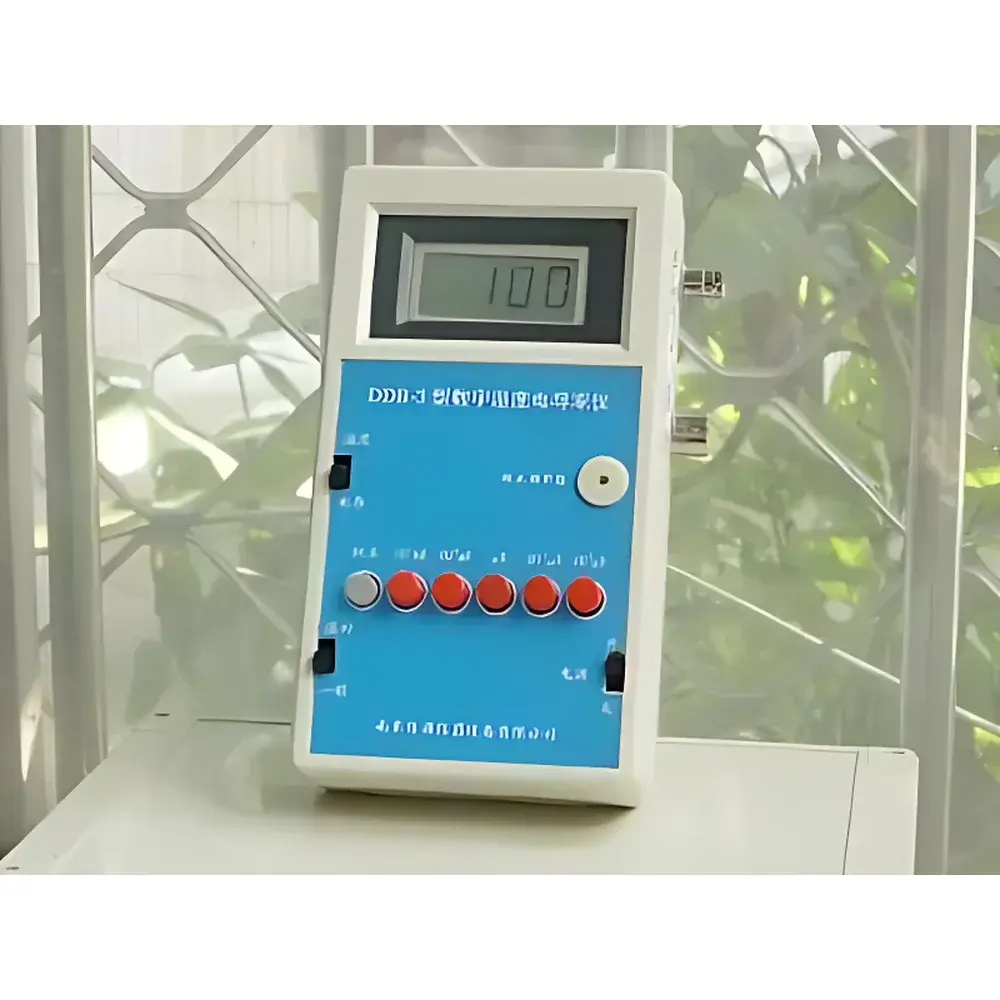
DDB-2 / DDB-3 Portable Digital Conductivity Meter
| Origin | Jiangsu, China |
|---|---|
| Manufacturer Type | Authorized Distributor |
| Origin Category | Domestic (China) |
| Model | DDB-2 / DDB-3 |
| Portability | Handheld |
| Conductivity Range | 1 µS to 100 mS (5 auto-ranging decades) |
| Accuracy | ±1.5% FS |
| Temperature Compensation Error | <±2% |
| Stability | ±0.1% FS ±1 digit/hour |
| Weight | 380 g (incl. batteries) |
| Dimensions | 180 × 100 × 40 mm |
| Power | Two AA (1.5 V) batteries |
| Operating Temp | 0–45 °C |
| RH Limit | ≤85% |
| DDB-3 Additional Function | Integrated Temperature Measurement (–10 to 100 °C, resolution 0.1 °C) |
Overview
The DDB-2 and DDB-3 Portable Digital Conductivity Meters are compact, battery-powered electrochemical instruments engineered for field-deployable measurement of electrical conductivity in aqueous solutions, ultrapure water, and soil extracts. Based on the principle of two-electrode AC conductometry, these meters apply a low-frequency alternating current across a conductive cell (e.g., DJS-1 conductivity electrode or TYC-2 soil salinity sensor) and measure the resulting current to compute solution conductivity—automatically referenced to the standard temperature of 25 °C via built-in thermistor-based temperature compensation. Unlike conventional benchtop conductivity analyzers requiring manual temperature input and post-hoc correction, the DDB series performs real-time, hardware-level temperature compensation—eliminating operator-induced calculation errors and streamlining data acquisition in uncontrolled environmental settings. The DDB-3 variant extends this capability with an integrated, calibrated temperature probe enabling concurrent dual-parameter logging (conductivity + temperature), supporting compliance with ASTM D1125 and ISO 7888 requirements for standardized reporting.
Key Features
- Five-decade auto-ranging conductivity measurement: Covers 1 µS to 100 mS (105 µS full scale) across five overlapping ranges—enabling reliable quantification of low-conductivity deionized water (1–10 µS/cm) and high-salinity brines (>50 mS/cm) without range switching or recalibration.
- Integrated automatic temperature compensation (ATC): Uses embedded NTC thermistor circuitry to correct conductivity readings to 25 °C per the linear temperature coefficient model (α = 2.0 %/°C default, adjustable), minimizing deviation from reference conditions as specified in USP and EPA Method 120.1.
- Field-optimized mechanical design: Weighing only 380 g with dimensions of 180 × 100 × 40 mm, the unit features impact-resistant ABS housing, IP54-rated ingress protection, and low-power consumption (200 hours of continuous operation on two AA alkaline cells.
- Dual-mode sensor compatibility: Supports standard DIN-style conductivity cells (e.g., DJS-1, K = 1.0 cm−1) and dedicated soil salinity probes (e.g., TYC-2), facilitating direct in-situ measurements of pore-water conductivity and bulk soil ECe without extraction.
- DDB-3 enhanced functionality: Adds calibrated temperature measurement (–10 to 100 °C, ±0.3 °C accuracy, 0.1 °C resolution) using a shielded Pt1000 RTD—enabling simultaneous recording of conductivity and temperature for thermal drift analysis and thermally corrected salinity modeling.
Sample Compatibility & Compliance
The DDB-2/DDB-3 meters are validated for use with liquid-phase electrolytes including freshwater, wastewater, hydroponic nutrient solutions, boiler feedwater, and soil leachates. When paired with TYC-2 or equivalent soil sensors, they comply with FAO guidelines for field estimation of soil electrical conductivity (ECs) and support correlation with USDA soil salinity classification thresholds (ECe 16 dS/m = severely saline). Instrument stability (±0.1% FS ±1 digit/hour) meets GLP requirements for short-term field campaigns, while ATC performance aligns with ISO 17025 clause 5.9.1 for measurement uncertainty management. No software validation package is provided; users performing regulated work (e.g., environmental monitoring under EU WFD or US Clean Water Act) must establish their own calibration traceability to NIST SRM 3198 or equivalent certified reference materials.
Software & Data Management
These meters operate as standalone, firmware-controlled devices with no onboard data logging or PC connectivity. All measurements are displayed in real time on a 3½-digit LCD with polarity indication and range identifier. While lacking USB/Bluetooth interfaces or proprietary software, the instruments support manual transcription into LIMS or spreadsheet platforms. For audit-ready workflows, users are advised to record instrument ID, calibration date, electrode constant, ambient temperature, and raw reading alongside each field entry. The absence of electronic records means FDA 21 CFR Part 11 compliance is not applicable; however, handwritten logbooks with observer signature and timestamp satisfy basic GLP documentation standards for non-GxP applications.
Applications
- On-site assessment of irrigation water quality and drainage effluent conductivity in agricultural extension services
- Rapid screening of potable water sources for total dissolved solids (TDS) estimation using industry-standard conversion factors (e.g., 0.64 × µS/cm ≈ mg/L NaCl)
- Monitoring conductivity drift in closed-loop cooling systems and reverse osmosis permeate streams
- Field validation of soil salinity maps generated by EM38 or Veris sensors
- Educational laboratory exercises demonstrating Kohlrausch’s law and ion mobility relationships
- Environmental baseline surveys in wetland restoration projects where portable, low-battery-footprint instrumentation is required
FAQ
Does the DDB-2/DDB-3 require calibration before each use?
Calibration is recommended prior to critical measurements using certified KCl standards (e.g., 1413 µS/cm at 25 °C). A single-point calibration suffices for routine field work if electrode constant is known and stable.
Can the DDB-3 temperature sensor be used independently of conductivity measurement?
Yes—the instrument allows standalone temperature readout mode, useful for ambient or sample temperature verification without electrode connection.
Is the DJS-1 electrode included with the meter?
No. The DJS-1 conductivity cell and TYC-2 soil probe are sold separately and must be ordered with appropriate cable assemblies and calibration solutions.
What is the maximum allowable conductivity for accurate measurement?
The upper limit is 100 mS/cm (1×10⁵ µS/cm); beyond this, electrode polarization effects may introduce nonlinearity—users should verify linearity with high-conductivity standards if operating near full scale.
How often should the ATC function be verified?
Verify annually against a traceable thermometer in a stirred water bath; field users should cross-check with a calibrated digital thermometer during seasonal temperature extremes (e.g., 35 °C).
Related Products





