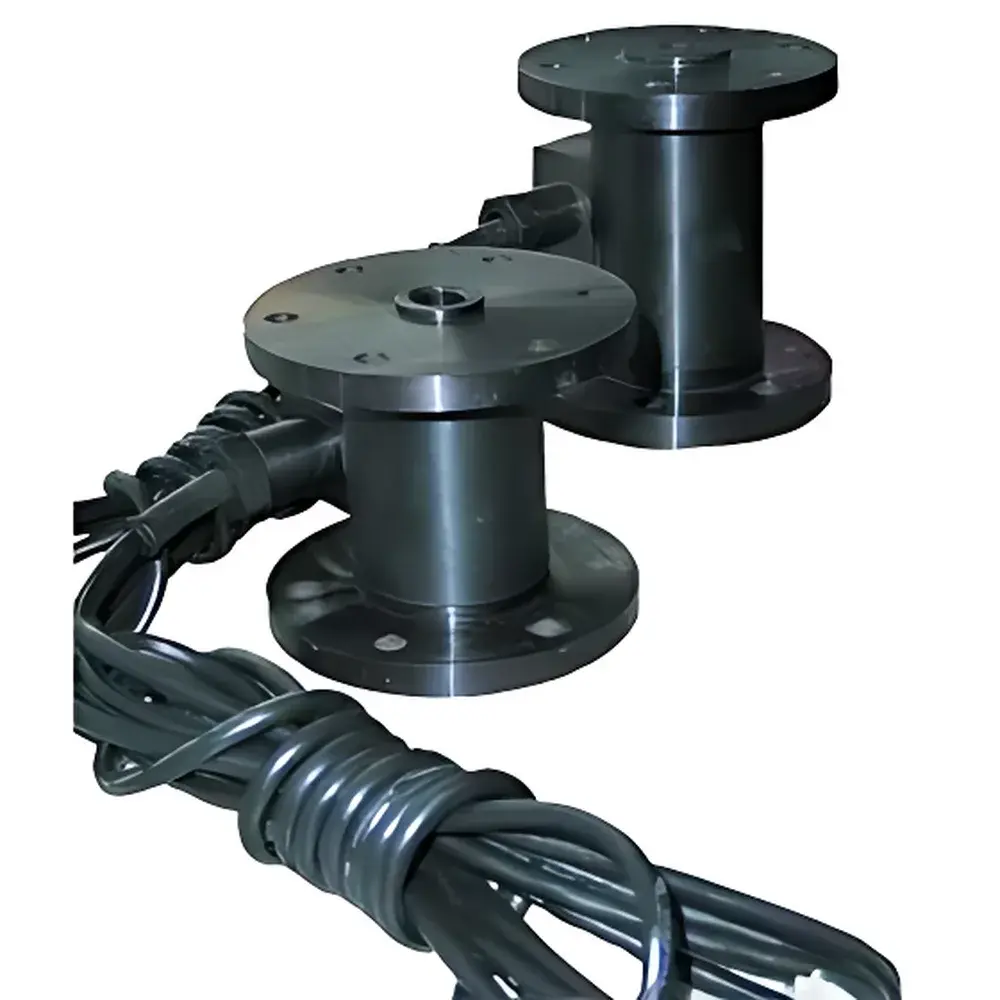
SINOTEST CNY-81 Precision Torque Sensor
| Brand | SINOTEST |
|---|---|
| Origin | Jilin, China |
| Manufacturer Type | Original Equipment Manufacturer (OEM) |
| Country of Origin | China |
| Model | CNY-81 |
| Torque Range | 50 N·m to 2000 kN·m |
| Accuracy Classes | ±0.02% FS, ±0.05% FS, ±0.1% FS |
| Output Sensitivity | 1.5–2.0 mV/V |
| Nonlinearity | ≤±0.03% FS / ≤±0.05% FS / ≤±0.1% FS |
| Hysteresis | ≤±0.03% FS / ≤±0.05% FS / ≤±0.1% FS |
| Repeatability | ≤±0.03% FS / ≤±0.05% FS / ≤±0.1% FS |
| Creep (30 min) | ≤±0.03% FS / ≤±0.05% FS / ≤±0.1% FS |
| Zero Temperature Effect | ≤±0.03% FS/°C / ≤±0.05% FS/°C |
| Output Temperature Effect | ≤±0.03% FS/°C / ≤±0.05% FS/°C |
| Safe Load Limit | 120% FS |
| Nominal Bridge Resistance | 350 Ω |
| Recommended Excitation Voltage | ≤12 V DC |
| Maximum Excitation Voltage | ≤15 V DC |
| Zero Balance | ≤±1.0% FS |
| Insulation Resistance | ≥500 MΩ |
Overview
The SINOTEST CNY-81 Precision Torque Sensor is a statically rated, strain-gauge-based transducer engineered for high-fidelity measurement of torsional moment in stationary or low-amplitude oscillatory conditions. Designed according to fundamental principles of elastic deformation and Wheatstone bridge signal conditioning, the CNY-81 converts mechanical twist into a proportional millivolt-per-volt (mV/V) analog output. Its robust monolithic shaft construction—machined from high-strength alloy steel and optimized for minimal bending interference—ensures mechanical linearity and long-term stability under sustained static loading. Unlike rotating torque sensors, the CNY-81 is specifically calibrated for non-rotating applications such as torque reaction measurement in motor test stands, structural load verification in material testing frames, bolt tension monitoring in pre-load validation, and calibration reference in metrology laboratories. The sensor operates within ambient temperature ranges of −20 °C to +70 °C and maintains traceable accuracy across its full span without requiring dynamic compensation.
Key Features
- Multiple accuracy grades available: ±0.02% FS (high-precision metrology), ±0.05% FS (industrial QA/QC), and ±0.1% FS (general-purpose engineering)
- Wide torque range coverage—from 50 N·m up to 2000 kN·m—achieved via modular mechanical design and calibrated strain gauge rosette configurations
- Low thermal drift performance: zero shift ≤±0.03% FS/°C and sensitivity drift ≤±0.03% FS/°C (for 0.02-grade variants), enabling reliable operation in uncontrolled environmental settings
- High insulation resistance (>500 MΩ at 50 V DC) ensures electrical noise immunity and compatibility with grounded instrumentation systems
- Standard 350 Ω nominal bridge resistance and low excitation voltage requirements (≤12 V recommended) support integration with legacy and modern signal conditioners, PLCs, and data acquisition modules
- Overload protection up to 120% full scale without permanent zero or sensitivity deviation, verified per ISO 376 Annex B procedures
Sample Compatibility & Compliance
The CNY-81 is compatible with rigidly mounted mechanical assemblies where torque is transmitted axially through a fixed shaft or flange interface. It supports both inline and reaction-mount configurations and is commonly integrated into universal testing machines (UTMs), engine dynamometers, gear train test rigs, and clamping force verification systems. While not intended for continuous rotation or high-frequency dynamic torque profiling, it meets static calibration requirements outlined in ISO 376:2011 (Metallic materials — Calibration of force-proving instruments used for the verification of uniaxial testing machines) and aligns with relevant clauses of ASTM E4 and JJG 391–2019 (Chinese national metrological verification regulation for torque sensors). Its traceable calibration certificates—optionally supplied with NIST-traceable reference standards—support GLP-compliant documentation workflows in regulated manufacturing environments.
Software & Data Management
The CNY-81 outputs a passive analog signal and does not include embedded firmware or digital communication protocols. As such, it interfaces seamlessly with third-party data acquisition systems—including National Instruments DAQmx platforms, Keysight U2300A series, and Dewesoft X—via standard signal conditioners offering gain, filtering, and cold-junction compensation. When paired with compliant software, users can implement audit trails, calibration history logging, and uncertainty budgeting per ISO/IEC 17025:2017 requirements. Optional factory calibration reports include expanded uncertainty statements (k=2) derived from Type A and Type B evaluations, supporting regulatory submissions under FDA 21 CFR Part 11 when combined with validated electronic record systems.
Applications
- Static torque verification in servo-motor and gearbox assembly lines
- Reaction torque measurement during tensile/compression testing of composite laminates and metallic joints
- Pre-torque validation of high-strength bolting in wind turbine nacelles and aerospace fastener systems
- Calibration transfer standard for secondary torque calibrators in accredited metrology labs
- Load cell cross-checking in multi-axis force/torque platforms used for robotic end-effector characterization
- Structural health monitoring of torsional restraint elements in civil infrastructure testing
FAQ
Is the CNY-81 suitable for rotating shaft applications?
No. The CNY-81 is designed exclusively for static or quasi-static torsional load measurement. For rotating applications, slip-ring or rotary transformer-based torque transducers are required.
What excitation voltage should be used for optimal signal-to-noise ratio?
A stable, low-noise DC supply of 10 V is recommended for 0.02% FS grade units; 12 V may be used for lower-grade variants, provided thermal effects remain within specification limits.
Can the sensor be recalibrated in-field?
Yes—provided appropriate dead-weight or hydraulic torque standards and environmental controls are available. However, factory recalibration is advised annually or after exposure to overload, shock, or extreme thermal cycling.
Does SINOTEST provide NIST-traceable calibration certificates?
Yes. Traceable calibration documentation—including uncertainty budgets, environmental conditions, and reference standard IDs—is available upon request and complies with ILAC-P10 requirements.
What mounting configurations are supported?
The CNY-81 is supplied with standardized flanged or threaded ends (per DIN 965/ISO 4762 specifications) and accommodates both axial reaction mounting and inline torsion rod integration, subject to proper alignment and bearing support per manufacturer guidelines.