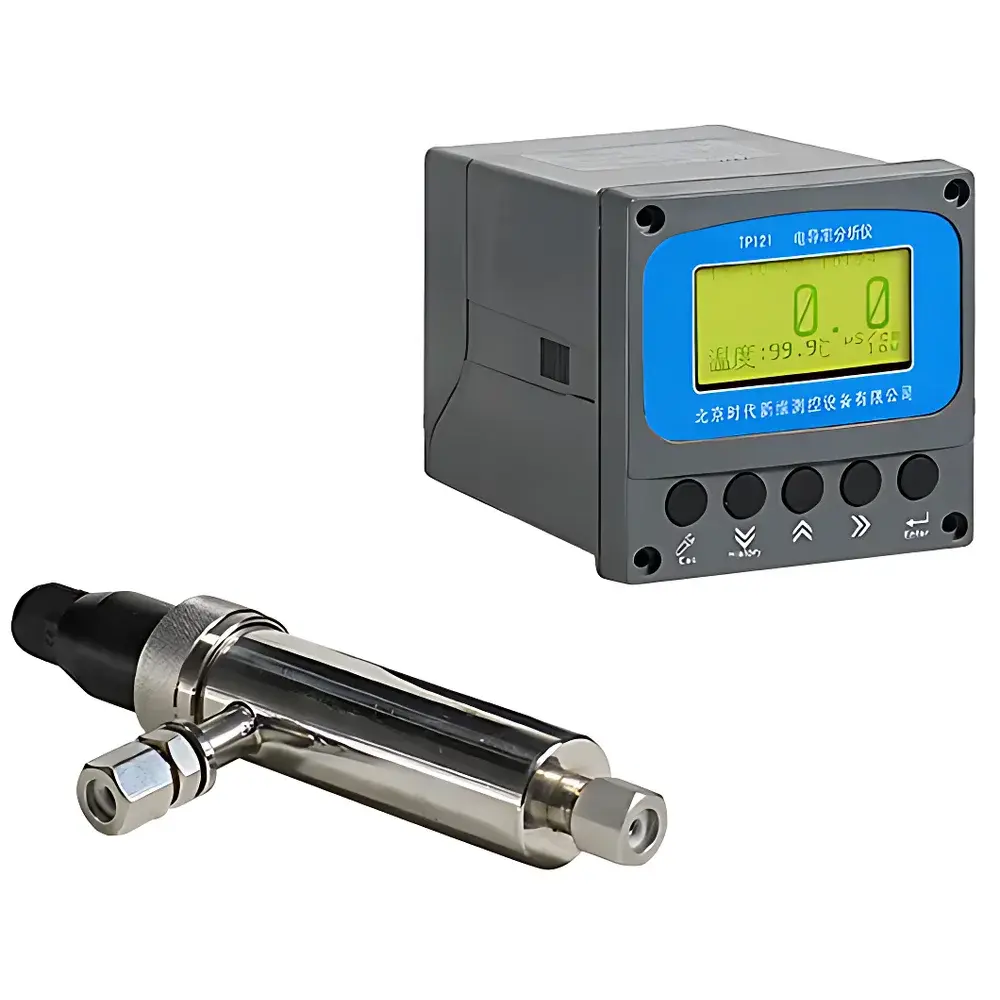
Timepower TP121 Online Conductivity Analyzer
| Brand | Timepower |
|---|---|
| Origin | Beijing, China |
| Manufacturer | Timepower Measurement & Control Co., Ltd. |
| Model | TP121 |
| Output Signals | 0–10 mA / 0–20 mA / 4–20 mA (selectable) |
| Temperature Compensation | Manual or Automatic (Pt1000 sensor, 0–60 °C) |
| Measurement Ranges | (0.01–20.00) µS/cm (K=0.01), (0.1–200.0) µS/cm (K=0.1), (2–2000) µS/cm (K=1.0), (20 µS/cm–20 mS/cm) (K=10.0) |
| Accuracy | ±2.5% F.S. |
| Resolution | 0.01 µS/cm |
| Repeatability | <1% |
| Display | 128×64 dot-matrix LCD with bilingual English/Chinese interface |
| Operating Temp. | 5–60 °C (sample), 5–45 °C (ambient) |
| Humidity | ≤90% RH (non-condensing) |
| Storage Temp. | −25–55 °C |
| Power Supply | AC 85–265 V or 24 VDC |
| Power Consumption | ≤15 W |
| Enclosure Rating | IP65 |
| Mounting | Panel-mount / wall-mount / rack-mount |
| Electrode Mounting | Flow-through / immersion / flanged / in-line pipe |
| Data Storage | User-configurable logging with historical trend display |
| Relay Outputs | 2 SPST (AC 220 V / 3 A or DC 30 V / 3 A) |
| Memory Retention | >10 years after power loss |
| Dimensions | 98 × 130 × 98 mm (W×H×D) |
| Cut-out | 94 × 94 mm |
| Weight | 0.5 kg |
Overview
The Timepower TP121 Online Conductivity Analyzer is a microprocessor-based industrial process instrument engineered for continuous, real-time monitoring of electrical conductivity in aqueous solutions across diverse production and treatment environments. It operates on the principle of two-electrode or four-electrode conductometric measurement—applying an alternating current across a pair of electrodes immersed in the sample medium and calculating conductivity (σ) from the measured conductance (G) and cell constant (K): σ = G × K. The analyzer supports interchangeable conductivity cells with standardized cell constants (K = 0.01, 0.1, 1.0, and 10.0 cm−1), enabling precise range selection for applications spanning ultrapure water monitoring (e.g., pharmaceutical WFI systems), boiler feedwater control, wastewater effluent compliance, and chemical dosing verification. Its robust architecture integrates high-impedance isolation circuitry and surface-mount technology to ensure long-term stability under electrically noisy plant conditions.
Key Features
- Bilingual 128×64 dot-matrix LCD with intuitive menu navigation—switchable between English and Chinese without firmware reset
- Auto-ranging capability across four decades (0.01 µS/cm to 20 mS/cm) via user-selectable cell constant configuration
- Dual-mode temperature compensation using integrated Pt1000 RTD sensor (0–60 °C), supporting both automatic and manual offset adjustment per ISO 7888 and ASTM D1125 standards
- High-immunity analog output (4–20 mA default, configurable to 0–10 mA or 0–20 mA) with galvanic isolation (>1500 VAC) for noise rejection in distributed control systems
- Two programmable relay outputs (SPST, 3 A resistive load) for alarm staging, pump interlock, or valve actuation—each independently assignable to conductivity thresholds or rate-of-change events
- Onboard data logging with non-volatile memory retaining >10 years of timestamped readings; accessible via scrollable history curve on display
- IP65-rated front panel enclosure suitable for indoor industrial enclosures and outdoor NEMA-type housings with optional sunshade
Sample Compatibility & Compliance
The TP121 is compatible with standard industrial conductivity sensors employing stainless steel, titanium, or graphite electrodes—configured for flow-through cells (for pressurized pipelines), immersion probes (for open tanks), flanged assemblies (for sanitary or high-pressure vessels), or direct in-line mounting. It meets electromagnetic compatibility requirements per IEC 61326-1 (industrial environment) and conforms to safety standards IEC 61010-1 for electrical equipment used in measurement, control, and laboratory applications. While not certified for intrinsic safety (e.g., ATEX/IECEx), its 24 VDC option enables integration into hazardous-area barrier systems. For regulated industries—including pharmaceuticals, food & beverage, and power generation—the device supports audit-ready operation when paired with external SCADA/HMI platforms compliant with FDA 21 CFR Part 11 (electronic records/signatures) and EU Annex 11 (computerized system validation).
Software & Data Management
No proprietary PC software is required for basic commissioning or calibration; all configuration—including relay setpoints, temperature coefficient (β), damping time (0–30 s), and display units (µS/cm, mS/cm, or % NaCl)—is performed locally via membrane keypad. However, time-stamped conductivity logs and trend snapshots can be exported manually via RS-232 serial port (optional module) for integration into LIMS or MES platforms. The analyzer maintains full GLP/GMP traceability through internal event logging: each calibration, relay activation, or parameter change is timestamped and stored alongside operator ID (if enabled via external authentication gateway). Data retention remains intact during power interruption due to supercapacitor-backed memory architecture.
Applications
- Power plant cycle chemistry: condensate polishing, demineralizer effluent, and steam drum water quality surveillance
- Pharmaceutical water systems: PW, WFI, and pure steam condensate conductivity verification per USP and EP 2.2.38
- Food & beverage processing: CIP rinse water conductivity profiling, brine concentration control, and syrup dilution monitoring
- Municipal and industrial wastewater: influent/effluent salinity screening, membrane fouling detection, and desalination reject stream management
- Chemical manufacturing: acid/base titration endpoint tracking, electrolyte bath concentration control, and catalyst solution monitoring
FAQ
What cell constant options are supported, and how do I select the appropriate one?
The TP121 accepts probes with K = 0.01, 0.1, 1.0, or 10.0 cm−1. Selection depends on expected conductivity: K = 0.01 for ultrapure water (10 mS/cm).
Does the analyzer support linearization for non-aqueous or high-ionic-strength solutions?
No—it assumes ideal electrolyte behavior per Kohlrausch’s law and does not implement custom conductivity vs. concentration polynomials. For non-standard media, empirical calibration against reference solutions is recommended.
Can the TP121 be integrated into a Modbus RTU network?
Not natively—the standard unit lacks built-in Modbus. An optional RS-485 expansion module (sold separately) enables Modbus RTU slave functionality with configurable slave ID and baud rate (9600–115200 bps).
Is temperature compensation disabled by default?
No—automatic Pt1000-based compensation is active upon power-up. Manual compensation mode allows fixed temperature input (e.g., for ambient-corrected lab-grade comparisons) but disables real-time thermal correction.
What maintenance intervals are recommended for the conductivity cell?
Electrode cleaning frequency depends on fouling risk: weekly for wastewater, quarterly for boiler feedwater, and annually for ultrapure water loops. Calibration verification should occur before critical batches or at least every 30 days in GMP environments.
Related Products