
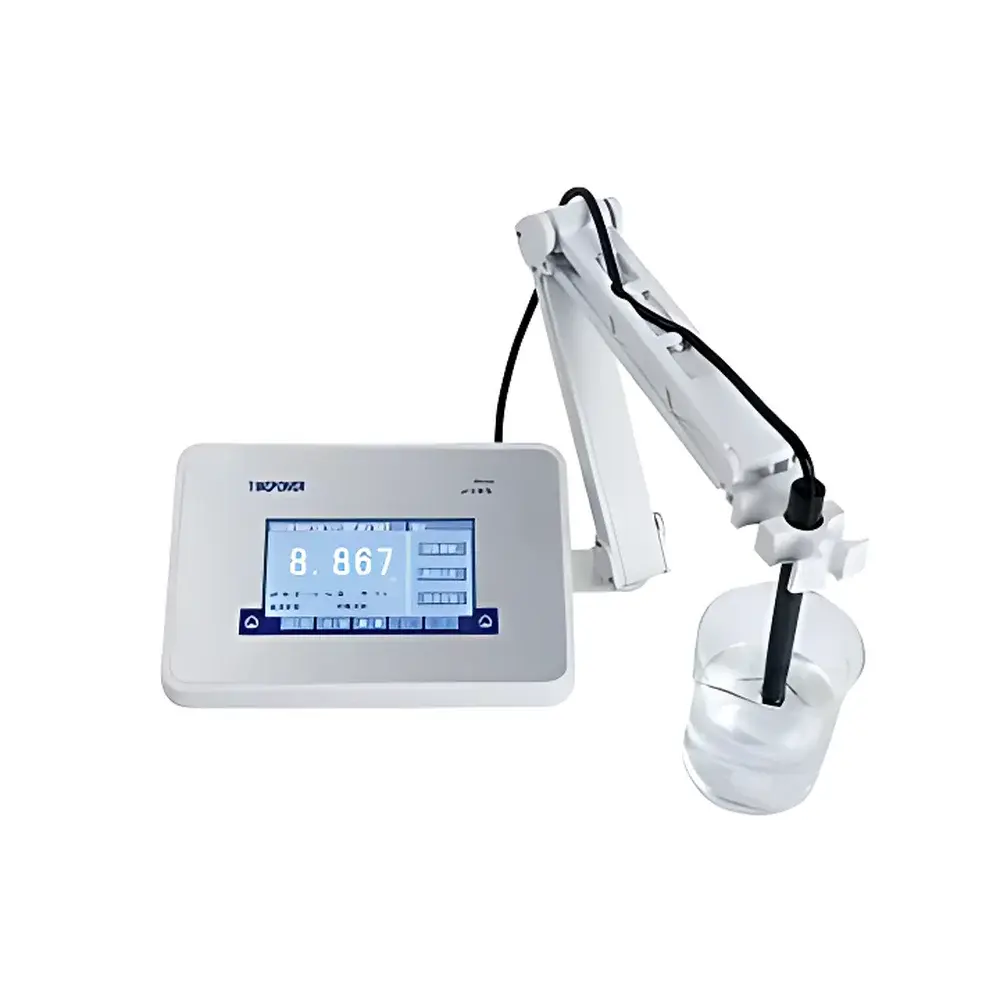
Timepower TP311 Benchtop Precision pH Meter
| Brand | Timepower |
|---|---|
| Origin | Beijing, China |
| Manufacturer Type | Manufacturer |
| Regional Category | Domestic (China) |
| Model | TP311 |
| Instrument Type | Benchtop |
| Parameter Capability | Multi-parameter |
| Measurement Accuracy | ±0.02 pH |
| pH Range | 0.00–14.00 pH |
| Resolution | 0.01 pH |
| Calibration Standard | NIST-traceable buffer solutions |
| Input Impedance | ≥1 × 10¹² Ω |
| Repeatability | ≤1% |
| Stability | ±1% F.S./4 h |
| Response Time (T90) | <1 min at 25 °C |
| Temperature Compensation Range | 0–60 °C |
| Temperature Sensor | Pt1000 |
| Operating Temperature | 5–60 °C (sample), 5–45 °C (ambient) |
| Relative Humidity | ≤90% RH (non-condensing) |
| Storage/Transport Temp | −25–55 °C (electrode excluded |
| Power Supply | AC 85–265 V, 45–65 Hz |
| Power Consumption | ≤5 W |
| Dimensions | 200 × 200 × 85 mm |
| Weight | 2.1 kg |
| Display | 5.0-inch color touchscreen LCD with Chinese UI |
Overview
The Timepower TP311 Benchtop Precision pH Meter is an electrochemical analytical instrument engineered for high-accuracy, routine pH measurement in regulated and industrial laboratory environments. It operates on the potentiometric principle: a galvanic cell formed by a pH-sensitive glass electrode (indicator), a stable reference electrode (Ag/AgCl), and the sample solution generates an electromotive force (EMF) proportional to the hydrogen ion activity—governed by the Nernst equation. The instrument integrates a high-input-impedance (>1 × 10¹² Ω) analog front-end and precision 24-bit ADC conversion to minimize leakage current errors and ensure reliable signal acquisition across the full 0.00–14.00 pH range. Designed for long-term stability in continuous operation, the TP311 delivers ±0.02 pH accuracy with 0.01 pH resolution and automatic temperature compensation (ATC) via integrated Pt1000 sensing—critical for compliance with ISO 7888, ASTM D1293, and USP pH measurement protocols.
Key Features
- True benchtop architecture with compact footprint (200 × 200 × 85 mm) and low power consumption (≤5 W), suitable for shared lab benches and QC stations.
- 5.0-inch color touchscreen LCD with intuitive Chinese-language menu navigation—optimized for rapid setup and real-time multi-parameter viewing (pH, temperature, time, status).
- Multi-parameter capability: simultaneous pH and temperature measurement with ATC from 0–60 °C; supports optional dissolved oxygen (DO) module integration via standardized analog/digital I/O interface.
- High-reliability circuit design using SMT (surface-mount technology) and monolithic PCB layout—enhancing thermal stability and electromagnetic immunity in industrial settings.
- Non-volatile memory retains calibration data, measurement logs, and user configurations for ≥10 years without power; supports circular data logging with auto-overwrite and timestamped recall.
- Compliant with CE electromagnetic compatibility (EMC) directives and RoHS material restrictions; designed for use with NIST-traceable pH buffer standards (e.g., 4.01, 7.00, 10.01 at 25 °C).
Sample Compatibility & Compliance
The TP311 accommodates aqueous samples across diverse matrices—including ultrapure water (≥18.2 MΩ·cm), boiler feedwater, pharmaceutical process streams, food-grade rinse solutions, and municipal wastewater effluents. Its high-input-impedance design prevents loading errors when measuring low-conductivity samples (e.g., deionized water), while the dual-junction pH tri-combination electrode minimizes liquid junction potential drift in high-ionic-strength or protein-rich media. For regulatory alignment, the instrument supports GLP/GMP workflows through manual audit trail documentation; optional firmware upgrade enables 21 CFR Part 11–compliant electronic signatures and secure user access control (Level 1–3 permissions). Calibration verification meets ISO/IEC 17025 requirements when performed using certified reference materials and documented SOPs.
Software & Data Management
Data export is supported via USB host interface (FAT32-formatted flash drives) for CSV-formatted measurement logs—including date/time stamps, operator ID fields, and calibration history. Internal memory stores up to 2,000 measurement records with automatic time/date stamping and sequence numbering. While the base unit does not include PC connectivity, RS-232 or optional USB-to-serial adapter enables integration with LIMS or SCADA systems using Modbus RTU or ASCII protocol. All stored data retain integrity during power interruption; no battery-backed RAM is required due to EEPROM-based storage architecture. Firmware updates are performed locally via USB—no cloud dependency or internet connection required.
Applications
The TP311 serves as a primary pH measurement platform in quality control laboratories across multiple sectors: monitoring conductivity-adjusted pure water loops in semiconductor fabrication; verifying neutralization endpoints in pharmaceutical API synthesis; validating cleaning-in-place (CIP) rinse pH in bioreactor facilities; assessing corrosion inhibitors in power plant condensate systems; and conducting batch-release testing of dairy, beverage, and canned food products per AOAC and Codex Alimentarius guidelines. Its robustness and repeatability make it suitable for daily calibration verification in metrology labs supporting ISO/IEC 17025-accredited pH testing services.
FAQ
What calibration standards are recommended for routine use?
NIST-traceable pH buffer solutions at 4.01, 7.00, and 10.01 (25 °C) are recommended for two- or three-point calibration. Buffers must be freshly opened and stored at ambient temperature; discard after 30 days post-opening.
Can the TP311 measure pH in low-conductivity water (e.g., RO/DI water)?
Yes—its input impedance ≥1 × 10¹² Ω and specialized low-resistance pH tri-combination electrode minimize measurement drift in ultrapure water applications.
Is temperature compensation mandatory for accurate pH readings?
Yes. The Nernst slope varies with temperature; the integrated Pt1000 sensor ensures automatic correction per IUPAC-recommended temperature coefficients.
How often should the electrode be recalibrated?
Recalibration is required before each analytical session, after electrode cleaning, or when drift exceeds ±0.03 pH between measurements.
Does the instrument support GLP-compliant record keeping?
Manual GLP adherence is supported via printed calibration logs and handwritten operator entries; electronic audit trails require optional firmware and external LIMS integration.




