
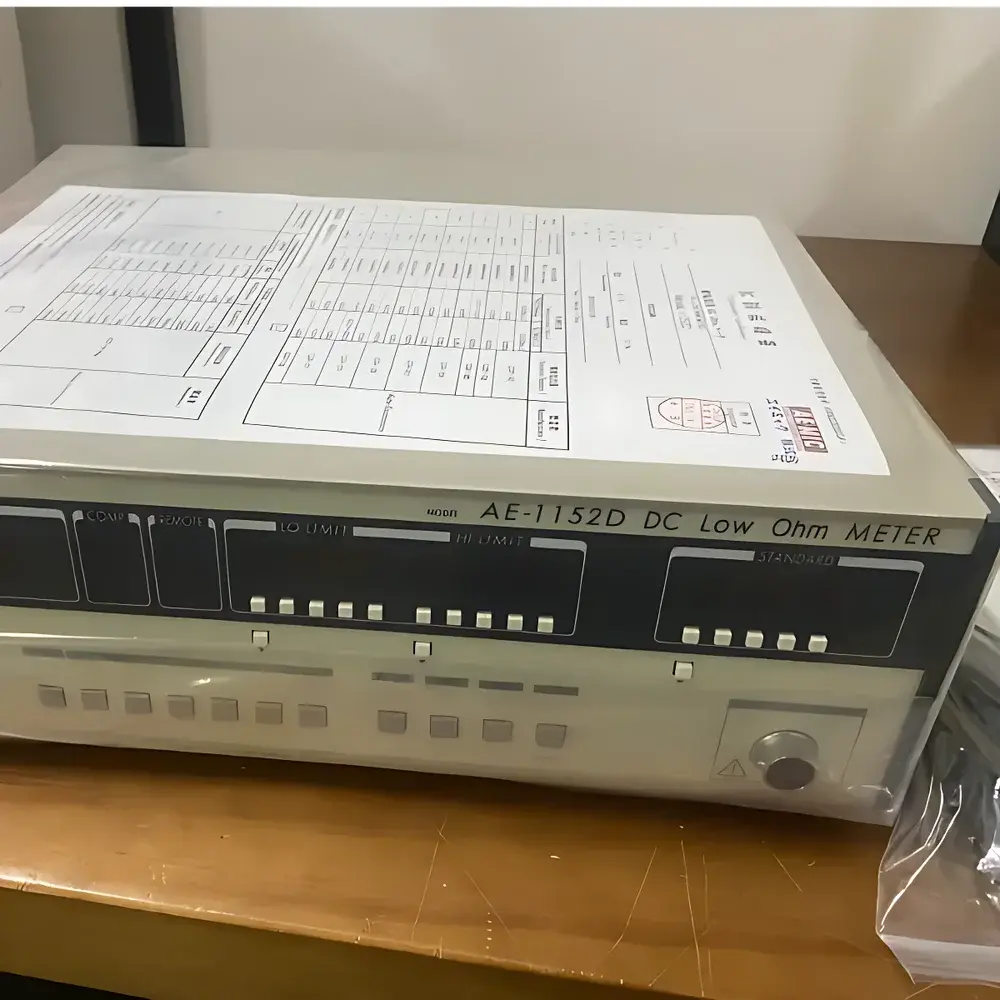
AEMIC AE-1152D Ultra-Low Resistance Meter
| Brand | AEMIC |
|---|---|
| Origin | Japan |
| Model | AE-1152D |
| Measurement Principle | 4-Terminal Kelvin (DC) |
| Basic Accuracy | ±(0.01% rdg + 1 μΩ) on 1 mΩ range |
| Minimum Resolution | 10 nΩ |
| Measurement Ranges | 0.0000 mΩ to 1.5000 kΩ |
| Test Currents | 3 A (1 mΩ), 1 A (10 mΩ), 100 mA (100 mΩ–10 Ω), 10 mA (100 Ω–1 kΩ), 1 mA (1 kΩ) |
| Open-Circuit Voltage | ≤5 V |
| Sampling Rate | 2–10 Hz (free-run) |
| Interfaces | Standard GPIB/RS-232C/Centronics (one optional interface built-in) |
| Comparator Outputs | Open-collector (max 40 V, 100 mA) for LO/GO/HI, CONT-E, EOC |
| Operating Environment | 5–40°C, ≤85% RH |
| Power Supply | AC 85–265 V, 50–60 Hz, ~60 VA |
| Dimensions | 333 W × 99 H × 300 D mm (excl. protrusions) |
| Weight | ~3 kg |
| Compliance | CE-marked |
Overview
The AEMIC AE-1152D is a high-precision, micro-ohmmeter engineered for stable, repeatable ultra-low resistance measurements in industrial quality control, battery cell interconnect validation, power electronics manufacturing, and precision shunt resistor verification. It employs a true 4-terminal (Kelvin) DC measurement architecture to eliminate lead and contact resistance errors—critical when characterizing resistances below 1 mΩ. Unlike conventional ohmmeters, the AE-1152D applies controlled, low-duty-cycle DC current pulses to suppress self-heating at test terminals and minimize thermoelectric EMF interference—a key design consideration for measuring copper busbars, welded joints, or current-sense shunts where thermal drift directly compromises repeatability. Its core architecture integrates real-time contact-check logic, open-circuit voltage limiting (≤5 V), and programmable current sourcing across six decades—from 3 A down to 1 mA—ensuring optimal signal-to-noise ratio across its full 10 nΩ–1.5 kΩ measurement span.
Key Features
- 10 nΩ minimum resolution with ±(0.01% rdg + 1 μΩ) basic accuracy on the 1 mΩ range—validated at 23°C ±5°C per IEC 61000-4-30 referenced environmental conditions
- Pulsed DC current excitation (2–10 Hz free-run; 9 ms–400 ms external-triggered) to mitigate Joule heating and thermoelectric offset in low-resistance DUTs
- Integrated contact-error detection (CONT-E) and end-of-cycle (EOC) signaling via open-collector outputs (40 V / 100 mA max)
- Multi-range auto-ranging with fixed-current selection: 3 A (1 mΩ), 1 A (10 mΩ), 100 mA (100 mΩ–10 Ω), 10 mA (100 Ω–1 kΩ), 1 mA (1 kΩ)
- Three-speed measurement modes (Fast/Medium/Slow) supporting digit averaging up to ±5-digit stability for high-reproducibility QC environments
- CE-compliant electromagnetic compatibility (EN 61326-1) and safety certification (EN 61010-1) for integration into ISO/IEC 17025-accredited laboratories
Sample Compatibility & Compliance
The AE-1152D is optimized for metallic conductors, solder joints, battery tab welds, PCB traces, and precision shunt resistors (e.g., Vishay WSHP, Ohmite LRxx series). Its 4-wire configuration supports fixtures with spring-loaded Kelvin probes or custom test jigs compliant with ASTM B578 (standard test method for electrodeposited and mechanically deposited coatings). The instrument meets requirements for GLP/GMP-aligned electrical testing workflows—including audit-ready comparator pass/fail logging—and supports traceability via GPIB or RS-232C interfaces under IEEE 488.2 and EIA/TIA-232-F standards. While not FDA 21 CFR Part 11–certified out-of-the-box, its digital output architecture enables integration with validated LIMS or MES systems requiring electronic record integrity.
Software & Data Management
Data acquisition and remote control are supported via standard SCPI command sets over GPIB (IEEE 488.2), RS-232C (EIA/TIA-232-F), or Centronics parallel interface (one option factory-installed). Raw resistance values, comparator status (LO/GO/HI), contact-error flags, and EOC timestamps can be streamed in ASCII format at up to 10 readings/sec. Third-party software (e.g., LabVIEW, Python pyVISA, MATLAB Instrument Control Toolbox) may configure measurement parameters, initiate sweeps, and log time-stamped datasets with metadata including ambient temperature and operator ID. All comparator thresholds (absolute or % deviation) are user-definable and stored in non-volatile memory—even after power cycling.
Applications
- Validation of low-resistance interconnects in lithium-ion battery modules (e.g., cell-to-busbar welds, busbar-to-terminal joints)
- Production-line screening of current-sense shunts used in EV inverters and power supply units
- Quality assurance of electroplated contacts, relay contacts, and circuit breaker contacts per IEC 60947-1 Annex G
- R&D characterization of novel conductive materials (e.g., graphene composites, metal matrix nanocomposites) requiring sub-microohm resolution
- Calibration lab verification of secondary standards (e.g., zero-ohm links, 100 µΩ–10 mΩ reference resistors)
FAQ
What is the maximum test current the AE-1152D delivers, and on which range?
The instrument supplies up to 3 A DC on the 1 mΩ measurement range to ensure sufficient signal amplitude while maintaining thermal stability through pulsed operation.
Does the AE-1152D support statistical process control (SPC) data export?
Yes—via RS-232C or GPIB, it outputs ASCII-formatted resistance values, comparator results, and timestamps compatible with SPC software such as Minitab, InfinityQS, or custom SQL-based dashboards.
Can the contact-check function detect intermittent connections during automated testing?
Yes—the CONT-E output activates upon detection of unstable probe contact or excessive contact resistance (>100 mΩ typical threshold), enabling immediate fixture re-engagement or test abort in integrated test systems.
Is the 10 nΩ resolution achievable across all ranges?
No—the 10 nΩ resolution is specified only on the 1 mΩ range (0.0000 mΩ to 15.000 mΩ); resolution degrades logarithmically per decade, reaching 100 mΩ on the 1 kΩ range.
How does the AE-1152D handle thermoelectric voltages during low-resistance measurement?
It uses synchronized current reversal and offset-compensated sampling—combined with low open-circuit voltage (<5 V) and pulsed excitation—to suppress thermal EMF contributions below 100 nV, ensuring measurement fidelity in uncontrolled ambient environments.



