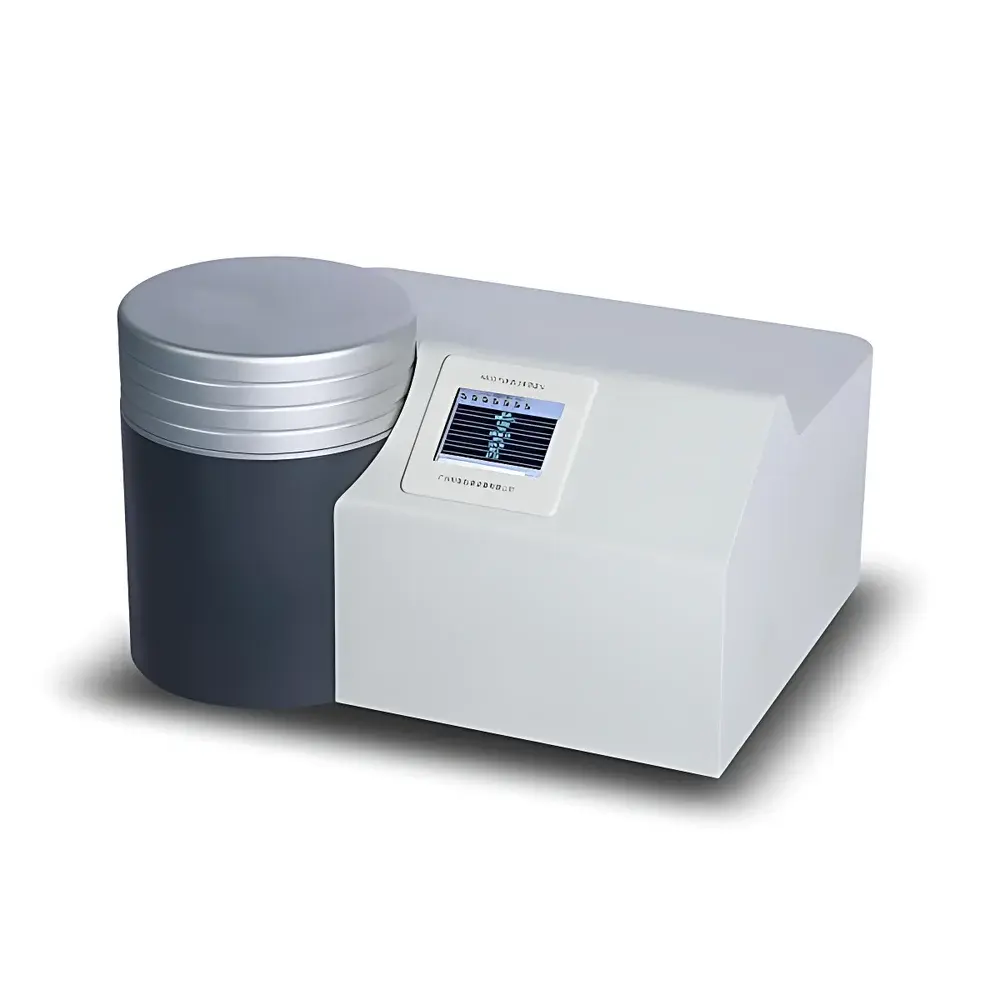
GBPI N500 Gas Permeability Tester
| Brand | GBPI |
|---|---|
| Origin | Guangdong, China |
| Manufacturer Type | Manufacturer |
| Origin Category | Domestic |
| Model | N500-aa |
| Price Range | USD 14,000 – 70,000 |
| Test Gases | O₂, CO₂, N₂ |
| Measurement Principle | Differential Pressure (Manometric) Method |
| Standard Compliance | GB/T 1038-2000, ISO 2556-1974, ISO 15105-1:2007, ASTM D1434, YBB 00082003-2015, JIS K7126-1:2006 |
| Test Range | 0.02–50,000 cm³/(m²·24h·0.1 MPa), extendable to 600,000 cm³/(m²·24h·0.1 MPa) |
| Accuracy | 0.001 cm³/(m²·24h·0.1 MPa) |
| Temperature Control | 15–60 °C, ±0.1 °C stability |
| Vacuum Level | <20 Pa |
| Vacuum Resolution | 0.01 Pa |
| Test Pressure Range | −0.1 to +0.1 MPa |
| Gas Supply Pressure | 0.2–0.8 MPa |
| Specimen Area | 50.24 cm² |
| Specimen Diameter | Φ110 mm |
| Max Thickness | ≤2 mm |
| Chamber Count | 1 |
| Dimensions | 700 × 600 × 450 mm |
| Weight | 41.7 kg |
| Power | 500 W, AC 220 V / 50 Hz |
Overview
The GBPI N500 Gas Permeability Tester is an engineered differential pressure (manometric) instrument designed for precise quantification of gas transmission rates—specifically oxygen (O₂), carbon dioxide (CO₂), and nitrogen (N₂)—through planar and contoured packaging materials. It operates on the fundamental principle of Fick’s first law of diffusion: under a controlled, steady-state pressure gradient across a conditioned specimen, the volumetric flow rate of gas permeating per unit area and time is directly proportional to the material’s intrinsic permeability coefficient. The system establishes a constant pressure differential between upper and lower test chambers via vacuum evacuation and regulated gas dosing; real-time monitoring of downstream pressure rise enables calculation of gas transmission rate (GTR) in standardized units (cm³/(m²·24h·0.1 MPa)). This methodology aligns with internationally recognized gravimetric and manometric standards, ensuring metrological traceability and inter-laboratory comparability.
Key Features
- High-resolution vacuum control: Achieves and maintains vacuum levels below 20 Pa with 0.01 Pa resolution, critical for low-permeability measurements (e.g., aluminum foil, PVDC-coated films).
- Electromagnetic programmable temperature control: Precise ±0.1 °C regulation across 15–60 °C range without external chiller or heater units—eliminating thermal lag and spatial non-uniformity.
- ARM-based embedded control architecture: Fully autonomous operation independent of external PCs; integrated 7-inch color touchscreen displays real-time pressure, differential pressure, temperature, and calculated GTR curves.
- Triple-range measurement capability: Automatically adapts sensitivity for high-, medium-, and low-barrier materials—enabling accurate quantification from ultra-high-barrier substrates (e.g., SiOₓ-coated PET) to highly permeable elastomers.
- Expandable test volume configuration: Optional auxiliary chamber extension increases upper detection limit to 600,000 cm³/(m²·24h·0.1 MPa), supporting rapid screening of porous foams or uncoated paperboard.
- Automatic pressure-differential maintenance: Dynamic feedback loop sustains user-defined ΔP throughout test duration—minimizing drift-induced error in kinetic permeation modeling.
Sample Compatibility & Compliance
The N500 accommodates flat specimens up to Φ110 mm and ≤2 mm thickness—including monolayer polymers (LDPE, PP), multilayer laminates (PET/AL/PE), metallized films, ceramic coatings, rubber sheets, and rigid thermoplastics. With optional container adapters, it extends functionality to sealed pouches, blister cavities, PET bottles, and thermoformed trays—enabling package-level barrier validation per ASTM F2622 and ISO 15105-2. All measurement protocols comply with regulatory-grade documentation requirements: full audit trail logging (system, method, and result-level), role-based access control (administrator, operator, reviewer), and electronic signature support conforming to FDA 21 CFR Part 11 and EU Annex 11 guidelines. Certified reference materials (GBW(E)130541/2) are supplied for routine calibration and verification, satisfying GLP/GMP laboratory accreditation criteria (CNAS ISO/IEC 17025).
Software & Data Management
The embedded GBPI PermeaSoft™ platform delivers ISO 17025-aligned data integrity. Each test session generates a timestamped, digitally signed report containing raw pressure vs. time datasets, curve-fitting residuals, environmental metadata (T, RH, ΔP), and uncertainty estimates per GUM (JCGM 100:2008). Reports export natively to PDF, Excel, and Word formats with configurable templates. Database queries support retrospective analysis by material ID, operator, date range, or specification limits. All modifications—parameter edits, result overrides, or calibration updates—are immutably logged with user ID, timestamp, and pre-/post-values. Software architecture adheres to ICH GCP and EU GMP Annex 11 principles: no local data deletion, encrypted storage, and periodic backup scheduling.
Applications
The N500 serves as a primary tool in quality assurance laboratories across regulated industries. In pharmaceutical packaging, it validates shelf-life predictions for blister packs and cold-form foil by measuring O₂ ingress under accelerated aging conditions (ICH Q1A). Food manufacturers use it to benchmark MAP (modified atmosphere packaging) film performance against spoilage thresholds (e.g., ≤0.5 cm³/m²·24h O₂ for fresh-cut produce). Medical device firms assess peel strength–barrier trade-offs in sterile barrier systems per ISO 11607-1. Emerging applications include evaluating moisture-gas coupling in perovskite solar cell encapsulation films and quantifying CO₂ permeability in biodegradable food containers compliant with EN 13432. Research institutions utilize its high-resolution kinetics mode to derive activation energy (Eₐ) values from Arrhenius plots across multiple temperatures.
FAQ
What gas types can be tested on the N500?
O₂, CO₂, and N₂ are fully supported; other gases may be used provided compatibility with stainless-steel wetted parts and pressure sensor specifications.
Does the instrument require external PC connectivity for routine operation?
No—ARM-based firmware enables standalone testing, reporting, and data export via USB or Ethernet; PC connection is optional for advanced batch analysis or LIMS integration.
How is calibration traceability maintained?
Using GBPI-certified national standard reference materials (GBW(E)130541/2), traceable to NIM (National Institute of Metrology, China); dual-mode calibration (gas standard + pressure transducer) ensures cross-verification.
Can the N500 meet FDA 21 CFR Part 11 requirements?
Yes—role-based authentication, electronic signatures, and immutable audit trails satisfy Part 11 Subpart B technical controls for electronic records and signatures.
What is the minimum detectable O₂ transmission rate for aluminum foil?
At 23 °C and 0% RH, the system achieves reliable quantification down to 0.001 cm³/(m²·24h·0.1 MPa) for high-barrier metals when operated at optimal vacuum stability and extended test duration (≥72 h).