
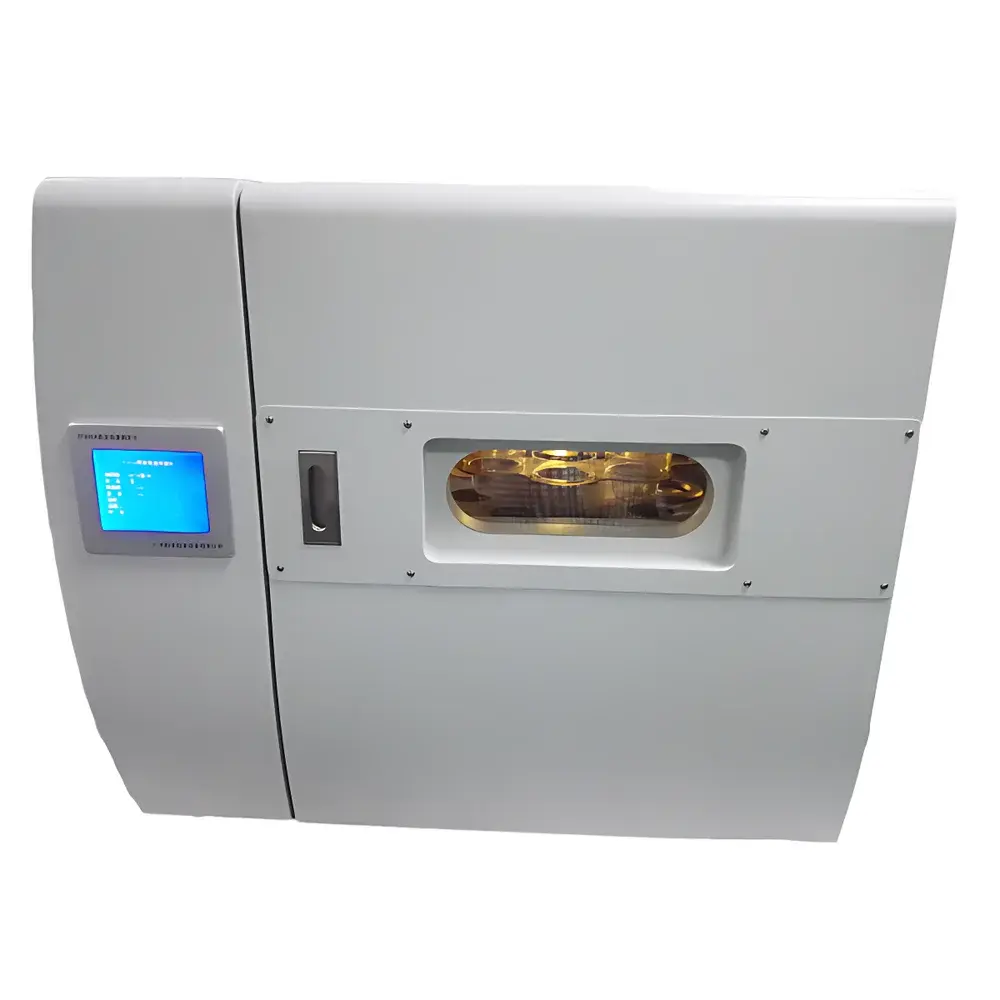
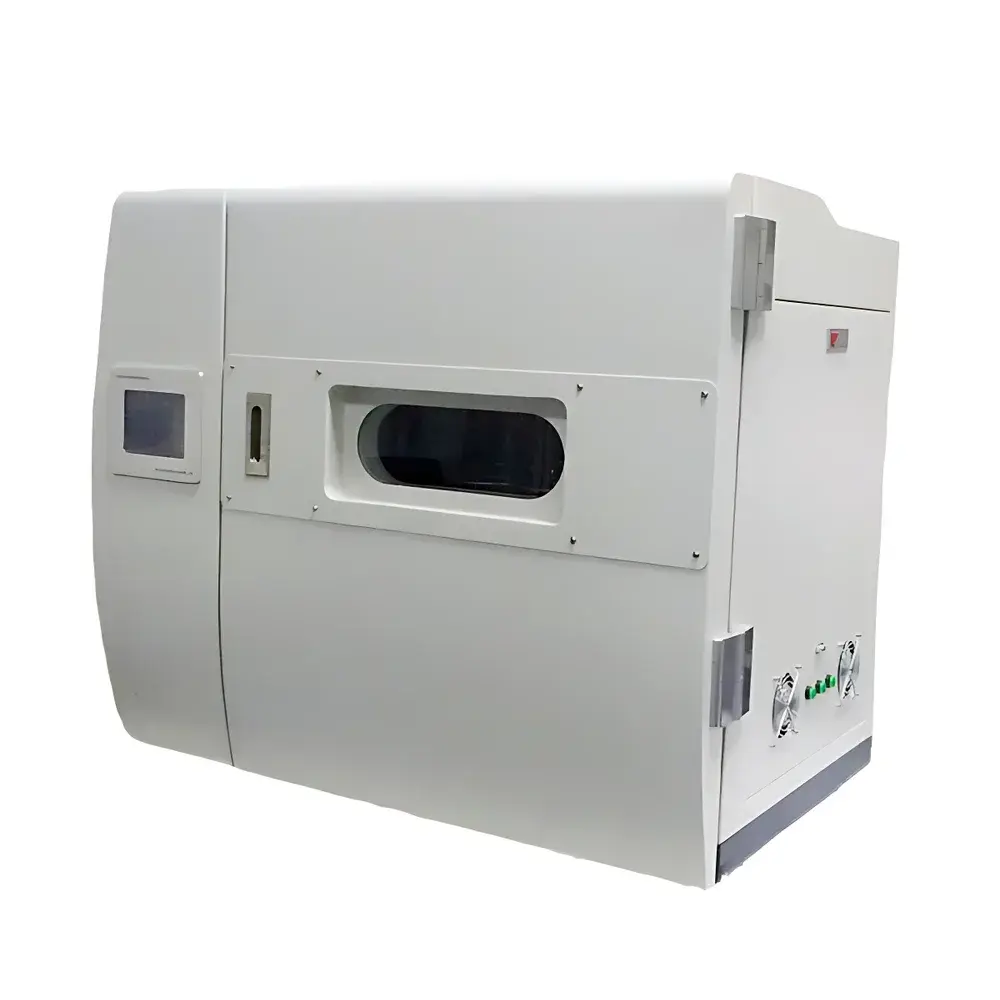
GBPI ZF800A Evaporative Residue Analyzer
| Brand | GBPI |
|---|---|
| Origin | Guangdong, China |
| Manufacturer Type | Manufacturer |
| Model | ZF800A |
| Testing Capacity | 8 independent stations (expandable to 36) |
| Residue Mass Range | 0–80 g |
| Weighing Accuracy | 0.2 mg |
| System Resolution | 0.1 mg |
| Temperature Control Range | 80–130 °C |
| Temperature Stability | ±0.2 °C |
| Hot Air Circulation Velocity | 0.2 m/s |
| Sample Volume per Vessel | 0–200 mL |
| Evaporation Vessel Capacity | 230 mL (included ×8) |
| Power Supply | 220 V, 50 Hz |
| Rated Power | 4000 W |
| Dimensions (W×D×H) | 937 × 660 × 830 mm |
| Interface Fittings | 1/8″ stainless steel tubing & Φ6 mm polyurethane tubing |
| Standard Accessories | Dedicated software, communication cable, 200 g calibration weight, Φ8 mm PU air tube |
Overview
The GBPI ZF800A Evaporative Residue Analyzer is a fully automated, multi-station laboratory instrument engineered for precise quantification of non-volatile residue following solvent extraction or aqueous leaching of food-contact materials. It operates on the gravimetric principle defined in multiple Chinese national standards—including GB/T 5009.60–2003, GB/T 5009.64–2003, GB/T 5009.68–2003, GB/T 5009.69–2008, GB/T 5009.203–2003, and GB/T 9740–2008—aligning with internationally recognized methodologies for extractable residue assessment in food packaging, utensils, coatings, gaskets, and processing equipment. The system integrates closed-loop solvent evaporation, embedded water-bath heating, programmable thermal control, and high-resolution microbalance measurement to deliver trace-level residue mass determination (down to 0.1 mg resolution) under strictly controlled thermal conditions. Designed for regulatory compliance laboratories, QC departments in packaging manufacturing, and food safety testing facilities, the ZF800A eliminates manual intervention during evaporation, drying, and weighing cycles—ensuring procedural consistency and minimizing operator-induced variability.
Key Features
- Eight independently controlled test stations, each with dedicated temperature regulation, real-time weight monitoring, and autonomous data logging; scalable architecture supports expansion to 36 stations via modular configuration.
- Hermetically sealed evaporation chamber with integrated solvent recovery system—prevents atmospheric release of volatile organic compounds (VOCs) and ensures operator safety and environmental compliance.
- Embedded dual-mode thermal control: precision water bath (for initial solvent removal) coupled with forced-air convection oven (for final drying), both governed by embedded electromagnetic PID controllers with 0.1 °C programmable step resolution and ±0.2 °C stability.
- Self-calibrating microbalance subsystem with 0.2 mg repeatability; includes factory-certified 200 g reference weight for rapid on-site verification per ISO/IEC 17025 metrological requirements.
- Autonomous workflow execution: after sample solution introduction into designated vessels, the instrument performs sequential evaporation, transfer to drying chamber, constant-temperature drying, cooling, and gravimetric analysis—all without manual handling.
- Onboard 7-inch color touchscreen HMI running a real-time embedded OS; supports parameter setup, live multi-channel monitoring (weight, temperature, humidity, residual rate), alarm triggering, and local report generation—no external PC required.
- Intelligent anomaly detection algorithm identifies and filters transient disturbances (e.g., vibration, draft, power fluctuation) during weighing, preserving data integrity and reducing false outliers.
Sample Compatibility & Compliance
The ZF800A accommodates diverse sample matrices compliant with food-contact material regulations, including but not limited to polyethylene (PE), polypropylene (PP), polystyrene (PS), chlorinated polyvinyl chloride (CPVC), epoxy-phenolic coatings, rubber gaskets, lacquered tinplate, plant-fiber-based containers, and food-grade piping components. It supports standard extraction solvents such as distilled water, 4% acetic acid, 20% ethanol, and n-heptane at specified temperatures and durations per GB/T 5009 series protocols. All operational parameters—including dwell time, ramp rates, drying duration, and endpoint criteria—are configurable to meet method-specific validation requirements. The instrument’s design conforms to GLP documentation standards: full audit trail (user ID, timestamp, parameter changes, weight logs), electronic signatures, and exportable CSV/Excel reports satisfy FDA 21 CFR Part 11 readiness when deployed with validated software configuration.
Software & Data Management
The included GBPI EvapSoft v3.x application provides comprehensive method management, calibration history tracking, statistical process control (SPC) charts, and batch-level reporting. Raw weight sequences are stored with metadata (vessel ID, start/end time, ambient RH, thermal profile), enabling retrospective analysis and root-cause investigation. Data export supports LIMS integration via OPC UA or TCP/IP protocols. Software validation documentation (IQ/OQ/PQ templates) is available upon request. Automatic backup to internal SSD and optional network share ensures data redundancy. All records comply with ISO/IEC 17025 clause 7.5.2 on result reporting and traceability.
Applications
- Regulatory testing of food packaging compliance per GB 4806 series and China’s Food Safety Law.
- Leachables screening in pharmaceutical primary packaging (e.g., blister foils, HDPE bottles) aligned with USP and ICH Q5C principles.
- Quality control of coating adhesion and solvent retention in metal can linings.
- Validation of cleaning efficacy in shared food processing lines using rinse-water residue analysis.
- Development and verification of migration-resistant polymer formulations.
- Third-party certification labs performing CNAS-accredited residue testing.
FAQ
What standards does the ZF800A directly support?
It is configured to execute all test procedures specified in GB/T 5009.60–2003, GB/T 5009.64–2003, GB/T 5009.68–2003, GB/T 5009.69–2008, GB/T 5009.203–2003, and GB/T 9740–2008.
Can the instrument operate without a connected computer?
Yes—the onboard embedded OS and 7-inch touchscreen enable full operation, real-time monitoring, and local report generation without external computing hardware.
Is solvent recovery mandatory for safe operation?
Yes—the integrated condensation and collection system is integral to the safety architecture; operation without active recovery violates CE/GB safety directives and voids warranty.
How is temperature uniformity verified across all eight chambers?
Each station includes an independent PT100 sensor calibrated against NIST-traceable references; validation reports include chamber-to-chamber delta-T mapping at 80 °C, 100 °C, and 121 °C.
What maintenance intervals are recommended?
Daily: vessel cleaning and visual seal inspection. Quarterly: balance recalibration, airflow velocity verification, and thermal gradient mapping. Annual: full preventive maintenance including pump service and firmware update audit.






