
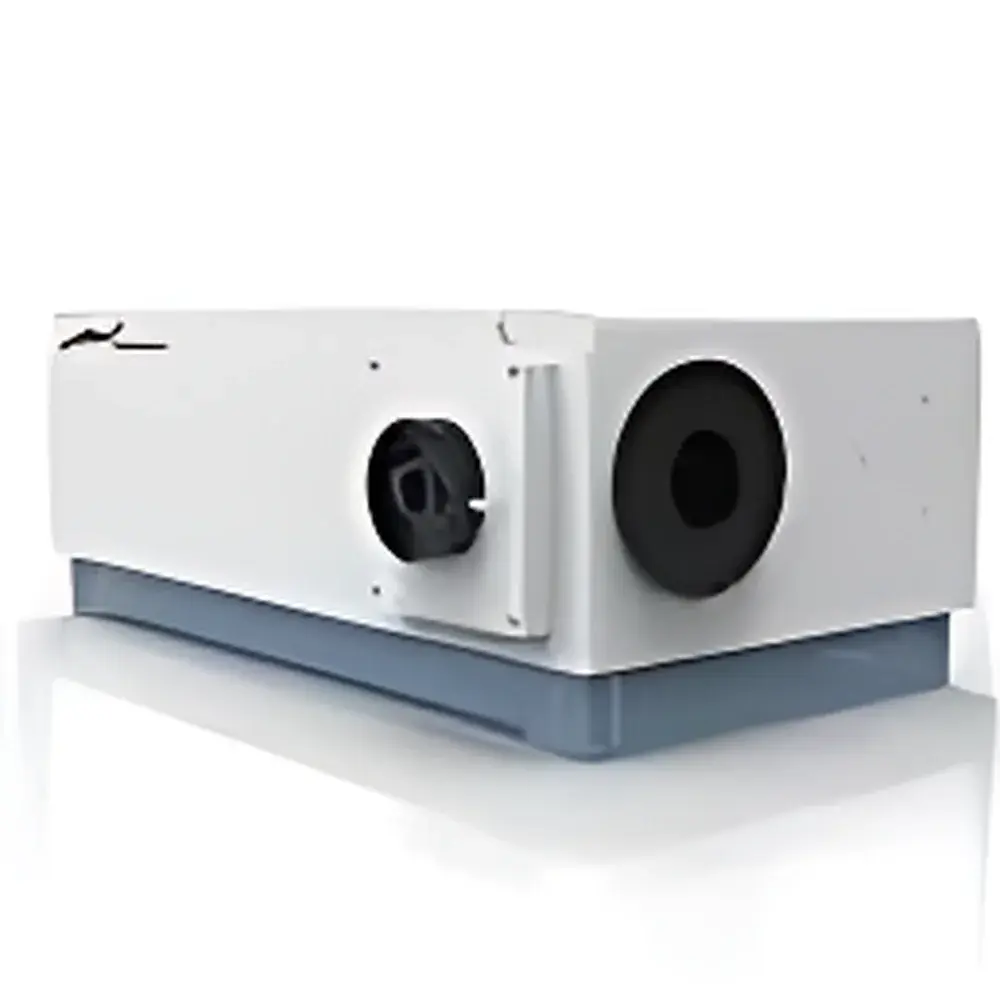
Abner ABN-SPEC-001 Grating Monochromator
| Brand | Abner |
|---|---|
| Origin | Jiangsu, China |
| Model | ABN-SPEC-001 |
| Focal Length | 500 mm |
| Relative Aperture | f/8 |
| Spectral Range (with 600 g/mm grating) | 300–1100 nm |
| Extended Range (with grating exchange) | 150 nm–40 µm |
| Grating Size | 68 mm × 68 mm |
| Max. Installed Gratings | 3 |
| Flat-Field Focal Plane | 30 mm × 12 mm |
| Wavelength Accuracy | ±0.30 nm |
| Wavelength Repeatability | ±0.01 nm |
| Spectral Dispersion (@500 nm) | 1.5 nm/mm |
| Magnification | 1.0 |
| Output Port | Single exit slit |
| Scanning Speed | 150 nm/sec |
| Minimum Step Size | 0.01 nm |
| Interface | High-Speed USB |
| Dimensions (L×W×H) | 530 × 327 × 218 mm |
| Stray Light Level | <1×10⁻⁵ |
Overview
The Abner ABN-SPEC-001 Grating Monochromator is a precision optical instrument engineered for high-fidelity wavelength selection and spectral isolation in research-grade spectroscopic systems. Based on the Czerny–Turner optical configuration, it employs interchangeable ruled or holographic diffraction gratings to disperse polychromatic light into its constituent wavelengths, enabling selective transmission of narrow spectral bands through a mechanically adjustable exit slit. Its 500 mm focal length and f/8 relative aperture provide an optimal balance between throughput and resolution, supporting rigorous applications requiring high spectral purity and mechanical stability. Designed for integration into custom optical benches or turnkey spectrometers, the ABN-SPEC-001 delivers calibrated monochromatic output across the deep ultraviolet (150 nm) to far-infrared (40 µm) range—subject to grating selection—making it suitable for both fundamental spectroscopy and applied photonic characterization.
Key Features
- Precision Wavelength Control: Motorized drive with 0.01 nm minimum step resolution and ±0.01 nm repeatability ensures reproducible spectral positioning across repeated scans.
- Triple-Grating Turret: Supports rapid, software-controlled switching among three pre-aligned gratings—enabling seamless coverage from UV to IR without realignment or recalibration.
- Low Stray Light Architecture: Optimized baffling, blackened internal surfaces, and high-efficiency coatings reduce stray light to <1×10⁻⁵, critical for quantitative absorbance and fluorescence measurements where background suppression is essential.
- Flat-Field Focal Plane: 30 mm × 12 mm imaging area accommodates linear array detectors or fiber-coupled inputs; maintains spectral linearity and spatial uniformity across the full scan range.
- High-Speed Spectral Scanning: Capable of continuous scanning at up to 150 nm/sec, compatible with time-resolved experiments and dynamic spectral monitoring.
- USB 2.0 Integration: Native high-speed USB interface enables plug-and-play control via industry-standard drivers (e.g., LabVIEW, Python pySerial, MATLAB Instrument Control Toolbox), eliminating proprietary hardware dependencies.
Sample Compatibility & Compliance
The ABN-SPEC-001 operates as a passive optical component and imposes no intrinsic sample constraints—it interfaces with free-space beams, fiber-optic inputs (SMA905 or FC/PC adaptors optional), or collimated sources including arc lamps, supercontinuum lasers, and LED arrays. Its mechanical and optical design complies with ISO 10110-7 (surface imperfections) and ISO 9022-3 (environmental testing for optical instruments). While not certified to GLP or GMP out-of-the-box, the monochromator’s deterministic wavelength calibration traceability (via NIST-traceable Hg/Ne spectral lines) and audit-ready position logging support validation workflows under ISO/IEC 17025 and FDA 21 CFR Part 11 when integrated into validated systems.
Software & Data Management
Abner provides a cross-platform native application (Windows/macOS/Linux) for full instrument control—including grating selection, slit width adjustment, wavelength presetting, and automated scan sequencing. The software exports spectral data in ASCII CSV format with timestamped metadata (wavelength, intensity, slit width, grating ID, motor position). API libraries (C/C++, Python, .NET) allow embedding into custom acquisition pipelines. All position commands and calibration parameters are logged with UTC timestamps, satisfying basic audit trail requirements for regulated environments. No cloud connectivity or telemetry is implemented—data remains fully local and under user control.
Applications
- Laser Tuning & Line Selection: Isolation of specific emission lines from broadband or multimode lasers for cavity injection, pump-probe setups, or frequency stabilization.
- Photodetector Calibration: Monochromatic irradiance delivery to reference photodiodes and radiometers across UV–Vis–NIR, traceable to primary standards.
- Raman Excitation Filtering: Pre-filtering of excitation sources to suppress ASE and parasitic emissions before sample interaction.
- Fluorescence Excitation Spectroscopy: Precise selection of excitation wavelengths to map quantum yield or energy transfer pathways in molecular and nanomaterial systems.
- Thin-Film & Semiconductor Characterization: Integration into reflectance/transmittance measurement stations for bandgap determination and interband transition analysis.
- Teaching & Method Development: Used in undergraduate optics labs to demonstrate dispersion, resolving power, and grating equation fundamentals—fully compatible with student-safe low-power sources.
FAQ
What gratings are included with the ABN-SPEC-001?
The standard configuration includes one 600 g/mm blazed grating optimized for 300–1100 nm. Additional gratings (e.g., 1200 g/mm for higher resolution in visible, or 150 g/mm for extended IR) are available as optional accessories.
Can the monochromator be used in vacuum or purged environments?
Yes—the housing features sealed O-ring ports and optional vacuum flange adapters (CF-35 or KF-25); optical path can be purged with N₂ or evacuated to ≤10⁻³ mbar for UV applications below 200 nm.
Is external triggering supported for synchronized measurements?
Yes—TTL-compatible input and output trigger ports enable hardware synchronization with detectors, choppers, or pulsed lasers at rates up to 10 kHz.
How is wavelength calibration performed and maintained?
Factory calibration uses Hg and Ne spectral lamp lines; users may perform recalibration using any known emission source. Calibration coefficients are stored per grating and persist across power cycles.
Does the device support motorized entrance and exit slits?
The ABN-SPEC-001 features a motorized exit slit only; entrance slit is fixed (25 µm default, replaceable with 10/50/100 µm options). Manual entrance slit adjustment is available upon request for OEM integration.
Related Products






