
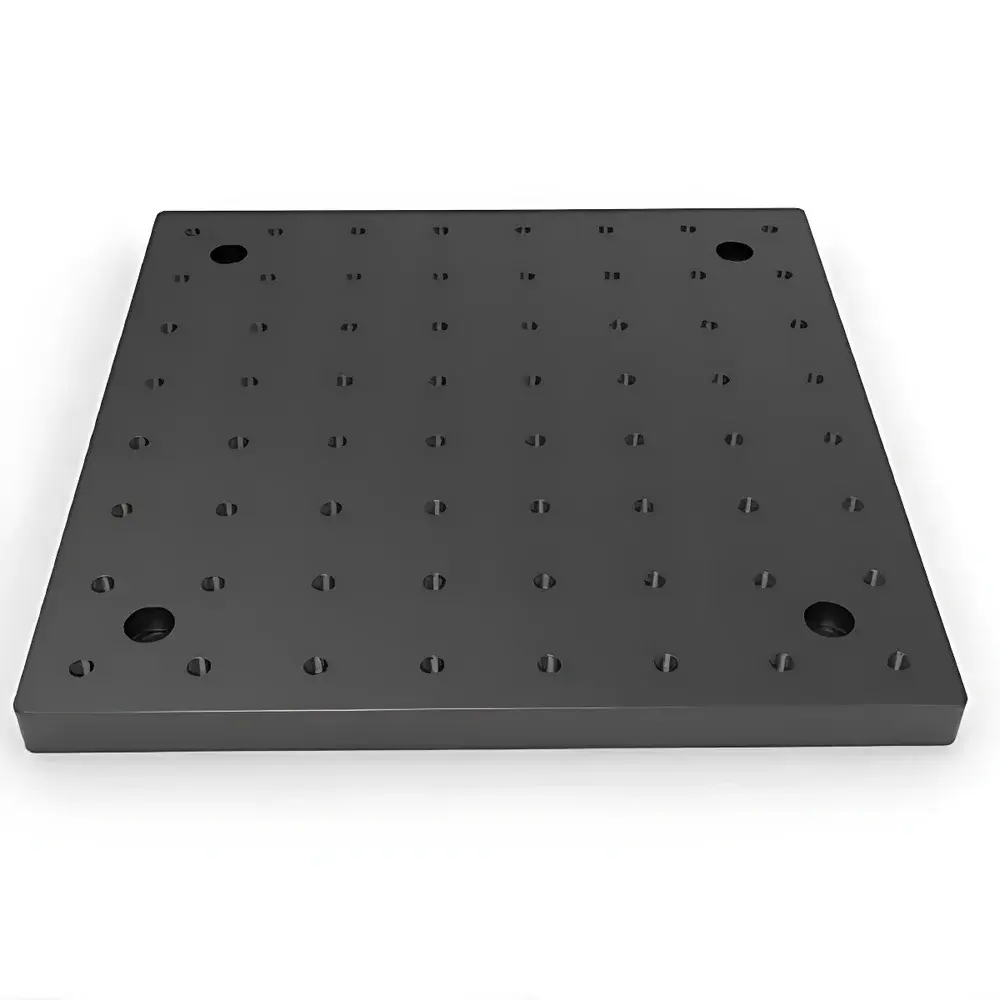
Abner Optical Grade Honeycomb Vibration Isolation Optical Table
| Brand | Abner |
|---|---|
| Origin | Jiangsu, China |
| Manufacturer Type | Authorized Distributor |
| Product Category | Domestic |
| Model | Optical Flat Table |
| Price | USD 8.20 (FOB) |
Overview
The Abner Optical Grade Honeycomb Vibration Isolation Optical Table is an engineered structural platform designed for high-stability optical experimentation and precision metrology. It operates on the principle of constrained-layer damping combined with geometric stiffness optimization—leveraging a monolithic aluminum top plate bonded to a lightweight yet rigid hexagonal aluminum honeycomb core. This architecture delivers exceptional static rigidity (bending stiffness > 1.2 × 10⁷ N·m²/m) and high first-mode natural frequency (> 15 Hz in free-standing configuration), minimizing coupling of floor-borne vibrations into sensitive optical paths. The table serves as a foundational mechanical reference plane for laser interferometry, coherent beam combining, quantum optics setups, and photonic device alignment—where sub-micron positional stability over extended acquisition periods is critical.
Key Features
- Monolithic 25 mm thick 6061-T6 aluminum top plate with black anodized finish (hardness ≥ 500 HV, reflectance < 5% at 400–1100 nm) for anti-glare performance and corrosion resistance
- Precision-machined grid of M6 threaded mounting holes (pitch: 25 mm) conforming to ISO 2768-mK general tolerances; optional 1/4″-20 UNC conversion inserts available
- High-density aluminum honeycomb core (cell size: 6 mm, wall thickness: 0.3 mm) providing optimal mass-to-stiffness ratio and broadband vibration attenuation (40–80 dB insertion loss above 5 Hz)
- Surface flatness certified to ≤ ±0.1 mm over full area (measured per ISO 10360-2 using laser tracker and coordinate measuring machine)
- Integrated edge stiffening ribs and perimeter damping channels to suppress torsional modes and improve modal separation
- Compatible with passive air-spring isolators (e.g., Kinetic Systems 7100 series) or active inertial cancellation systems (e.g., TMC STACIS III)
Sample Compatibility & Compliance
The optical table supports standard optical components including kinematic mounts (e.g., Thorlabs KM100, Newport U100), translation stages (±0.5 µm repeatability), fiber launch systems, and vacuum-compatible optomechanics (when sealed with Viton O-rings). All materials comply with RoHS Directive 2011/65/EU and REACH Annex XVII restrictions. Surface finish meets ASTM B580 Class II anodizing specifications. Structural design adheres to ISO 14644-1 Class 5 cleanroom compatibility guidelines when used with appropriate grounding straps and ESD-safe accessories. No hazardous substances are employed in core fabrication—no lead-based solder, brominated flame retardants, or cadmium plating.
Software & Data Management
While the optical table itself is a passive mechanical system, its integration into automated laboratories follows established digital infrastructure protocols. Mounting hole coordinates are supplied in DXF and STEP formats (ISO 10303-21) for CAD-based optical layout planning (Zemax OpticStudio, Synopsys Code V, FRED). Platform flatness deviation maps (ASCII .xyz point cloud files) are provided for calibration-aware alignment algorithms. When deployed with motorized stages or environmental sensors, the table forms part of a traceable measurement chain compliant with ISO/IEC 17025:2017 requirements for uncertainty budgeting. Audit trails for installation verification—including levelness reports, vibration spectral analysis (1/3-octave bands from 1–100 Hz), and thermal drift logs—are maintained in accordance with GLP documentation standards.
Applications
- Laser cavity alignment and mode-matching in ultrafast Ti:sapphire and fiber laser systems
- White-light and laser Doppler interferometry requiring phase stability < λ/20 over 10-minute intervals
- Precision assembly of micro-opto-electro-mechanical systems (MOEMS) under vision-guided robotics
- Photolithography mask alignment validation in university cleanroom teaching labs
- Gravitational wave detector prototype testing (e.g., tabletop Michelson-Morley configurations)
- Calibration of coordinate measuring machines (CMMs) and laser trackers per VDI/VDE 2617 Part 6
FAQ
What surface flatness tolerance is guaranteed across a 1.5 m × 1.0 m table?
Certified flatness is ≤ ±0.1 mm over the entire usable surface, verified via calibrated laser interferometer and documented in the factory test report.
Can this table be bolted directly to a concrete floor without isolators?
Yes—but dynamic performance degrades significantly below 10 Hz; we recommend minimum isolation with elastomeric pads (Shore A 60) for vibration-sensitive applications.
Is the anodized surface compatible with vacuum environments?
The black anodized layer is non-outgassing per ASTM E595 criteria (CVCM < 0.1%, TML < 1.0%) and suitable for rough vacuum (10⁻³ mbar); bake-out to 80°C is permissible.
Do you provide custom hole patterns or cutouts?
Yes—custom CNC machining services are available under NDA, including through-holes for optical fiber routing, cable management slots, and integrated grounding studs.
How is long-term dimensional stability ensured under thermal cycling?
The matched coefficient of thermal expansion (CTE ≈ 23.6 µm/m·°C) between top plate and honeycomb core minimizes internal stress; thermal drift is < 1.5 µm/°C over 20–30°C ambient range.




