
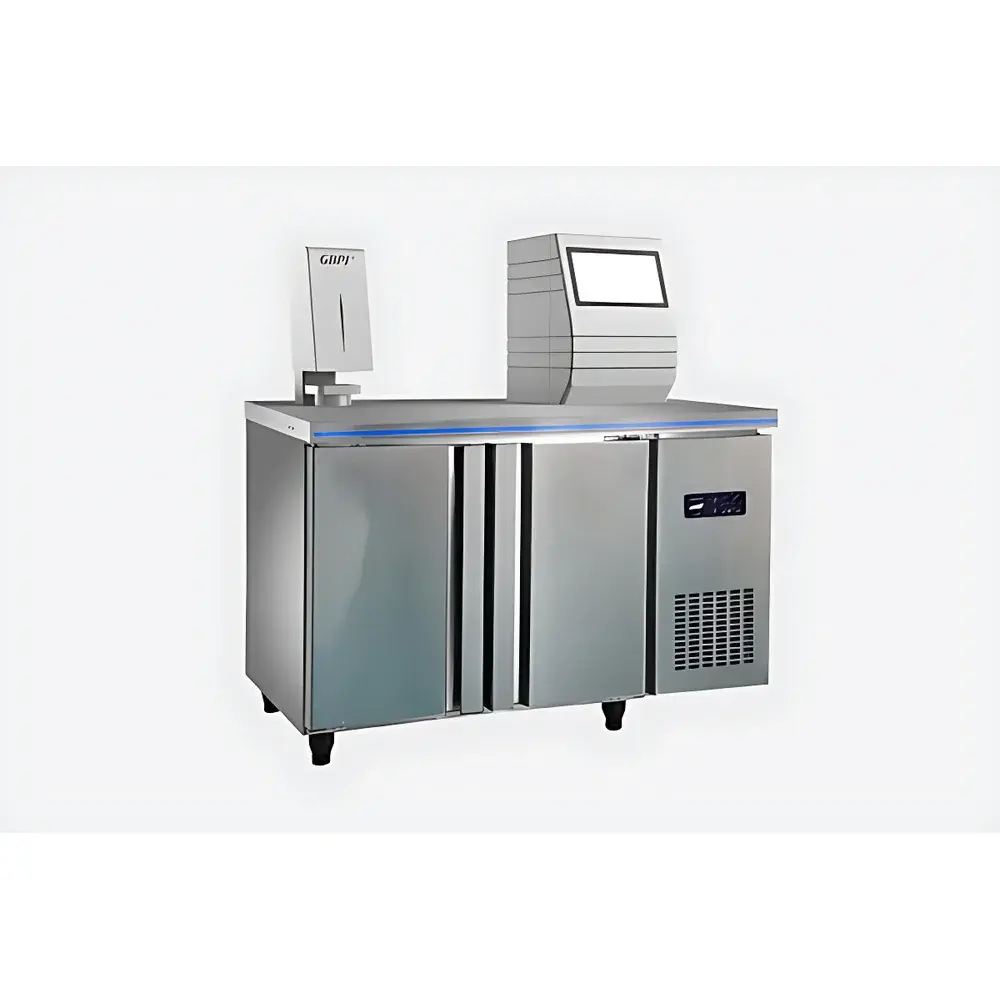
GBPI GB-KF30010I Oil-Based Particulate Filtration Efficiency Tester for Respiratory Protective Devices
| Brand | GBPI |
|---|---|
| Origin | Guangdong, China |
| Manufacturer Type | Direct Manufacturer |
| Country of Origin | China |
| Model | GB-KF30010I |
| Price Range | USD 42,000 – 70,000 |
| Filtration Efficiency Range | 0–99.999% |
| Flow Rate Control Range | 20–100 L/min |
| Pressure Drop Measurement Range | 0–1000 Pa |
| Test Particle Sizes | 0.3 µm, 0.5 µm, 5.0 µm |
| Aerosol Sources | DEHS (Di-Ethyl-Hexyl-Sebacate) and 2% NaCl solution |
| Standard Test Area | 100 cm² (customizable per mask geometry) |
| Dimensions | 130 × 75 × 157 cm |
| Weight | 250 kg |
| Power Supply | AC 220 V, 50 Hz |
| Max Power Consumption | <1500 W |
Overview
The GBPI GB-KF30010I Oil-Based Particulate Filtration Efficiency Tester is an engineered benchtop system designed for quantitative evaluation of filtration performance in respiratory protective devices—including surgical masks, N95/N99 respirators, medical gowns, and industrial filter media—under standardized aerosol challenge conditions. It operates on the principle of controlled aerosol generation, real-time particle concentration measurement upstream and downstream of the test specimen, and differential pressure monitoring across the sample under constant volumetric flow. The instrument complies with core regulatory frameworks governing respiratory protection and textile barrier performance, including GB 2626–2006, GB/T 32610–2016, YY 0469–2011, YY/T 0969–2013, GB 19083–2010, and EN 1822–3:1998 (for single-layer filter media testing). Its dual-aerosol capability—supporting both oil-based (DEHS) and salt-based (NaCl) challenges—enables compliance with classification requirements for oil-resistant (R- and P-class) particulate filters per GB 2626 and NIOSH 42 CFR Part 84 equivalency assessments.
Key Features
- Cold-generation aerosol generator capable of stable, reproducible output of monodisperse DEHS and NaCl aerosols without thermal degradation—ensuring fidelity to ISO 16890 and EN 1822 particle size distributions.
- Integrated bipolar ionizer for neutralizing electrostatic charge on aerosol particles prior to upstream sampling—minimizing electrophoretic bias and enabling accurate assessment of mechanical filtration mechanisms.
- Full containment aerosol pathway with leak-tight seals, negative-pressure exhaust manifold, and HEPA-filtered exhaust—meeting OSHA 1910.120 and ISO 15195 laboratory biosafety requirements for operator protection.
- Pneumatic clamping system with force-limiting actuation and mechanical safety interlocks—ensuring consistent specimen loading pressure (±0.5 kPa) and eliminating manual torque variability.
- Dual-channel laser particle counter (0.3–10 µm detection range, ±5% counting efficiency at 0.3 µm) synchronized with high-accuracy mass flow controllers (±1% full scale) for real-time upstream/downstream concentration ratio calculation.
- Embedded industrial PC with touchscreen HMI and deterministic real-time control loop (100 ms cycle time), supporting automated test sequencing, pass/fail logic per standard thresholds, and audit-ready data logging.
Sample Compatibility & Compliance
The GB-KF30010I accommodates flat-sheet filter media—including glass fiber, melt-blown polypropylene (PP), and hydrophobic membrane laminates—as well as finished three-dimensional face masks (flat-fold, cup-shaped, duckbill) via configurable test fixtures. All sample holders maintain ISO 15195-defined sealing integrity and enforce uniform airflow distribution over the 100 cm² nominal test area (adjustable per ASTM F2299 and GB/T 32610 Annex B protocols). Regulatory alignment includes full traceability to GB 2626–2006 Clause 6.3 (filtration efficiency), Clause 6.4 (inhalation/exhalation resistance), and YY 0469–2011 Section 5.6. Data records comply with GLP and GMP documentation standards, supporting FDA 21 CFR Part 11-compliant electronic signatures when deployed with validated software configuration.
Software & Data Management
The proprietary GBPI FilterTest Suite v3.2 provides ISO/IEC 17025-aligned test method templates, automatic calibration certificate import (flow meter, pressure transducer, particle counter), and configurable report generation per GB/T 27025 requirements. Raw data—including time-stamped particle counts, differential pressure waveforms, flow stability metrics, and environmental temperature/humidity—is stored in encrypted SQLite databases with immutable audit trails. Export options include CSV (for statistical process control), PDF (regulatory submission-ready), and XML (LIMS integration via ASTM E1482 or HL7 ADT messaging). Software validation documentation (IQ/OQ/PQ protocols) is available upon request for regulated laboratory deployment.
Applications
- Quality control of melt-blown nonwovens during production ramp-up and routine batch release.
- Comparative evaluation of electrostatic enhancement decay under humidity aging (per GB/T 32610–2016 Annex D).
- Regulatory submission support for Class II medical device registration (NMPA, FDA 510(k), EU MDR Annex II technical documentation).
- R&D validation of novel nanofiber or graphene-enhanced filtration layers against oil aerosol penetration limits.
- Third-party certification testing per CNAS-CL01:2018 accredited scopes for textile and PPE laboratories.
FAQ
Does the system meet ISO 16890 or EN 1822 requirements for filter classification?
Yes—the GB-KF30010I implements the fractional efficiency measurement protocol specified in EN 1822–3:1998 and aligns with ISO 16890’s MPPS (Most Penetrating Particle Size) scanning methodology when operated with calibrated DEHS aerosol and certified particle counters.
Can it test respirators with exhalation valves?
Yes—valved respirators are tested in inhalation mode only, per GB 2626–2006 Clause 6.3.2; the system automatically disables exhalation-side sampling during valve-inclusive protocols.
Is remote operation supported for multi-site labs?
Remote desktop access is permitted within secure intranet environments; however, real-time control requires local network latency <50 ms to maintain closed-loop flow regulation integrity.
What maintenance intervals are recommended for the aerosol generator?
DEHS reservoir cleaning and nozzle inspection every 200 operational hours; NaCl solution delivery tubing replacement every 6 months or after 500 tests—documented in the included Maintenance Logbook per ISO/IEC 17025 Clause 6.4.6.
Does the system include calibration certificates for all metrological components?
Factory calibration certificates (traceable to NIM, China) are supplied for flow meters, pressure transducers, and particle counters; field recalibration services are available through GBPI-authorized service centers in APAC and EMEA regions.





