
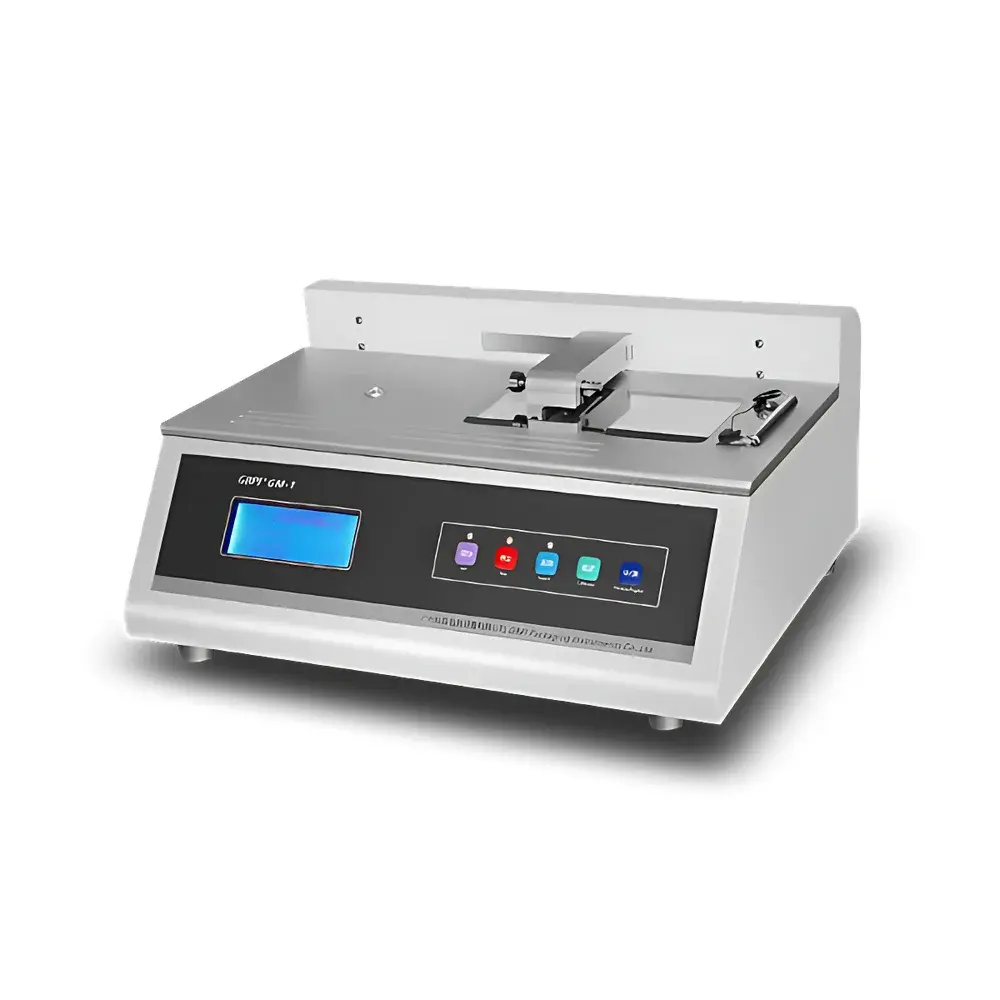
GBPI GM-1t High-Precision Coefficient of Friction Tester
| Brand | GBPI (Guangzhou Biaoji) |
|---|---|
| Origin | Guangdong, China |
| Manufacturer Type | Direct Manufacturer |
| Country of Origin | China |
| Model | GM-1t |
| Pricing | Upon Request |
| Test Standards | GB 10006, ISO 8295, TAPPI T816 |
| Friction Coefficient Range | 0.001–0.999 |
| Resolution | 0.001 |
| Force Measurement Range | 0–9.8 N |
| Slider Velocity | 100 ± 10 mm/min |
| Travel Distance | 100 ± 5 mm |
| Max Sample Thickness | ≤ 2 mm |
| Slider Dimensions | 63 mm × 63 mm |
| Slider Mass | 200 g ± 2 g |
| Test Platform Size | 200 mm × 470 mm |
| Overall Dimensions | 470 mm × 350 mm × 220 mm |
| Power Consumption | 100 W |
| Electrical Supply | AC 220 V, 50 Hz |
| Net Weight | 12.5 kg |
Overview
The GBPI GM-1t High-Precision Coefficient of Friction Tester is an engineered solution for quantitative evaluation of static and kinetic friction behavior between two solid surfaces under controlled normal load and relative motion. Based on the fundamental principle of Coulomb friction measurement—where a standardized slider traverses a stationary test specimen at constant velocity—the instrument delivers traceable, repeatable friction coefficient (μ) values derived from direct force transduction via high-stability load cell technology. Designed explicitly for packaging R&D, quality control, and regulatory compliance laboratories, the GM-1t adheres strictly to internationally recognized test protocols including GB 10006 (Chinese national standard), ISO 8295 (Plastics — Film and sheeting — Determination of coefficient of friction), and TAPPI T816 (Friction of Paper and Paperboard). Its architecture supports both static friction (μs)—measured at the onset of motion—and dynamic friction (μk)—recorded during steady-state sliding—enabling comprehensive assessment of surface slip resistance critical to film handling, pouch opening performance, and automated packaging line efficiency.
Key Features
- High-resolution force sensing system with 0.001 resolution across 0.001–0.999 μ range, ensuring detection of subtle surface treatment variations such as silicone coating or corona treatment efficacy.
- Modular mechanical design featuring a precision-machined 200 g ± 2 g steel slider (63 mm × 63 mm) and calibrated linear drive mechanism delivering consistent 100 ± 10 mm/min traverse speed per ISO 8295 requirements.
- Integrated 5-inch LCD interface providing real-time display of μs, μk, and force-time curves; curve zoom functionality enables granular inspection of stick-slip transitions.
- Automatic over-range protection circuitry safeguards the load cell during unexpected high-force events, extending sensor service life and maintaining calibration integrity.
- Fully compliant with Annex 11 of EU GMP and FDA 21 CFR Part 11: audit trail logging captures operator ID, parameter changes, test initiation/termination timestamps, and data export actions—supporting GLP/GMP validation and regulatory inspections.
- User-role-based access control (administrator, analyst, reviewer) ensures procedural governance and prevents unauthorized configuration changes or data deletion.
Sample Compatibility & Compliance
The GM-1t accommodates a broad spectrum of planar materials up to 2 mm in thickness, including but not limited to polyolefin films (LDPE, PP), metallized polyester (PET-Al), laminated structures (e.g., PET/AL/PE), paperboard substrates, rubber sheets, ceramic tiles, and woven/nonwoven textiles. Its standardized slider geometry and defined normal force profile ensure cross-material comparability when testing according to harmonized methods. All mechanical and electrical components meet CE marking directives for safety and electromagnetic compatibility (EMC). Calibration traceability is maintained through NIST-traceable reference weights and certified force standards supplied with each unit, supporting ISO/IEC 17025-compliant laboratory accreditation.
Software & Data Management
The proprietary GBPI CoF Analysis Suite provides intuitive workflow navigation, parameter preset libraries (e.g., “Film Opening”, “Printing Surface”, “Lamination Interface”), and real-time statistical processing—including mean, standard deviation, CV%, and outlier identification per ASTM E178 guidelines. Raw force-time datasets are stored in encrypted .csv and .xlsx formats with embedded metadata (operator, date/time, sample ID, environmental conditions). The software natively integrates with LIMS platforms via HL7 or RESTful API, enabling automated data ingestion into enterprise quality management systems. Optional cloud-enabled IoT gateway allows secure remote access to instrument status, live test monitoring, historical report retrieval, and firmware updates—all accessible via web browser without client-side installation.
Applications
- Packaging film development: Quantifying anti-block agent effectiveness and optimizing surface energy for improved machinability on vertical form-fill-seal lines.
- Pharmaceutical blister packaging: Validating peel-open consistency and child-resistant closure reliability per USP and ISO 15378 requirements.
- Food-grade laminate qualification: Assessing interlayer friction in retort pouch constructions to prevent delamination during thermal processing.
- Label stock certification: Measuring facestock-to-liner release characteristics under varying humidity conditions per FINAT FTM 1 and PSTC-101.
- Automotive interior trim QC: Evaluating tactile slip resistance of PVC-coated fabrics used in door panels and seating surfaces.
FAQ
What standards does the GM-1t comply with for regulatory submissions?
The instrument implements test methodologies fully aligned with GB 10006, ISO 8295, and TAPPI T816. Its software satisfies 21 CFR Part 11 requirements for electronic records and signatures, including audit trails, user authentication, and data immutability.
Can the GM-1t measure both static and kinetic coefficients in a single run?
Yes. The system automatically detects the peak static force (μs) at motion initiation and continuously records the stabilized kinetic force (μk) over the full 100 mm travel distance.
Is third-party calibration certification included?
Each unit ships with a factory-issued calibration certificate referencing traceable standards. Optional UKAS-accredited calibration services are available upon request.
How is data integrity ensured during remote operation via IoT platform?
All remote sessions use TLS 1.2+ encrypted WebSocket connections. No raw data resides on the cloud; only metadata and authorized export packages are transmitted, with local storage remaining the primary repository per ALCOA+ principles.
What maintenance intervals are recommended for long-term accuracy?
Load cell verification using certified reference masses is advised every 6 months or after 500 test cycles. Routine cleaning of the slider base and test platform with isopropyl alcohol is required before each test series.




