
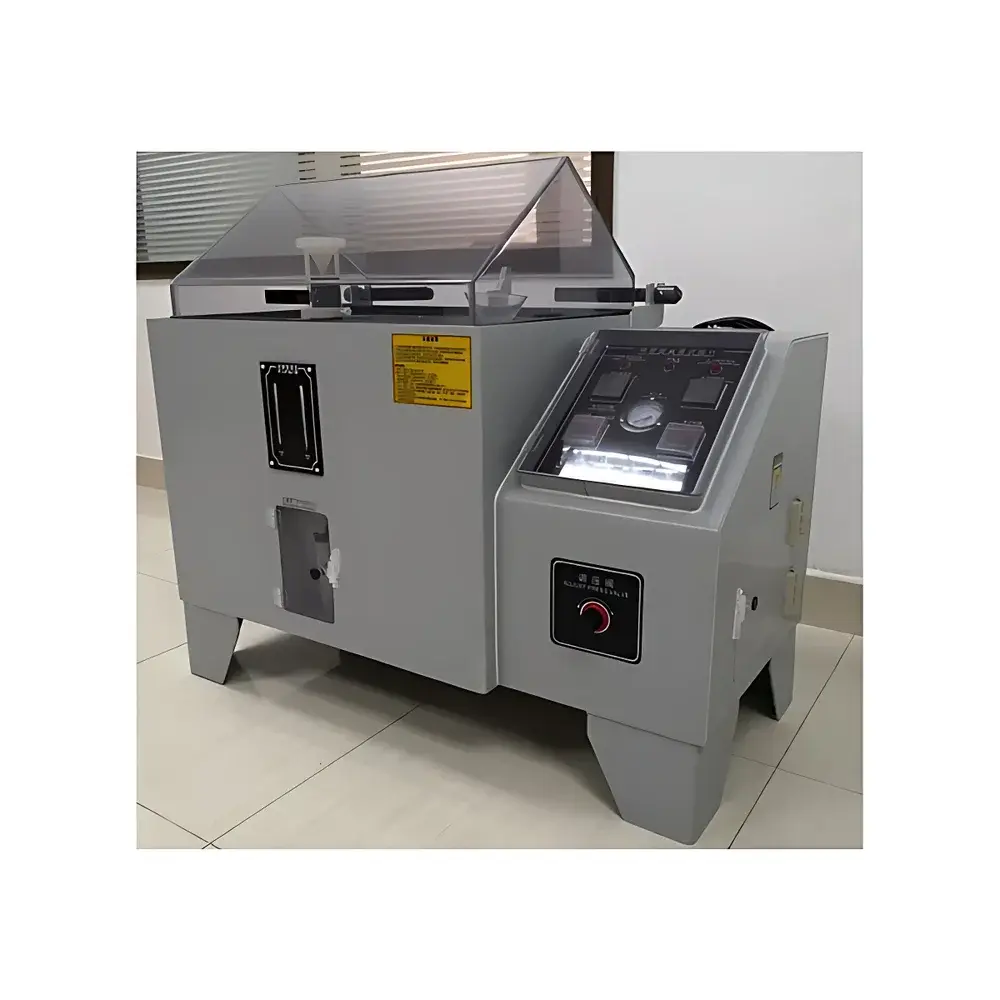
GBPI OSH-60 Composite Salt Spray Test Chamber
| Brand | GBPI |
|---|---|
| Origin | Guangdong, China |
| Manufacturer Type | Direct Manufacturer |
| Country of Origin | China |
| Model | OSH-60 |
| Pricing | Upon Request |
Overview
The GBPI OSH-60 Composite Salt Spray Test Chamber is an engineered environmental simulation system designed to replicate corrosive atmospheric conditions characterized by dispersed saline aerosols. It operates on the principle of controlled nebulization of standardized salt solutions—primarily sodium chloride (NaCl)—into a thermally regulated test chamber, enabling accelerated corrosion assessment under reproducible and traceable conditions. This instrument supports multiple internationally recognized corrosion test protocols, including Neutral Salt Spray (NSS), Acetic Acid Salt Spray (AASS), and Copper-Accelerated Acetic Acid Salt Spray (CASS), making it suitable for evaluating coating integrity, material resistance, and surface treatment performance across electronics, automotive components, metallic fasteners, electroplated parts, and polymer-based enclosures. Its dual-zone temperature control architecture—separate regulation of chamber and saturated air reservoir—ensures strict compliance with ASTM B117, ISO 9227, JIS Z2371, and CNS 4798 standards.
Key Features
- Chamber construction from 5 mm thick A-grade PVC board, resistant to acids, alkalis, and stable up to 78 °C; transparent lid also fabricated from same-grade material for real-time visual monitoring without compromising containment integrity.
- Integrated saturation tower made of cylindrical PP high-pressure tubing (Ø32 mm, 10 mm wall thickness), rated for 5 kg/cm² pressure and >90 °C operational temperature, ensuring consistent humidification of compressed air via thermal equilibrium with deionized water.
- Bernoulli-effect spray nozzle system using borosilicate glass nozzles—rated for ≥4000 hours continuous operation—with adjustable output (1–2 mL/80 cm²/h, averaged over 16 h) and selectable continuous or cyclic intermittent modes per IEC 60068-2-52 requirements.
- Dual independent PID+SSR temperature controllers (Taision brand) for precise regulation of both test chamber (0–99 °C, ±1 °C accuracy) and pressure-saturation vessel (0–99 °C, ±1 °C accuracy), backed by liquid-expansion safety cutoffs at both zones.
- Automated dual-direction water replenishment via solenoid valves (German Proportion-Air), servicing both chamber and saturation tank; manual override capability included for maintenance flexibility.
- Robust electrical architecture featuring Omron intermediate relays, Kaida SSRs, Chint contactors, and Taiwan Shan-Nais pneumatic actuators—designed for long-term reliability in industrial lab environments.
- Comprehensive safety suite: low-water-level cut-off, overtemperature shutdown, visual alarm indicator, and sealed mist containment trough with manual fill provision.
Sample Compatibility & Compliance
The OSH-60 accommodates flat-panel specimens, small assemblies, and component-level samples up to 60 × 45 × 40 cm (L×W×H). Its 108 L internal volume and adjustable 15°/30° specimen racks support high-density placement while maintaining uniform fog distribution across all surfaces. The system meets essential regulatory prerequisites for quality assurance workflows in ISO/IEC 17025-accredited laboratories. Its design facilitates audit-ready documentation through time-stamped cycle logs (with power-failure memory), calibrated temperature and pressure records, and adherence to GLP-aligned operational practices. While not inherently 21 CFR Part 11 compliant, data export capabilities allow integration into validated LIMS or ELN platforms where electronic signature and audit trail requirements apply.
Software & Data Management
The OSH-60 utilizes a standalone Taision push-button controller with embedded PID algorithms and digital display interface. All operational parameters—including chamber temperature, saturation vessel temperature, elapsed test time, and cycle mode—are recorded locally with timestamped resolution down to 0.1 seconds. Time controllers feature dual-channel functionality to execute complex alternating cycles (e.g., 4 h salt fog / 4 h dry / 4 h humidity), meeting IEC 60068-2-52 Annex A specifications. Raw data can be manually transcribed or exported via optional RS-232/USB module (sold separately) for traceability in Excel-based QA reports or statistical process control (SPC) dashboards. Firmware updates are performed offline via SD card, minimizing downtime during calibration intervals.
Applications
This chamber serves as a primary tool for comparative corrosion screening in R&D labs and production QC departments. Typical use cases include validation of zinc-nickel plating adhesion on automotive brackets, evaluation of conformal coating durability on printed circuit boards, qualification of stainless steel passivation layers in medical devices, and accelerated aging studies of polymer housings exposed to coastal environments. It is routinely deployed by packaging suppliers testing metallized PET barrier films, battery enclosure manufacturers assessing aluminum alloy corrosion resistance, and Tier-1 automotive vendors verifying bolt torque retention after exposure. Its compatibility with standard collection funnels and graduated cylinders enables direct measurement of salt deposition rate per ASTM B117 Annex A.
FAQ
What salt solutions are compatible with the OSH-60?
Standard NaCl solution (5% w/v) for NSS testing; acetic acid-adjusted NaCl for AASS; and CuCl₂-enhanced acetic acid–NaCl mixture for CASS—prepared using supplied reagents and deionized water.
Is compressed air supply included?
No—users must provide clean, oil-free compressed air at ≥4 kg/cm², filtered to ≤5 µm particle size, with moisture removal upstream of the unit’s inlet port.
Can the OSH-60 perform cyclic corrosion testing (CCT)?
Yes—via dual timer configuration supporting programmable sequences of salt spray, drying, and high-humidity phases per ISO 16701 and VDA 621-415 protocols.
What maintenance intervals are recommended?
Daily: check water levels and nozzle clarity; weekly: inspect saturation tower water purity and clean PVC interior with mild detergent; quarterly: verify temperature sensor calibration against NIST-traceable reference.
Does GBPI provide installation and commissioning support?
Yes—on-site setup, operational training, and initial performance verification are available globally through authorized service partners; remote diagnostics supported via secure VPN link.
Related Products





