CMA Microdialysis System for Freely Moving Animals
| Brand | Harvard Apparatus |
|---|---|
| Origin | Sweden |
| Model | System for Freely Moving Animals |
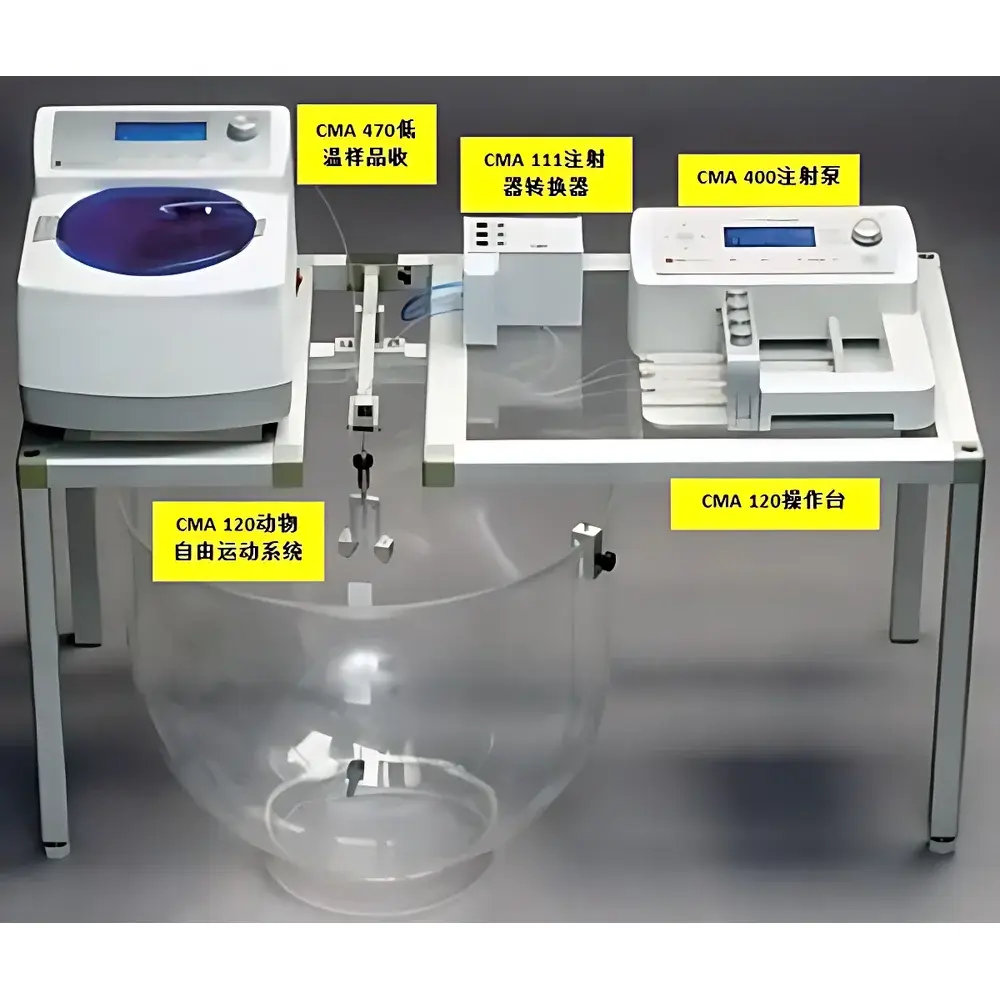
| Key Components | CMA 470 Refrigerated Fraction Collector, CMA 111 Syringe Selector, CMA 120 Freely Moving Animal System, CMA 400 Syringe Pump, CMA 120 Instrument Table |
Overview
The CMA Microdialysis System for Freely Moving Animals is a fully integrated, research-grade platform engineered for in vivo neurochemical monitoring in awake, untethered rodents and small mammals. Built upon the established CMA (Carnegie Medicine AB) microdialysis architecture and distributed globally by Harvard Apparatus, this system enables continuous, real-time sampling of extracellular fluid from discrete brain or peripheral tissue regions under physiologically relevant behavioral conditions. The core measurement principle relies on passive diffusion across a semi-permeable membrane (typically 2–6 kDa cutoff), where analytes—including neurotransmitters (e.g., dopamine, serotonin, acetylcholine), metabolites (e.g., glucose, lactate), peptides, and pharmacokinetic compounds—equilibrate between the perfusate and interstitial space. Unlike static or anesthetized preparations, this system preserves natural circadian rhythms, locomotor activity, and stimulus-response integrity—critical for translational neuroscience, addiction research, behavioral pharmacology, and metabolic studies.
Key Features
- True freedom-of-movement design: The CMA 120 Freely Moving Animal System incorporates a low-torque swivel, flexible tether, and lightweight harness compatible with standard home cages or open-field arenas—enabling uninterrupted ambulation, feeding, social interaction, and sleep-wake cycling.
- Temperature-controlled sample integrity: The CMA 470 Refrigerated Fraction Collector maintains collected fractions at +4 °C throughout acquisition, minimizing enzymatic degradation, oxidation, and volatilization of labile analytes such as monoamines and nitric oxide metabolites.
- Pulse-free, high-precision perfusion: The CMA 400 Syringe Pump delivers stable, non-pulsatile flow rates from 0.1 to 10 µL/min with <±1% accuracy—optimized for low-flow microdialysis protocols requiring minimal tissue disturbance and maximal recovery stability.
- Modular syringe handling: The CMA 111 Syringe Selector allows rapid, bubble-free switching between up to three pre-loaded syringes without interrupting perfusion—essential for multi-analyte protocols, internal standard addition, or sequential drug challenge paradigms.
- System-level ergonomics: The CMA 120 Instrument Table provides vibration-dampened, height-adjustable mounting for all components—including pump, collector, swivel, and data acquisition interfaces—ensuring mechanical stability and operator workflow efficiency during long-duration experiments (up to 72+ hours).
Sample Compatibility & Compliance
This system supports microdialysis probes with outer diameters ranging from 0.22 to 0.35 mm and membrane lengths of 1–4 mm, compatible with commercially available CMA, Eicom, and custom-fabricated probes. Collected fractions (typically 1–50 µL per fraction) are directly dispensed into standard 0.5–2.0 mL microcentrifuge tubes or HPLC vials, enabling seamless downstream analysis via HPLC-ECD, LC-MS/MS, or enzymatic assays. The hardware and operational workflow align with GLP-compliant study design requirements, including traceable component lot numbers (CMA 470: 8002770; CMA 111: 8308210; CMA 120: 8309049; CMA 400: 8002020), documented calibration procedures, and temperature-logged fraction collection. While not inherently 21 CFR Part 11–validated, the system integrates with validated third-party data acquisition software supporting audit trails and electronic signatures where required.
Software & Data Management
The CMA platform operates independently of proprietary software—functioning as a hardware ecosystem compatible with widely adopted laboratory control environments including LabChart (ADInstruments), AcqKnowledge (BIOPAC), and custom Python/Matlab-based acquisition scripts. Fraction timing, pump status, and collector tray position are relayed via TTL or RS-232 signals, enabling synchronized timestamping with electrophysiological, behavioral video, or physiological telemetry data. All hardware modules retain non-volatile configuration memory, ensuring reproducible setup across sessions. Raw fraction files (text-based metadata logs) are exportable in CSV format for integration into LIMS or statistical platforms (e.g., R, GraphPad Prism) without vendor lock-in.
Applications
- In vivo monitoring of dopamine dynamics during operant conditioning or reward-based learning tasks
- Real-time assessment of glutamate spillover in hippocampal CA1 during spatial navigation
- Pharmacokinetic/pharmacodynamic profiling of CNS-penetrant therapeutics across blood-brain barrier interfaces
- Metabolic coupling studies—simultaneous tracking of glucose, lactate, and pyruvate in tumor microenvironments or ischemic penumbra
- Neuroendocrine investigation—cortisol or CRH release kinetics in response to acute stress paradigms
- Chronic inflammation modeling—interleukin-1β or TNF-α sampling from joint synovium or gut mucosa
FAQ
What is the minimum recommended flow rate for stable microdialysis recovery using the CMA 400 pump?
The CMA 400 is validated for continuous operation down to 0.1 µL/min; however, optimal recovery stability for low-molecular-weight neurotransmitters is typically achieved between 0.3–2.0 µL/min, depending on probe geometry and target analyte.
Can the CMA 470 collect fractions automatically based on time or external TTL triggers?
Yes—the CMA 470 supports both programmable time-based fractionation (1–1440 min intervals) and external TTL pulse triggering, allowing synchronization with behavioral events or stimulus onset.
Is the CMA 120 System compatible with simultaneous EEG or EMG recordings?
Yes—its low-noise swivel and shielded cabling minimize electrical interference; users routinely integrate it with wireless or wired electrophysiology systems without signal artifact.
Does the system support dual-probe configurations (e.g., ipsilateral vs. contralateral sampling)?
Yes—using two independent CMA 400 pumps, two CMA 111 selectors, and one CMA 470 collector with dual-tray capability (optional accessory), bilateral or multi-site sampling is fully supported.
Are replacement parts and service support available outside the EU?
Harvard Apparatus provides global technical support, extended warranty options, and authorized distributor networks across North America, APAC, and EMEA—with spare parts inventory maintained in Boston, Singapore, and Stockholm.
Related Products