
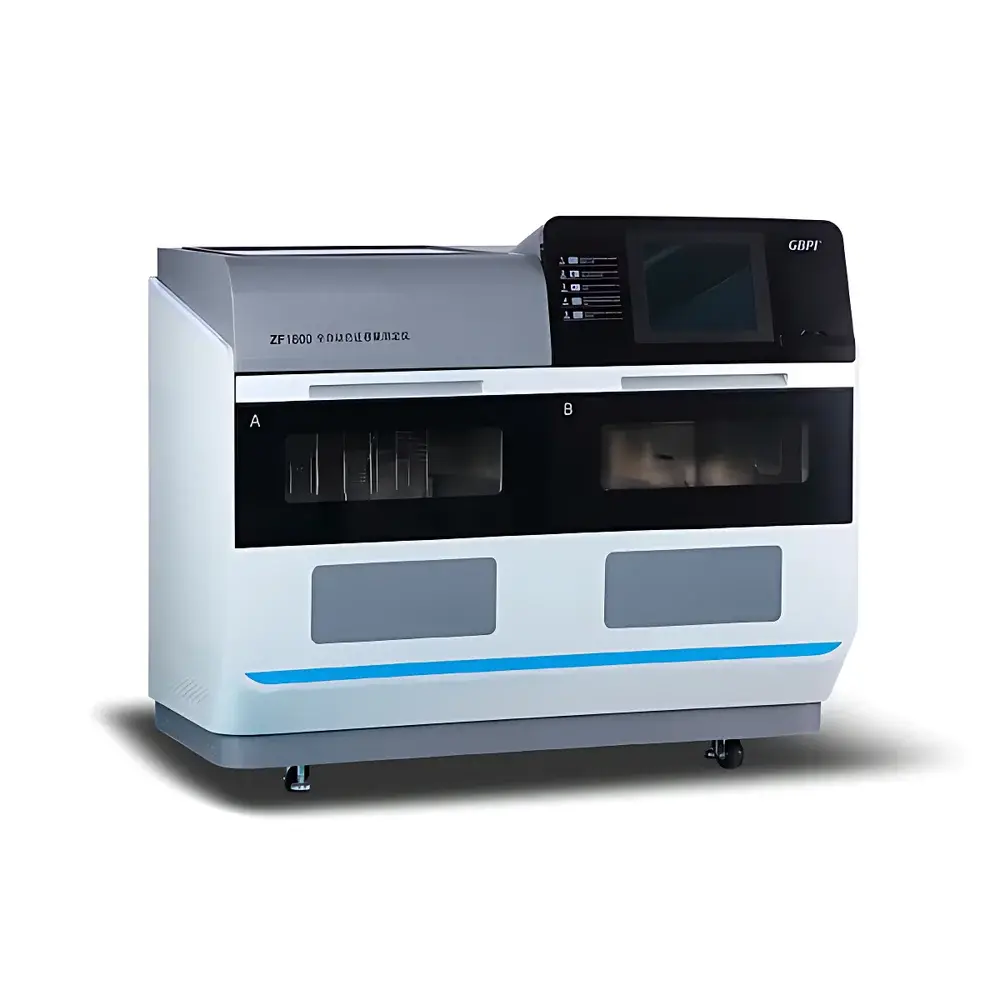
GBPI ZF1800-D Automated Total Migration and Non-Volatile Residue Tester
| Brand | GBPI |
|---|---|
| Origin | Guangdong, China |
| Manufacturer Type | Manufacturer |
| Origin Category | Domestic |
| Model | ZF1800-D |
| Price | Upon Request |
| Measurement Range | 0.2–167,000 mg/dm² |
| Resolution | 0.0001 g/dm² |
| Balance Capacity | 0–200 g |
| Balance Resolution | 0.1 mg |
| Water Bath Temp. Control | RT–100 °C |
| Heating Chamber Temp. Control | RT–117.9 °C |
| Cooling Chamber Temp. Control | 10–35 °C |
| Temperature Accuracy | ±5 °C |
| Sample Capacity | 1–18 independent test positions |
| Evaporating Dish Volume | 0–200 mL |
| Dimensions (Main Unit) | 178 × 93 × 145 cm (L×W×H) |
| Solvent Recovery System Dimensions | 120 × 88 × 170 cm (L×W×H) |
| Power Supply | 220 V, 50 Hz |
| Rated Power | 5000 W |
Overview
The GBPI ZF1800-D Automated Total Migration and Non-Volatile Residue Tester is a fully integrated laboratory instrument engineered for precise quantification of total migration and non-volatile residue (NVR) in food-contact materials (FCMs), as defined by regulatory frameworks including EU Regulation (EC) No. 10/2011, ISO 17724:2015, and GB 31604.8–2021. It operates on the gravimetric principle: samples are immersed in standardized food simulants (e.g., 3% acetic acid, 10% ethanol, olive oil, or distilled water) under controlled time–temperature conditions; following extraction, the simulant is evaporated to dryness under inert atmosphere or vacuum, and the residual mass—representing migrated substances—is determined via high-precision microbalance measurement. The system automates the complete workflow: immersion conditioning, solvent evaporation, desiccation, cooling, and sequential gravimetric determination—including automated pre-weighing and post-evaporation re-weighing cycles—to deliver traceable, reproducible results compliant with GLP and GMP requirements.
Key Features
- Dual-Independent Climate Chambers: Separated heating and cooling zones enable simultaneous thermal conditioning and post-evaporation stabilization—eliminating cross-chamber thermal inertia and reducing cycle time by up to 40% compared to single-chamber systems.
- Integrated Water Bath Evaporation System: Features auto-fill, real-time water level sensing, PID-controlled temperature regulation (RT–100 °C), automatic drainage, and dual-safety interlocks (dry-run and over-temperature alarms) to ensure uninterrupted, hazard-free operation.
- Closed-Loop Solvent Recovery: All evaporation occurs within a hermetically sealed chamber; vapors are condensed and collected via an integrated refrigerated recovery unit—preventing atmospheric release of organic solvents and meeting OSHA PEL and EU Directive 2004/42/EC occupational exposure limits.
- Inert Atmosphere Capability: Optional nitrogen purge function enables oxygen-sensitive evaporation protocols, minimizing oxidative degradation of thermolabile migrants during residue formation.
- Negative-Pressure Test Chamber: Maintains consistent sub-atmospheric pressure (< −5 kPa) throughout the evaporation phase—enhancing solvent removal efficiency and suppressing bumping or splashing in low-boiling simulants.
- 18-Position Independent Testing: Each station operates autonomously with dedicated temperature monitoring, weight acquisition, and data logging—supporting parallel analysis of heterogeneous sample types (e.g., PET trays, PP lids, PVC gaskets) without cross-contamination or calibration drift.
- ARM-Based Embedded Control: Touchscreen HMI integrates instrument control, method sequencing, real-time weight trending, and environmental parameter visualization—requiring no external PC for routine operation.
Sample Compatibility & Compliance
The ZF1800-D accommodates a broad spectrum of food-contact articles per ISO 17724 and national standards: rigid and flexible packaging films (PE, PP, PS, PVC, PVDC), molded containers, laminated structures, coatings, adhesives, and processing equipment surfaces (e.g., conveyor belts, piping). It supports all standard food simulants—including aqueous (distilled water, 3% acetic acid), alcoholic (10%, 20%, 50% ethanol), and fatty (olive oil, synthetic triglyceride mixture) media—and complies with prescribed migration test conditions (e.g., 10 days at 40 °C, 2 hours at 70 °C, or 30 minutes at 100 °C). Its design meets mechanical safety requirements per IEC 61010-1, electrical insulation class II, and chemical resistance specifications outlined in EN 61326-1 for laboratory equipment in electromagnetic environments.
Software & Data Management
The embedded software conforms to Annex 11 of the EU GMP Guidelines and FDA 21 CFR Part 11 for computerized systems. Access control enforces role-based permissions (Administrator, Analyst, Reviewer, Observer), with granular audit trail coverage across three layers: system events (login/logout, configuration changes), method execution (parameter modifications, run initiation/termination), and data handling (weight entry edits, report generation). All critical operations—including balance calibration, chamber temperature setpoint adjustments, and result finalization—are digitally signed and timestamped. Raw weight data, migration calculations (mg/dm²), environmental logs (temp/humidity vs. time), and user activity records are stored in encrypted SQLite databases with configurable retention policies. Reports export natively to PDF/A-1b and Microsoft Excel (.xlsx) formats, including full metadata (instrument ID, operator, method version, calibration certificate IDs).
Applications
- Regulatory compliance testing for manufacturers supplying to EU, US, China, and ASEAN markets
- QC release testing of food packaging prior to distribution
- R&D screening of new polymer formulations, barrier coatings, and ink systems
- Migration kinetics studies under accelerated aging conditions
- Validation of cleaning protocols for reusable food-processing equipment
- Investigation of migrant identity via coupling with GC-MS or LC-MS (residue collected in pre-weighed vials)
FAQ
What regulatory standards does the ZF1800-D support?
It is validated for EU Regulation (EC) No. 10/2011, ISO 17724:2015, GB 31604.8–2021, and ASTM D5967–20 for total migration testing.
Can the system handle fatty food simulants like olive oil?
Yes—its heating chamber reaches 117.9 °C and includes optimized airflow and condensate management to prevent charring or incomplete evaporation of high-boiling simulants.
Is the balance calibrated automatically during operation?
No—external calibration using certified weights is required before each test batch per ISO/IEC 17025; however, the system logs calibration timestamps and prompts users when overdue.
How is data integrity ensured during power interruption?
The ARM controller maintains volatile memory backup via supercapacitors, preserving active test state and weight readings for ≥15 minutes; all completed measurements are written to non-volatile storage every 30 seconds.
Does the solvent recovery system require consumables or periodic maintenance?
The condenser coil requires quarterly inspection for frost accumulation; the collection flask must be emptied after each 10-test sequence—no filters, traps, or replaceable cartridges are used.





