
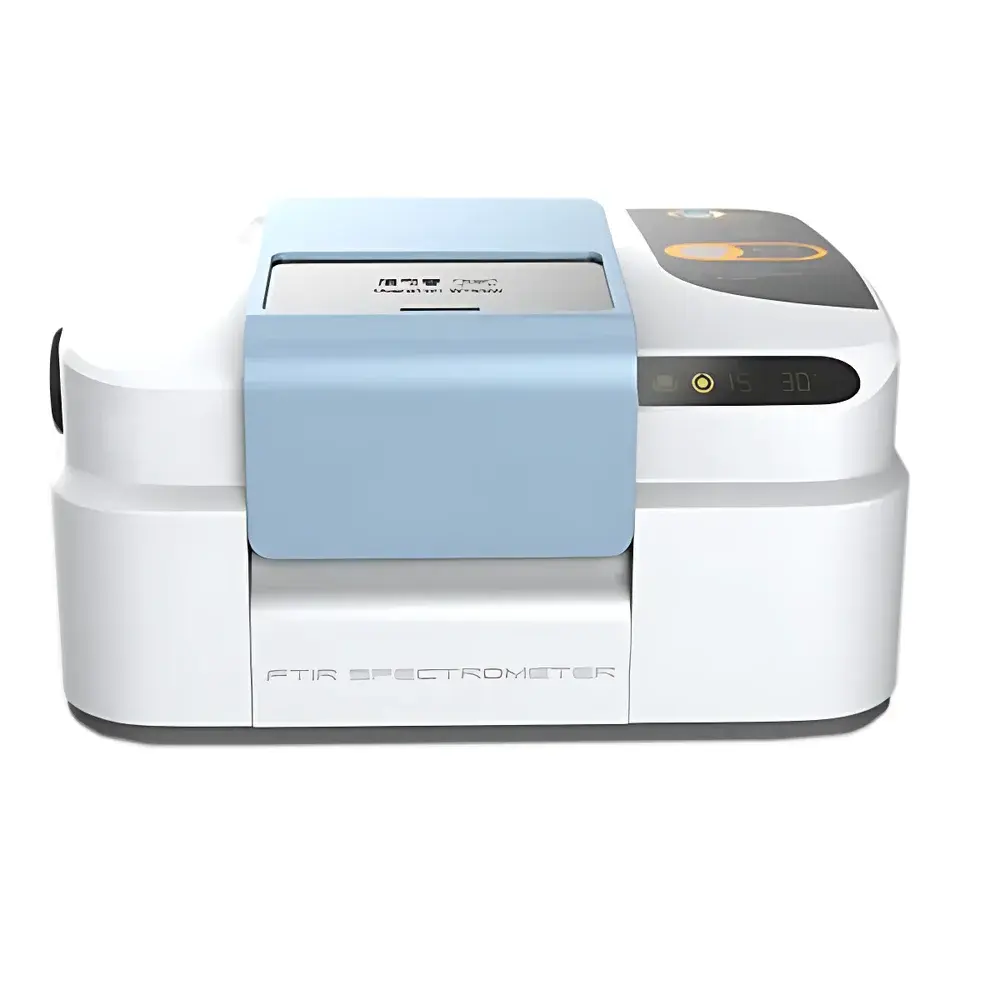
GBPI BFH-200 Fourier Transform Infrared (FTIR) Spectrometer
| Brand | GBPI |
|---|---|
| Origin | Guangdong, China |
| Manufacturer Type | Direct Manufacturer |
| Product Origin | Domestic (China) |
| Model | BFH-200 |
| Price | USD 27,500 (FOB Guangzhou) |
| Spectral Range | 350–7800 cm⁻¹ |
| Spectral Resolution | <1.0 cm⁻¹ |
| Signal-to-Noise Ratio | 40,000:1 (peak-to-peak, 4 cm⁻¹, 1 min scan) |
| Light Source | Ge-coated KBr beam splitter (imported) |
| Interferometer | Non-orthogonal Michelson-type with DSP-controlled electromagnetic drive |
| Detector | DLATGS with anti-humidity coating (imported) |
| Operating Systems | Windows XP through Windows 10 (64-bit compatible) |
| Dimensions | 450 × 350 × 210 mm |
| Weight | 13 kg |
Overview
The GBPI BFH-200 Fourier Transform Infrared (FTIR) Spectrometer is a benchtop analytical instrument engineered for precision molecular identification and quantitative analysis across research, quality control, and regulatory environments. It operates on the fundamental principle of interferometric modulation: infrared radiation from a broadband source passes through a non-orthogonal Michelson interferometer, generating time-domain interference patterns (interferograms). These patterns are digitized in real time via a 24-bit, 500 kHz analog-to-digital converter and transformed into frequency-domain spectra using fast Fourier transform (FFT) algorithms. This architecture delivers high spectral fidelity, excellent energy throughput, and intrinsic wavelength accuracy traceable to He–Ne laser referencing. Designed for long-term stability in routine laboratory use, the BFH-200 integrates robust optical alignment—featuring monolithic SPDT-machined gold-coated mirrors and permanent optical path calibration—to eliminate mechanical drift and minimize maintenance requirements.
Key Features
- DSP-controlled electromagnetic interferometer with continuous dynamic alignment: maintains optimal optical throughput without manual intervention or periodic recalibration.
- Sealed optical cavity with integrated industrial-grade temperature/humidity sensor and visual on-screen humidity monitoring; includes audible humidity alarm and reusable 304 stainless steel desiccant cartridge for field replacement.
- Digital power supply for SiC rod IR source ensures stable thermal emission and extended operational lifetime (>10,000 hours typical).
- SuperTect digital electronics platform: fully digitized signal chain, USB 2.0 high-speed data interface, and real-time interferogram acquisition at up to 16 scans per second (4 cm⁻¹ resolution).
- Optimized optical train with anti-humidity coatings on KBr, ZnSe, and CaF₂ beam splitters; DLATGS detector equipped with hydrophobic barrier film to mitigate moisture-induced degradation.
- Modular accessory compatibility: supports transmission, ATR (including diamond and ZnSe crystals), diffuse reflectance, specular reflectance, and external beam configurations.
Sample Compatibility & Compliance
The BFH-200 accommodates solid films (e.g., polyethylene, PET), powders (via KBr pellet or DRIFTS), liquids (in sealed cells or ATR contact), and coated substrates (e.g., metallized films, laminated packaging). Its design aligns with internationally recognized standards for spectroscopic instrumentation, including ASTM E1421 (standard practice for FTIR calibration), ISO 18389 (spectral purity verification), and USP (infrared identification of pharmaceutical excipients). The system’s software architecture complies with FDA 21 CFR Part 11 requirements for electronic records and signatures—supporting role-based access control, audit trail logging with immutable timestamps, electronic signature workflows, and encrypted log backups. Full GLP/GMP traceability is enabled through session-level metadata capture, including operator ID, environmental conditions (T/RH), instrument configuration, and raw interferogram archiving.
Software & Data Management
The proprietary GBPI FTIR Analysis Suite provides a validated, multi-tiered software environment compliant with computerized system validation (CSV) protocols. Core modules include real-time interferogram preview, automated water/CO₂ atmospheric compensation, baseline correction (Rubberband, Concave Rubberband), spectral subtraction, peak integration, multivariate curve resolution (MCR), and KK transformation for phase retrieval. Quantitative tools support single- and multi-component calibration using Beer–Lambert modeling, with QC comparison against reference libraries. The software natively imports and exports industry-standard formats (SPA, SP, CSV, TXT, DPT) and permits seamless unit switching between wavenumber (cm⁻¹) and wavelength (µm). Spectral libraries cover polymers, pharmaceuticals, food contaminants, petroleum fractions, and forensic materials—with customizable user-defined library creation, hierarchical taxonomy tagging, and similarity search (cosine correlation, Euclidean distance).
Applications
- Materials science: identification of polymer additives, degradation products, and crystallinity assessment in thermoplastics and elastomers.
- Pharmaceutical QA/QC: raw material verification (e.g., lactose polymorphs), excipient compatibility screening, and counterfeit drug detection.
- Food & packaging safety: migration testing of plasticizers (e.g., DEHP, DINP) from multilayer films into simulants; detection of adulterants in edible oils and honey.
- Petroleum & lubricants: quantification of oxidation byproducts (carbonyls), sulfur species, and additive depletion in insulating oils and engine lubricants.
- Construction & electronics: compositional analysis of architectural glass coatings, silicon wafer surface contamination, and fiber optic polymer cladding integrity.
FAQ
What spectral resolution options are available on the BFH-200?
The instrument is factory calibrated for ≤1.0 cm⁻¹ nominal resolution; users may select lower resolutions (e.g., 2 cm⁻¹, 4 cm⁻¹) to improve signal-to-noise ratio during rapid screening.
Is the BFH-200 suitable for regulated GMP environments?
Yes—the software implements full 21 CFR Part 11 compliance features, including electronic signatures, audit trails with tamper-proof hashing, and configurable user roles with privilege escalation controls.
How is moisture protection implemented in the optical path?
A hermetically sealed interferometer chamber, hydrophobic detector coating, humidity-sensing circuitry with visual/audible alerts, and field-replaceable stainless-steel desiccant housing collectively ensure >98% relative humidity tolerance during operation.
Can the BFH-200 be integrated with LIMS or ERP systems?
Yes—via standardized ASCII/CSV export, ODBC-compliant database connectors, and optional API-driven automation modules supporting LabWare, Thermo Fisher SampleManager, and Siemens Opcenter interfaces.
What accessories are certified for quantitative ATR analysis?
GBPI offers NIST-traceable diamond, ZnSe, and Ge ATR crystals with documented pressure calibration curves and certified contact-area profiles for reproducible pathlength estimation in liquid and semi-solid samples.






