
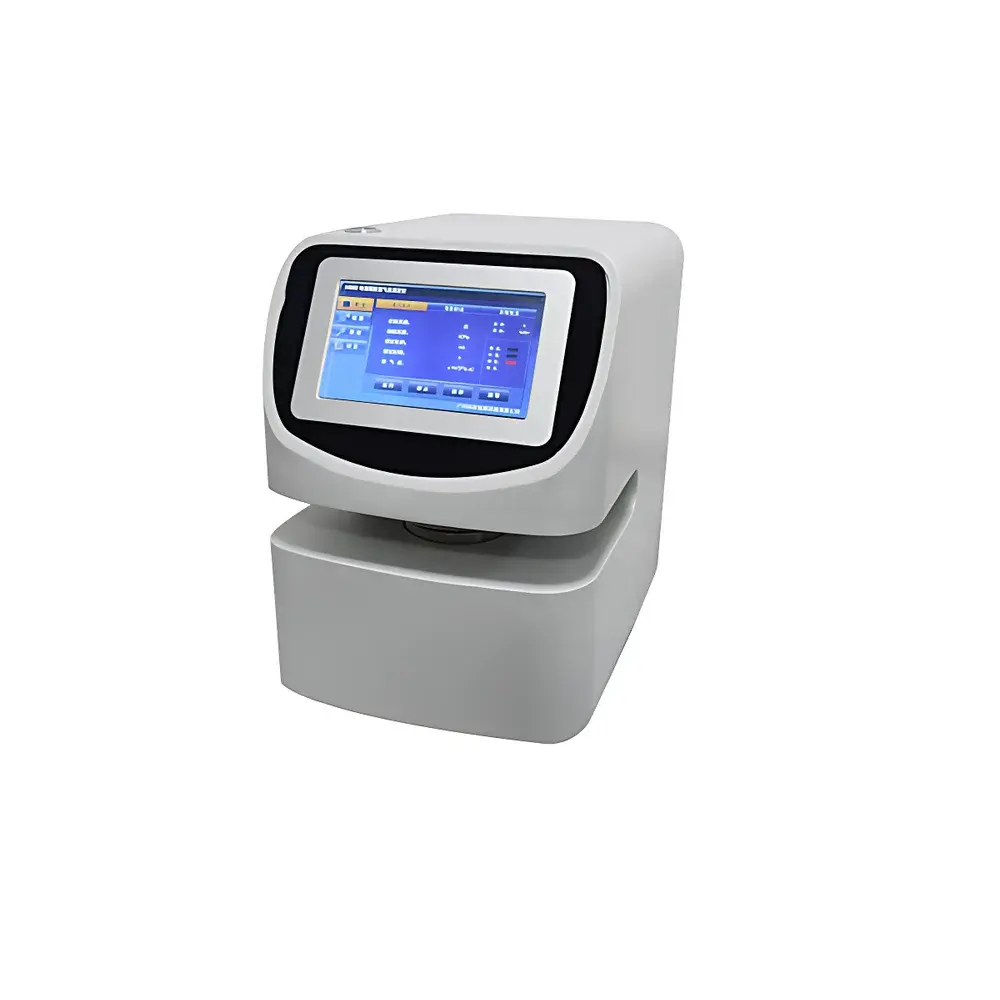
GBPI GBN701Q Respiratory Resistance and Differential Pressure Tester for Face Masks
| Brand | GBPI |
|---|---|
| Origin | Guangdong, China |
| Manufacturer Type | Direct Manufacturer |
| Regional Classification | Domestic (China) |
| Model | GBN701Q |
| Price Range | USD 7,000 – 14,000 |
| Air Source | Compressed Air |
| Air Flow Range | 1–10 L/min (Standard Test Flow: 8 L/min) |
| Flow Accuracy Class | Class 1 |
| Test Area Diameter | Ø25 mm |
| Differential Pressure Range | 0–500 Pa |
| Pressure Sensor Accuracy | ±0.5% FS |
| Display | Integrated HD Touchscreen Interface |
| Dimensions (W×D×H) | 480 × 430 × 570 mm |
| Weight | 30 kg |
| Power Supply | 220 V AC, 50 Hz |
Overview
The GBPI GBN701Q Respiratory Resistance and Differential Pressure Tester is a precision-engineered instrument designed specifically for quantifying airflow resistance and pressure differential across respiratory protective devices—primarily surgical masks, medical face masks, and particulate-filtering respirators—as defined in internationally referenced regulatory standards. It operates on the principle of controlled laminar airflow through a standardized test area (Ø25 mm), where a calibrated mass flow controller delivers a stable, user-selectable volumetric flow rate (1–10 L/min), while high-stability piezoresistive differential pressure sensors measure the resulting pressure drop across the specimen. The system computes respiratory resistance (ΔP, in Pa) at the specified flow rate—most commonly 8 L/min per YY/T 0469–2011 and YY/T 0969–2013—and provides traceable, repeatable data essential for compliance verification, quality control, and R&D validation in medical device manufacturing and textile filtration development.
Key Features
- Integrated Class 1-certified mass flow control system with real-time digital display and manual flow adjustment capability—ensuring precise adherence to standard test conditions (e.g., 8 L/min ± 0.1 L/min).
- High-accuracy (±0.5% full scale) differential pressure transducer optimized for low-range measurement (0–500 Pa), enabling resolution down to 0.1 Pa for sensitive filtration evaluation.
- Dedicated Ø25 mm circular test fixture with pneumatically assisted clamping mechanism, minimizing edge leakage and ensuring uniform sample exposure to airflow.
- Embedded industrial-grade 7-inch HD capacitive touchscreen interface with intuitive navigation, multilingual UI support (English, Chinese), and embedded calibration status indicators.
- Built-in thermal line printer for immediate hard-copy output of test reports—including date/time stamp, operator ID, flow setting, measured ΔP, pass/fail status, and compliance reference.
- Modular firmware architecture supporting future protocol updates (e.g., ISO 13485-aligned audit trails, ASTM F2100 annex extensions) via secure USB-based firmware upgrade.
Sample Compatibility & Compliance
The GBN701Q accommodates flat, non-woven, layered, or composite fabric specimens up to 3 mm thickness within the standardized 25 mm test aperture. It is validated for use with surgical masks, procedure masks, KN95/N95-equivalent respirators, melt-blown filter media, and other breathable barrier materials used in personal protective equipment (PPE). The instrument meets the mechanical and metrological requirements of YY/T 0469–2011 (“Technical Requirements for Surgical Masks”) and YY/T 0969–2013 (“General Technical Requirements for Disposable Medical Masks”) as adopted by China NMPA. Its design aligns with broader international frameworks including ISO 16900-1:2016 (Respiratory Protective Devices — Part 1: Determination of Resistance to Airflow) and ASTM F2299/F2299M (Standard Test Method for Determining the Initial Efficiency of Materials Used in Medical Face Masks to Penetration by Particulates Using Latex Spheres). All sensor calibrations are traceable to national metrology institutes (NIM, China) and include documented uncertainty budgets per ISO/IEC 17025.
Software & Data Management
The embedded operating system supports local data storage of ≥10,000 test records with timestamp, operator code, environmental metadata (optional ambient temperature/humidity input), and raw sensor outputs. Export options include CSV and PDF formats via USB port. Optional PC-based GBPI LabLink software enables centralized fleet management, statistical process control (SPC) charting (X̄–R, Cpk), automated report generation compliant with GLP and GMP documentation requirements, and electronic signature functionality aligned with FDA 21 CFR Part 11 Annex 11 principles. Audit trail logs record all parameter changes, calibration events, and user actions with immutable timestamps—supporting regulatory inspections and internal quality audits.
Applications
- Regulatory conformance testing of medical/surgical masks prior to market release under NMPA, CE-MDR, or FDA 510(k) pathways.
- Comparative evaluation of filter media performance during material selection and supplier qualification.
- In-process QC in nonwoven production lines for melt-blown, spunbond, or electrospun layers.
- Research into breathability–filtration trade-offs in next-generation mask architectures (e.g., graphene-enhanced composites, hydrophobic nanofibers).
- Validation of cleaning/reuse protocols for reusable cloth masks per WHO interim guidance (2020) and ISO 14644 cleanroom compatibility assessments.
- Supporting ISO 10993 biocompatibility studies where airflow resistance correlates with wearer comfort and CO₂ rebreathing risk.
FAQ
What standards does the GBN701Q directly support out-of-the-box?
YY/T 0469–2011, YY/T 0969–2013, and ISO 16900-1:2016 test configurations are preloaded; custom protocols can be configured via system settings.
Is external calibration required before first use?
Yes—a certified factory calibration certificate (traceable to NIM) is supplied; users must perform annual recalibration using GBPI-certified pressure and flow standards.
Can the instrument test irregularly shaped or curved masks?
No—it requires flat, rigidly mounted specimens within the Ø25 mm aperture; three-dimensional mask forms require auxiliary fixtures not included with base configuration.
Does the built-in printer support network or cloud printing?
No—the thermal printer is locally connected only; however, exported CSV/PDF files may be routed to network printers via LabLink software.
What maintenance intervals are recommended for long-term accuracy?
Filter replacement every 6 months; flow sensor zero-check weekly; full pneumatic path inspection and leak test quarterly per GBPI Maintenance Manual Rev. 3.2.





