
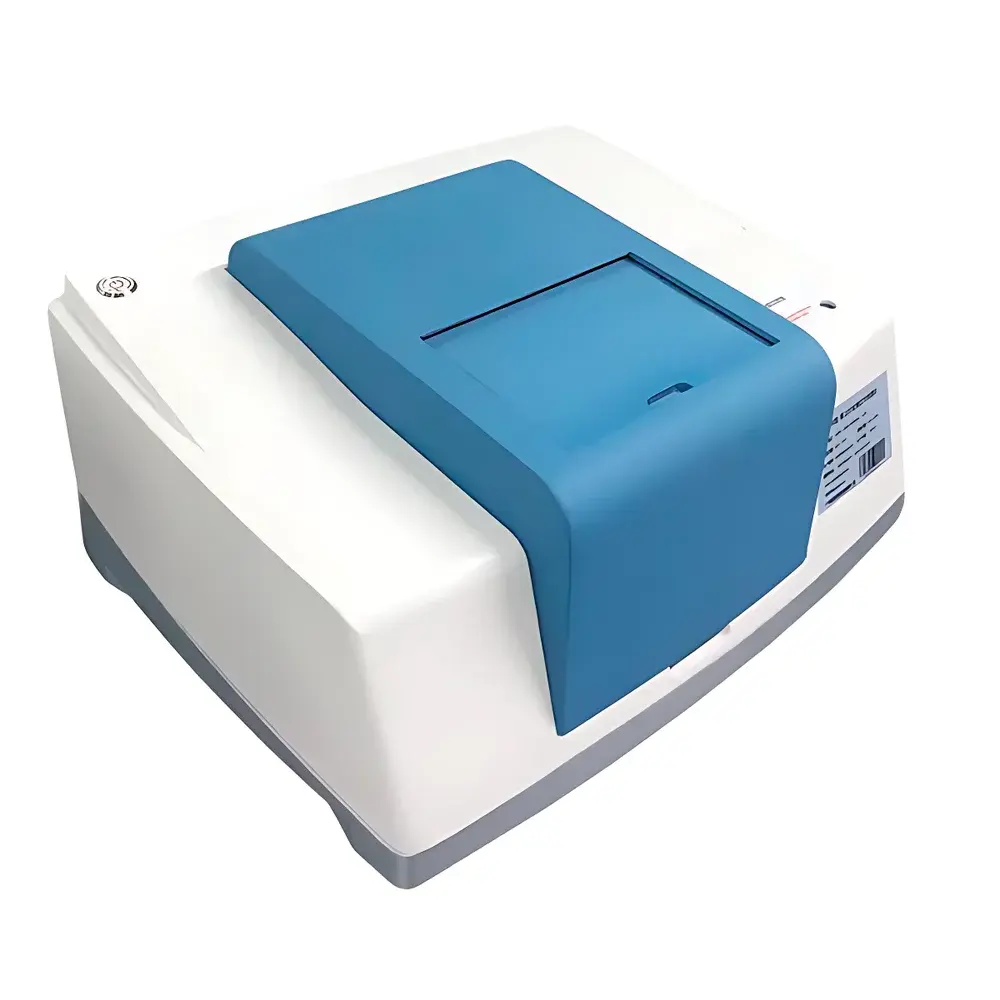
GBPI BFH-960 Fourier Transform Infrared (FTIR) Spectrometer
| Brand | GBPI |
|---|---|
| Origin | Guangdong, China |
| Manufacturer Type | Direct Manufacturer |
| Instrument Type | Laboratory FTIR Spectrometer |
| Spectral Range | 7800–350 cm⁻¹ |
| Resolution | <1.0 cm⁻¹ |
| Scan Speed | 4 cm⁻¹ |
| Signal-to-Noise Ratio | 15,000:1 (at 4 cm⁻¹, 1 min scan) / 30,000:1 (at 4 cm⁻¹, 5 min scan) |
| Beamsplitter | KBr substrate with Ge coating |
| Detector | Imported high-sensitivity DLaTGS |
| Source | Imported long-life, air-cooled high-intensity IR source |
| Interferometer | Sealed 30°-incidence Michelson interferometer with automatic optical alignment |
| Laser | VCSEL-based He–Ne reference laser |
| A/D Conversion | 24-bit, 500 kHz |
| Communication Interface | USB 2.0 (backward compatible with USB 3.0) |
| Dimensions | 450 × 350 × 235 mm (L×W×H) |
| Weight | 14 kg |
| Operating Temperature | 15–35 °C |
| Power Consumption | <30 W |
Overview
The GBPI BFH-960 Fourier Transform Infrared (FTIR) Spectrometer is a precision laboratory-grade instrument engineered for high-fidelity molecular identification and quantitative analysis across pharmaceutical, environmental, polymer, forensic, and academic research applications. It operates on the fundamental principle of interferometric modulation: infrared radiation from a broadband thermal source is split, recombined after differential path-length delay in a sealed Michelson interferometer, and detected as an interferogram. This time-domain signal is digitized at high fidelity (24-bit, 500 kHz sampling) and converted into a frequency-domain absorption spectrum via fast Fourier transform (FFT) algorithms. The system employs a stabilized VCSEL-based He–Ne laser for real-time mirror position encoding, ensuring exceptional wavenumber accuracy (<0.01 cm⁻¹ repeatability) and long-term spectral stability—critical for regulatory-compliant method validation and inter-laboratory data transfer.
Key Features
- Hermetically sealed Michelson interferometer with gold-coated corner-cube retroreflectors, delivering superior optical alignment retention and angular precision over extended operation cycles.
- Desiccant management system featuring oversized reusable desiccant cartridge and moisture-indicating window with 7° forward tilt—designed for ergonomic monitoring and maintenance without disassembly.
- Push-pull sample compartment door minimizes ambient H₂O and CO₂ intrusion during measurement, reducing atmospheric interference peaks and improving baseline stability in the 2400–2200 cm⁻¹ and 1900–1700 cm⁻¹ regions.
- Optimized optical train with diamond-turned mirrors and KBr/Ge beamsplitter ensures consistent throughput and minimal polarization artifacts across the full 7800–350 cm⁻¹ range.
- Low-power electronics architecture (<30 W typical consumption) supports continuous operation in shared lab environments without thermal drift or cooling infrastructure requirements.
- Tool-free, pin-aligned optical module integration enables rapid detector or source replacement with no realignment needed—reducing downtime and technician dependency.
Sample Compatibility & Compliance
The BFH-960 accommodates standard transmission cells (KBr, CaF₂), single-bounce and multi-bounce ATR accessories (ZnSe, Ge, Diamond), gas cells (up to 10 cm pathlength), and microsampling stages. Its spectral fidelity meets ASTM E1421–22 (Standard Practice for Describing and Measuring Performance of FTIR Spectrometers) and ISO 18380:2021 (Molecular spectroscopy — Requirements for FTIR instruments). Data acquisition and processing workflows support audit-trail-enabled operation per FDA 21 CFR Part 11 when deployed with validated software configurations. The instrument’s wavenumber accuracy and reproducibility are traceable to NIST SRM 1921b (polystyrene film), enabling compliance with USP , EP 2.2.24, and ICH Q5E guidelines for identity testing and comparability studies.
Software & Data Management
The bundled GBPI SpectraSuite software provides full spectral acquisition, preprocessing, and chemometric analysis capabilities. Key functions include real-time interferogram preview, automated background subtraction, adaptive baseline correction (Rubberband, Concave Rubberband), derivative spectroscopy (1st–3rd order), peak integration (area/height), functional group annotation, and ATR correction using refractive index libraries. Batch processing supports QC pass/fail evaluation against reference spectra using correlation coefficient, RMS error, or Euclidean distance metrics. The system ships with over 15 domain-specific spectral libraries—including Chinese Pharmacopoeia, Veterinary Pharmacopoeia, Polymer, Solvent, Food Additive, and Forensic Toxicology collections—and allows user-defined library creation, version-controlled updates, and spectral metadata tagging (operator, date, instrument ID, method parameters). All raw interferograms and processed spectra are stored in open-format HDF5 containers, ensuring long-term readability and third-party interoperability.
Applications
The BFH-960 delivers robust performance in regulated and exploratory settings: identification of active pharmaceutical ingredients (APIs) and excipients per ICH Q5A; quantification of residual solvents in drug substances (ICH Q3C); characterization of polymer degradation products and crosslink density; verification of coating composition and thickness in medical devices; detection of adulterants in food matrices (e.g., melamine, Sudan dyes); forensic fiber and paint chip analysis; and routine QC of raw materials in chemical manufacturing. Its high S/N ratio and sub-1 cm⁻¹ resolution enable detection of subtle conformational shifts in proteins and secondary structure analysis under controlled humidity/temperature conditions—supporting biopharmaceutical formulation development.
FAQ
What is the calibration protocol for wavenumber accuracy?
The BFH-960 uses a built-in VCSEL laser for real-time mirror displacement tracking. Wavenumber scale is verified daily using polystyrene film (NIST SRM 1921b) per ASTM E1421 Annex A1.
Can the instrument be integrated into a LIMS environment?
Yes—spectral data export supports CSV, JCAMP-DX, and HDF5 formats; API access and metadata tagging enable direct ingestion into enterprise LIMS platforms compliant with ASTM E2500 and ISO/IEC 17025.
Is the DLaTGS detector temperature-stabilized?
The detector operates at ambient temperature but features low-noise JFET preamplification and thermally optimized housing to minimize drift; optional liquid-nitrogen-cooled MCT detector modules are available for mid-IR high-sensitivity applications.
How often must the desiccant be replaced?
Under standard lab conditions (RH <60%), the integrated desiccant cartridge requires replacement every 6–12 months, indicated visually via the humidity window; regeneration is possible using standard laboratory ovens at 120 °C for 4 hours.
Does the software support GLP-compliant reporting?
Yes—electronic signatures, audit trails, version-controlled method storage, and locked report templates are enabled when operating in validated mode with password-protected administrator access.





