
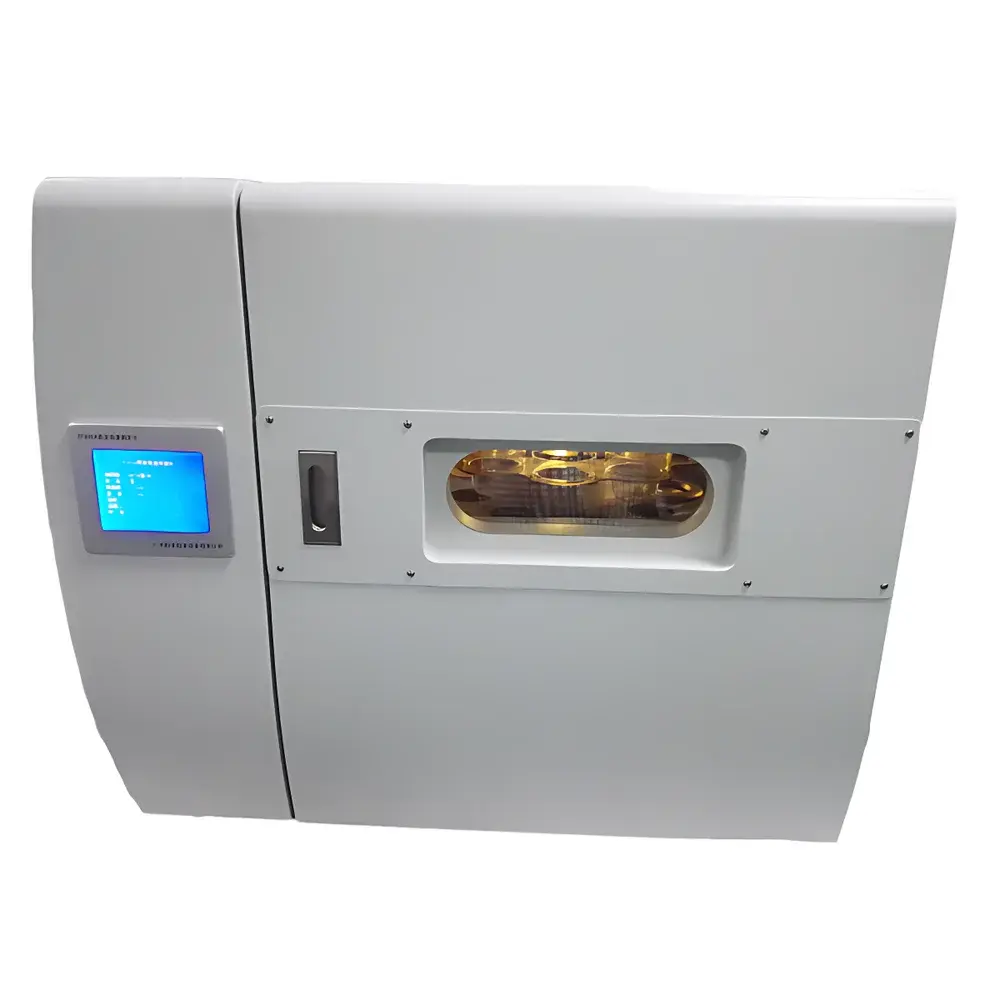
GBPI ZF1800B Total Migration Tester for Food Contact Materials
| Brand | GBPI |
|---|---|
| Model | ZF1800B |
| Origin | Guangdong, China |
| Manufacturer Type | Direct Manufacturer |
| Category | Domestic Instrument |
| Price | Upon Request |
Overview
The GBPI ZF1800B Total Migration Tester is a fully automated analytical system engineered for the precise quantification of non-volatile residue—commonly referred to as total migration—in food contact materials (FCMs) under standardized regulatory conditions. It operates on the gravimetric principle: test specimens are immersed in prescribed simulant solutions (e.g., 3% acetic acid, 10% ethanol, or olive oil) for specified durations and temperatures per applicable national and international standards. Following immersion, aliquots of the extractant solution are transferred to pre-weighed, tared evaporation dishes. The solvent is then removed via controlled water-bath evaporation, followed by sequential drying and cooling cycles in temperature- and humidity-regulated chambers until constant mass (i.e., “constant weight”) is achieved. The difference between the final dish mass (after residue deposition) and the blank dish mass yields the mass of non-volatile residue. Total migration is calculated in mg/dm² using geometric surface area normalization, ensuring compliance with physicochemical exposure assessment requirements defined in food safety regulations.
Key Features
- Cold–hot dual-chamber architecture: Independent temperature-controlled evaporation and cooling zones enable simultaneous heating and cooling operations—reducing thermal equilibration time and improving throughput.
- Integrated water-bath evaporation system: Features automatic water-level detection, self-filling, precise temperature control (68.3–100 °C), and overheat/dry-run protection with audible and visual alarms.
- Sealed solvent recovery loop: All evaporation occurs within a fully enclosed chamber; vapors are condensed and recovered, eliminating ambient solvent release and minimizing occupational exposure risk.
- Nitrogen purge capability: Optional nitrogen gas inlet supports inert-atmosphere evaporation for oxygen-sensitive or thermally labile simulants, enhancing method robustness.
- Negative-pressure test chamber: Maintains consistent sub-atmospheric pressure during evaporation to suppress boiling point elevation and improve repeatability across volatile simulants.
- 18 independent test stations: Each station processes individual samples autonomously—with separate mass tracking, thermal profiles, and data logging—enabling parallel multi-condition testing (e.g., different simulants, temperatures, or contact times).
- ARM-based embedded control system: Touchscreen interface integrates instrument control, method programming, real-time mass monitoring, and automated endpoint detection (constant-weight validation based on user-defined drift thresholds).
Sample Compatibility & Compliance
The ZF1800B supports testing of diverse FCM categories including polyolefin films (PE, PP), polystyrene containers, rubber gaskets and seals, epoxy-phenolic coated metal cans, PVC and chlorinated vinyl coatings, plant-fiber molded trays, and interior lacquers used in beverage and condiment packaging. It conforms to mandatory Chinese food safety standards: GB 31604.8–2016 (determination of total migration into food simulants), GB 31604.1–2015 (general principles for migration testing), GB/T 5009.156–2016, GB/T 9740–2008, and GB/T 23949–2009. It also fulfills pharmaceutical packaging requirements per YBB series standards (e.g., YBB00342002–2015, YBB00102005–2015), which reference non-volatile residue limits for parenteral and oral dosage form containers. While not certified to ISO 10993 or EU Regulation (EC) No. 10/2011 out-of-the-box, its operational parameters—including temperature accuracy (±3 °C), mass resolution (0.1 mg), and environmental stability—meet the technical prerequisites for method transfer and laboratory validation under GLP and GMP frameworks.
Software & Data Management
The embedded software complies with Annex 11 of the EU GMP Guidelines and FDA 21 CFR Part 11 requirements for computerized systems. Access control enforces role-based permissions (Administrator, Operator, Reviewer, Observer) with customizable privilege matrices. All user actions—including method edits, parameter changes, result overrides, and report exports—are logged in immutable audit trails covering system events, run history, and analytical method versions. Real-time dashboards display live mass readings per station, cumulative migration values, chamber temperatures, and humidity levels. Reports include raw mass sequences, constant-weight verification logs, migration calculation worksheets, and customizable graphical overlays (e.g., mass vs. time curves). Export formats include PDF (with digital signature support) and editable Office-compatible files (XLSX), suitable for regulatory submission and internal quality review.
Applications
This instrument serves QC laboratories in food packaging manufacturing, third-party testing service providers, and regulatory compliance units evaluating migration behavior of polymer laminates, adhesives, ink layers, and coating systems. Typical use cases include validation of shelf-life compatibility for acidic beverages in PET bottles, verification of barrier integrity in retort pouches, qualification of sealing compounds in glass jar closures, and screening of recycled content in thermoformed trays. It is equally applicable to extractables testing in pharmaceutical primary packaging—particularly for assessing residual monomers, catalysts, or processing aids leaching from elastomeric stoppers or blister foil laminates.
FAQ
What regulatory standards does the ZF1800B directly support?
It is configured and validated for full alignment with GB 31604.8–2016, GB 31604.1–2015, and YBB-series pharmacopoeial standards for non-volatile residue determination.
Can the system operate unattended overnight?
Yes—its automated constant-weight algorithm, integrated safety interlocks, and scheduled start/stop functionality enable 24-hour无人值守 operation without manual intervention.
Is external vacuum or nitrogen supply required?
Vacuum pump and nitrogen generator are optional accessories; the base configuration includes internal negative-pressure generation and ambient-air evaporation modes.
How is data integrity ensured during long-duration tests?
All mass measurements are timestamped and stored locally with battery-backed memory; audit trails record every modification, and exported reports retain cryptographic hash signatures for tamper-evident archiving.
What maintenance is required for the water-bath and solvent recovery modules?
Routine tasks include periodic descaling of the water-bath heater, condenser coil cleaning, and activated carbon replacement in the solvent trap—procedures detailed in the bilingual (CN/EN) service manual supplied with the system.
Related Products






