
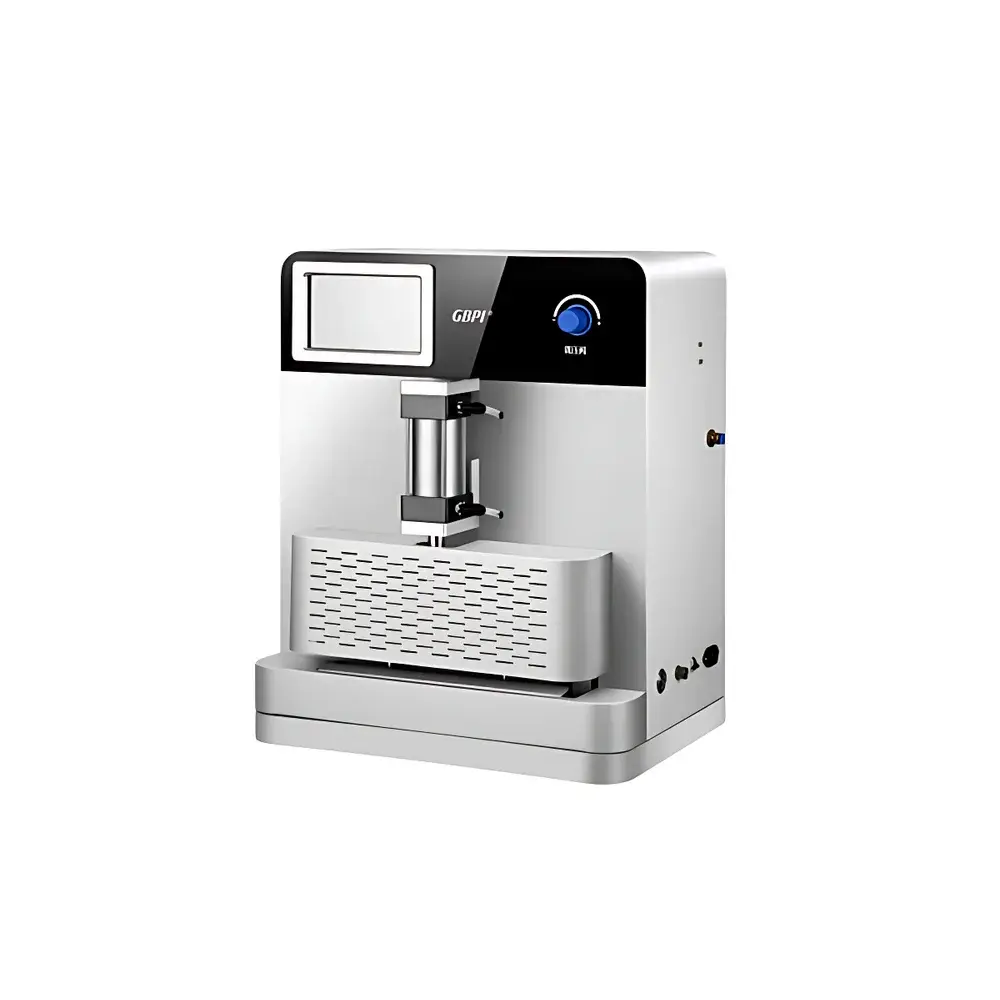
GBPI GBB-A2 Heat Sealing Tester
| Brand | GBPI |
|---|---|
| Origin | Guangdong, China |
| Manufacturer Type | Direct Manufacturer |
| Country of Origin | China |
| Model | GBB-A2 |
| Price Range | USD 4,200 – 7,000 |
| Heat Seal Temperature Range | Ambient to 300 °C |
| Temperature Control Accuracy | ±0.2 °C |
| Seal Time Range | 0.01 s to 99.99 h |
| Seal Pressure Range | 0.05–0.8 MPa |
| Sealing Surface Dimensions | 300 mm × 5.5 mm (smooth, lower sealing bar with silicone pad) |
| Heating Method | Dual independent heating zones (upper & lower jaws) |
| Actuation | Pneumatic (dual synchronized external cylinders) |
| Control Interface | Touchscreen display showing real-time upper/lower jaw temperatures, pressure, and seal time |
| Temperature Control Algorithm | Digital PID |
| Compliance Standards | QB/T 2358–1998, ASTM F2029–22, YBB00122003–2015 |
Overview
The GBPI GBB-A2 Heat Sealing Tester is an engineered precision instrument designed for quantitative evaluation of heat seal integrity in flexible packaging materials. It operates on the principle of controlled thermal compression—applying calibrated temperature, pressure, and dwell time to replicate industrial sealing conditions—and measures the resulting bond strength via subsequent tensile testing (performed externally using a universal tester). This device enables laboratories to determine the optimal sealing window—the intersection of temperature, pressure, and time at which maximum seal strength and minimal delamination risk are achieved—for thermoplastic films, laminates, coated papers, aluminum foils, and pharmaceutical blister lidding materials. Its dual-zone independent temperature control and pneumatic actuation architecture ensure high reproducibility across repeated trials, making it suitable for method development, process validation, and routine quality assurance in regulated environments.
Key Features
- Dual independent heating zones: Upper and lower sealing jaws each feature aluminum-encapsulated heating elements with digital PID temperature regulation, enabling precise differential thermal profiling for asymmetric or multi-layer structures.
- Pneumatic actuation system: Twin externally mounted cylinders provide synchronized, repeatable force application; pressure is adjustable from 0.05 to 0.8 MPa with analog pressure gauge monitoring and optional digital transducer integration.
- Flexible operational modes: Supports both automatic timed cycling and manual/foot-switch–activated single-cycle operation—ideal for R&D iteration and production line correlation studies.
- Configurable sealing interface: Standard 300 mm × 5.5 mm smooth sealing surface (lower jaw fitted with food-grade silicone pad); custom geometries—including stepped, patterned, or micro-textured sealing bars—are available upon request to simulate fin seals, lap seals, or medical pouch configurations.
- Intuitive HMI: 7-inch capacitive touchscreen displays real-time upper/lower jaw temperatures, applied pressure, and elapsed seal time; stores up to 1,000 test parameter sets with timestamp and operator ID tagging (when integrated with optional audit trail software).
- Traceable thermal calibration: Integrated Pt100 sensors allow field verification against NIST-traceable reference thermometers; temperature uniformity across the sealing bar is validated per ASTM F2029 Annex A1.
Sample Compatibility & Compliance
The GBB-A2 accommodates a broad spectrum of packaging substrates, including polyethylene (LDPE, LLDPE, HDPE), polypropylene (CPP, BOPP), polyester (PET), ethylene-vinyl acetate (EVA), ionomer resins, metallized films, paperboard laminates, and pharmaceutical-grade aluminum/PVC/PVDC blisters. It meets the geometric and procedural requirements of key international standards: QB/T 2358–1998 (China’s standard for plastic film heat seal strength), ASTM F2029–22 (Standard Test Method for Making Heat-Sealed Packages for Testing), and YBB00122003–2015 (Chinese Pharmacopoeia packaging material specification). When deployed within a validated laboratory workflow—including documented equipment qualification (IQ/OQ/PQ), environmental monitoring, and analyst training—the instrument supports GLP-compliant data generation for regulatory submissions to CFDA, FDA, EMA, and PMDA.
Software & Data Management
While the base unit operates as a standalone hardware platform, optional GBPI LabLink™ software enables full computer control, automated parameter logging, and CSV/PDF report export. The software supports 21 CFR Part 11–compliant user authentication, electronic signatures, and immutable audit trails—including all parameter changes, start/stop events, and calibration history. Data files include metadata such as ambient temperature/humidity (when connected to external sensors), operator credentials, and instrument firmware version—ensuring full traceability for internal audits and regulatory inspections. Raw thermal profiles can be exported for statistical process control (SPC) analysis using Minitab or JMP.
Applications
- Determination of optimal sealing parameters during new packaging material qualification (e.g., switching from PVC to cold-forming aluminum for blister packs).
- Root cause analysis of seal failures in commercial production—correlating lab-replicated conditions with field complaints.
- Stability testing of heat-seal integrity under accelerated aging (e.g., 40 °C/75% RH for 6 months per ICH Q1A).
- Evaluation of sealant layer performance in multilayer coextrusions used in retortable pouches.
- Teaching thermoplastic bonding kinetics and interfacial diffusion theory in polymer science curricula.
- Supporting ISO 11607–1:2019 validation of sterile barrier systems for Class II/III medical devices.
FAQ
Does the GBB-A2 include built-in tensile testing capability?
No. It is a dedicated heat sealing apparatus; seal strength must be measured separately using a calibrated universal testing machine (e.g., ASTM F88-compliant instrument) on specimens prepared by the GBB-A2.
Can the sealing pressure be calibrated traceably?
Yes. Optional pressure transducer kits with NIST-traceable calibration certificates are available; on-site verification follows ISO 6789–2 procedures.
Is compressed air supply included?
No. A clean, dry, oil-free compressed air source (minimum 0.8 MPa supply pressure, ISO 8573–1 Class 2:2:2) must be provided externally.
What maintenance is required for long-term accuracy?
Quarterly verification of temperature uniformity and annual recalibration of Pt100 sensors and pressure gauges are recommended; GBPI provides certified service contracts with metrology documentation.
Can the GBB-A2 be integrated into a LIMS environment?
Yes—via LabLink™’s OPC UA or REST API interface, enabling bidirectional data exchange with major LIMS platforms including Thermo Fisher SampleManager and LabWare LIMS.
Related Products






